Contents
Hyperliquid vs Bybit in one tableFees on the same trade: Hyperliquid vs BybitFunding: the cost of holding, and where the two differAccount, money in and money outChoose Hyperliquid if… choose Bybit if…Hyperliquid vs Bybit in one table
These two are not the same kind of venue, even though the trade on your screen looks almost identical. Bybit is a centralised exchange: you open an account, verify your identity, and your balance sits with the exchange. Hyperliquid runs on-chain: you connect a crypto wallet, send USDC, and there is no account to register.
Both venues quote two fee numbers, and they mean the same thing on each. You pay the lower rate when your order waits in the order book and someone else trades into it — that is the maker rate. You pay the higher one when you take a price that is already sitting there, which is what a market order does — the taker rate. Everything below is checked as of 2026-10-24, and both venues can change their terms.
| What you are checking | Hyperliquid | Bybit |
|---|---|---|
| Getting in | Connect a wallet and deposit USDC — no registration | Exchange account plus identity verification |
| Base futures fee | 0.015% maker / 0.045% taker | 0.02% maker / 0.055% taker on the starting level (VIP 0); can vary by region |
| Fee discounts | Lower tiers by 14-day volume; up to 40% off for staking HYPE | Lower tiers by 30-day volume or by asset balance held |
| Funding interval | Every hour | Shown in each contract's details — check it in the app |
| Markets | 178 crypto perps, plus stocks, indices and commodities deployed on Hyperliquid by trade.xyz | Crypto perpetuals and dated contracts, pre-market perps, TradFi perpetuals, copy trading, demo trading |
| Leverage | BTC up to 40x; on the trade.xyz markets most stocks 10–20x, gold 25x, S&P 500 50x | Check the limit for your contract in the app |
| Where it is closed | Hyperliquid publishes no country list; the app simply shows a block message in some places — open it and see | A published restricted list including the US, Canada, mainland China, Hong Kong, Singapore and others |
Fees on the same trade: Hyperliquid vs Bybit
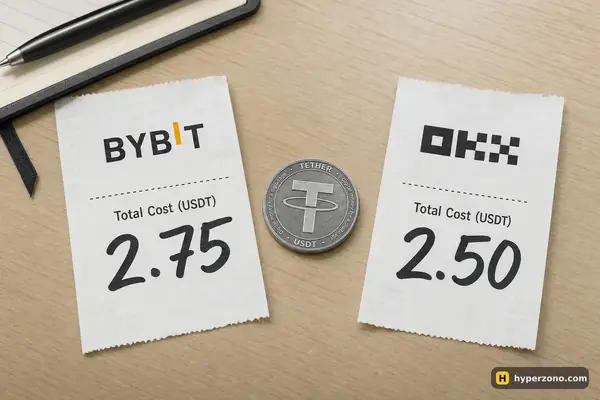
Take the example from the lead again: 500 USDT of your own money at 5x, so the position on screen is 2,500 USDT. The fee is charged on that 2,500, once when you open and once when you close. Buying and selling at market on Hyperliquid costs 2 × 2,500 × 0.045% = 2.25 USDT for the round trip. The same round trip on Bybit costs 2 × 2,500 × 0.055% = 2.75 USDT, using the starting fee level every new account gets.
So the saving is 50 cents per trade. If you place twenty such trades in a month, that is 10 USDT — real, but not the thing that decides whether you end the month up or down. If you enter with limit orders that sit in the book and wait, both get cheaper: 0.75 USDT round trip on Hyperliquid, 1.00 USDT on Bybit. The gap between the two venues is smaller than the gap between trading at market and trading with patient limit orders.
| Where | Maker | Taker | How to pay less | A 2,500 USDT trade: market in and out | Limit in, market out |
|---|---|---|---|---|---|
| Binance Futures | 0.02% | 0.05% | pay fees in BNB: 0.018% / 0.045% | 2.50 USDT | 1.75 USDT |
| Bybit | 0.02% | 0.055% | — | 2.75 USDT | 1.88 USDT |
| OKX | 0.02% | 0.05% | — | 2.50 USDT | 1.75 USDT |
| Hyperliquid | 0.015% | 0.045% | up to 40% off for staking HYPE: 0.009% / 0.027% | 2.25 USDT | 1.50 USDT |
| Binance Wallet / Aster | 0% | 0.04% | — | 2.00 USDT | 1.00 USDT |
Base level for a new account. 2,500 USDT is 500 USDT at 5x leverage; the fee is charged on the position size, not on your 500. Taker is the rate when an order fills at once, maker when a limit order waits in the book.
fees checked 24 Oct 2026 on the exchanges’ fee pages, Binance Futures, Bybit, OKX, Hyperliquid, Binance Wallet / Aster.
Your Bybit rate can depend on where you live. The exact number for your account shows up on the My Fee Rate page after you verify your identity, so if you want to see it, sign up on Bybit and look there. New-listing contracts cost more: pre-market perpetuals are 0.04% maker and 0.10% taker, Innovation Zone contracts 0.04% and 0.11%, both at the starting level.
On Hyperliquid one fee tier covers everything you trade, and your perps and spot volume are counted together over the last 14 days. Staking HYPE takes up to 40% off, which brings the taker rate down to 0.027% for the largest stakers. If per-trade cost is your whole question, the cheapest futures fees page lines up more venues side by side.
Funding: the cost of holding, and where the two differ
Funding is the payment that passes between longs and shorts while a perpetual position is open — the venue does not keep it, and the funding page explains how it works. Hyperliquid pays funding every hour. On Bybit the interval is set per contract and shown in that contract's details, so check it in the app for the coin you want. If one venue quotes an hourly rate and the other an 8-hour rate, multiply the hourly figure by 8 before comparing them, not by 24; comparing 1-hour and 8-hour funding walks through that.
Funding is usually the bigger cost once you hold for days, and it genuinely differs between the two venues, because each rate follows the balance of longs and shorts on that venue's own order book. It also flips sign, and your side decides everything: when longs are paying, a short receives instead. Look up your coin and your side in the table below before you choose where to open the trade — a week of funding can dwarf the half a dollar you save on the fee, in either direction.
| Coin | Binance Futures | Binance Wallet | Bybit | OKX | Hyperliquid |
|---|---|---|---|---|---|
| BTC | 2.91 USDT | 4.23 USDT | 2.91 USDT | 3.48 USDT | 6.85 USDT |
| ETH | 3.17 USDT | 5.11 USDT | 2.85 USDT | 3.13 USDT | 6.73 USDT |
| XRP | 2.48 USDT | 4.48 USDT | 2.61 USDT | 3.54 USDT | 7.42 USDT |
| BNB | 1.59 USDT | 1.26 USDT | −0.06 USDT | 4.53 USDT | 5.96 USDT |
| SOL | 2.63 USDT | 3.21 USDT | 1.94 USDT | 2.93 USDT | 5.70 USDT |
| HYPE | 3.54 USDT | 3.92 USDT | 1.14 USDT | 3.74 USDT | 6.88 USDT |
| DOGE | 4.10 USDT | 4.26 USDT | 2.84 USDT | 5.58 USDT | 8.64 USDT |
| ENA | 6.42 USDT | 8.01 USDT | 4.71 USDT | 5.11 USDT | 9.18 USDT |
What a 1,000 USDT long paid over the last 30 days on each venue (minus means it received). The coin name opens its page with month-by-month history.
Updated 25 Oct 2026, 01:20 UTC from the exchanges’ public APIs.
Reading it for our example is simple arithmetic: the rate shown applies to the position size, so 0.01% on a 2,500 USDT position is 0.25 USDT at that one settlement, paid or received depending on the sign and your side. The funding rate history page shows what each venue has charged over longer stretches, which is a fairer basis for a holding plan than today's single number.
Fees are per trade, funding is per hour you hold. If you open and close inside the same day, the fee is almost your whole cost, and Hyperliquid's base rate is the lower one. If you plan to hold for a week, run the funding number for your coin and your side first — it can be several times the fee.
Account, money in and money out
On Bybit you sign up, pass identity verification, and then you fund the account with whichever deposit methods Bybit shows in your country — the deposit screen is not the same everywhere, so open it and see what is offered to you. Your balance sits with the exchange, you can reset a password if you lose it, and there is a support team and a demo mode to practise in. Bybit publishes a restricted-countries list that includes the US, Canada, mainland China, Hong Kong, Singapore and several others, and in the EEA you are onboarded through its separate European entity, so check during sign-up that futures are offered to you at all.
On Hyperliquid there is no sign-up and no verification: you connect a wallet and deposit USDC, and the step-by-step is on the Hyperliquid USDC deposit page. That cuts out the account approval, and it also means nobody can restore anything for you — lose access to the wallet and the money is gone. The app blocks access from some places with a short message rather than a published list, so the only way to know is to open Hyperliquid and see whether it loads where you are. Withdrawals go back to your own wallet address, covered on the withdrawal page.
One more practical difference: the stocks, indices, gold and oil you see on Hyperliquid are not deployed by Hyperliquid itself but by trade.xyz on top of it, with their own collateral and leverage rules — the HIP-3 markets explainer covers who sets what. The 0.045% taker rate applies to Hyperliquid's own crypto contracts; on the trade.xyz stock, index and commodity markets the deployer can add a share on top, so check the fee shown on that specific market before you trade it. Bybit's non-crypto contracts come from Bybit.
Choose Hyperliquid if… choose Bybit if…
- Choose Hyperliquid if you already use a crypto wallet, you are comfortable holding your own keys, you trade in and out within a day or two so the lower fee actually lands, and you want the crypto perps plus the trade.xyz stock, index and commodity markets in one place.
- Choose Bybit if this is your first futures account, you would rather have support and a password reset than sole custody of your money, you want to see which deposit methods the app offers in your country, and you plan to practise in demo mode before risking anything real.
- Choose on funding, not on fees, if you expect to hold positions for days — look up your coin and your side in the live table above before you decide.
- If neither feels right, Binance versus Bybit and Binance Futures versus Hyperliquid cover the other two common pairings, and Bybit versus OKX compares two centralised exchanges head to head.
There is no rule that says you have to pick one forever. Plenty of people keep a verified exchange account for deposits and a wallet for on-chain trading, and move money between them. What matters for a first trade is that you can actually get in, that you know what the round trip costs, and that you have a stop-loss on before you walk away from the screen.
Is Hyperliquid cheaper than Bybit?
On the base per-trade fee, yes: 0.045% taker against 0.055%, which is 2.25 USDT versus 2.75 USDT for a 2,500 USDT round trip at market. Holding is a different question — funding varies by coin, by side and by day on both venues, so check the live table for the contract you want rather than assuming one is always cheaper.
Do I need KYC to trade futures on Hyperliquid?
There is no account to register, so there is no identity check — you connect a wallet and deposit USDC. The app does block access in some places with a short message, and it names no countries, so the only honest way to know is to open it where you live. Bybit, by contrast, requires verification and publishes a restricted-countries list.
Which is better for a first trade with $100?
For most beginners, Bybit: the app shows you the deposit methods available in your country, there is a demo mode to practise the buttons, and losing your password is not the end of the account. Hyperliquid makes more sense once you are comfortable with a wallet and on-chain transfers. Check the minimum order size for your contract in either app before you plan the trade.
How do I compare funding between the two?
Hyperliquid settles funding every hour, so multiply its rate by 8 to put it next to an 8-hour rate elsewhere, and check the interval of your Bybit contract in its details. Then apply the rate to your position size: 0.01% on 2,500 USDT is 0.25 USDT per settlement, paid or received depending on your side.
Can I use both Hyperliquid and Bybit?
Yes, and many people do — an exchange account on one side, a wallet for on-chain trading on the other. Just keep your records straight, because you will have two sets of trades, fees and funding payments to add up at the end of the year.
Sources and fact-check
Exchange terms were checked against official documents on October 24, 2026. Terms change — before you trade, check what matters to you in the exchange app and in your contract’s specs.
Hyperliquid Docs: FeesBybit: Bybit Trading Fee Structure — Help Center