Contents
The HYPE funding rate right now on five exchangesWhat holding HYPE has actually cost in moneyMonth by month: when longs paid most, and when they got paidWhy holding a HYPE long has cost the most on HyperliquidHow to check HYPE funding before you open the tradeThe HYPE funding rate right now on five exchanges
Funding is a payment between the two sides of a perpetual contract: when the rate is positive, longs pay shorts, and when it is negative, shorts pay longs. The exchange only moves the money between traders. If that part is new to you, how funding is charged explains the mechanism in full — here we stay on HYPE and on money.
One of the five venues below is not a separate exchange. It is the Perpetuals tab inside Binance Wallet in the Binance app, with its own wallet balance; execution there comes from Binance's partner protocol Aster, which is why its funding differs from Binance Futures even though both sit in the same app. If you have never opened it, how perpetuals work in Binance Wallet walks through the screen.
The table shows the current HYPE funding rate on each venue, how often it settles there, and what the recent pace of payments looks like. Read it like this: find the rate for the venue you trade on, remember that it applies to your whole position size and not to your margin, and check the interval column — a rate that looks identical on two lines can cost twice as much if one venue settles twice as often.
| Where | Paid | Rate now | A 1,000 USDT long: 30 days | 90 days | 12 months | Longs paid (90 days) |
|---|---|---|---|---|---|---|
| Binance Futures | every 4 h | +0.0050% | pays 3.54 USDT | pays 17.38 USDT | pays 53.65 USDT | in 79% of settlements |
| Binance Wallet (Aster book) | every 4 h | +0.0041% | pays 3.92 USDT | pays 16.02 USDT | pays 32.56 USDT | in 73% of settlements |
| Bybit | every 8 h | +0.0100% | pays 1.14 USDT | pays 10.13 USDT | pays 31.45 USDT | in 68% of settlements |
| OKX | every 8 h | +0.0100% | pays 3.74 USDT | pays 14.22 USDT | — | in 80% of settlements |
| Hyperliquid | every hour | +0.0013% | pays 6.88 USDT | pays 24.24 USDT | pays 97.37 USDT | in 91% of settlements |
Rate now is what the venue shows for the next settlement. The totals are what a 1,000 USDT long would have paid holding the whole time (price changes aside); a short would have received the same. "Longs paid" is the share of settlements over 90 days when the rate was above zero. OKX only publishes 3 months of history.
Updated 24 Oct 2026, 20:12 UTC from the exchanges’ public APIs.
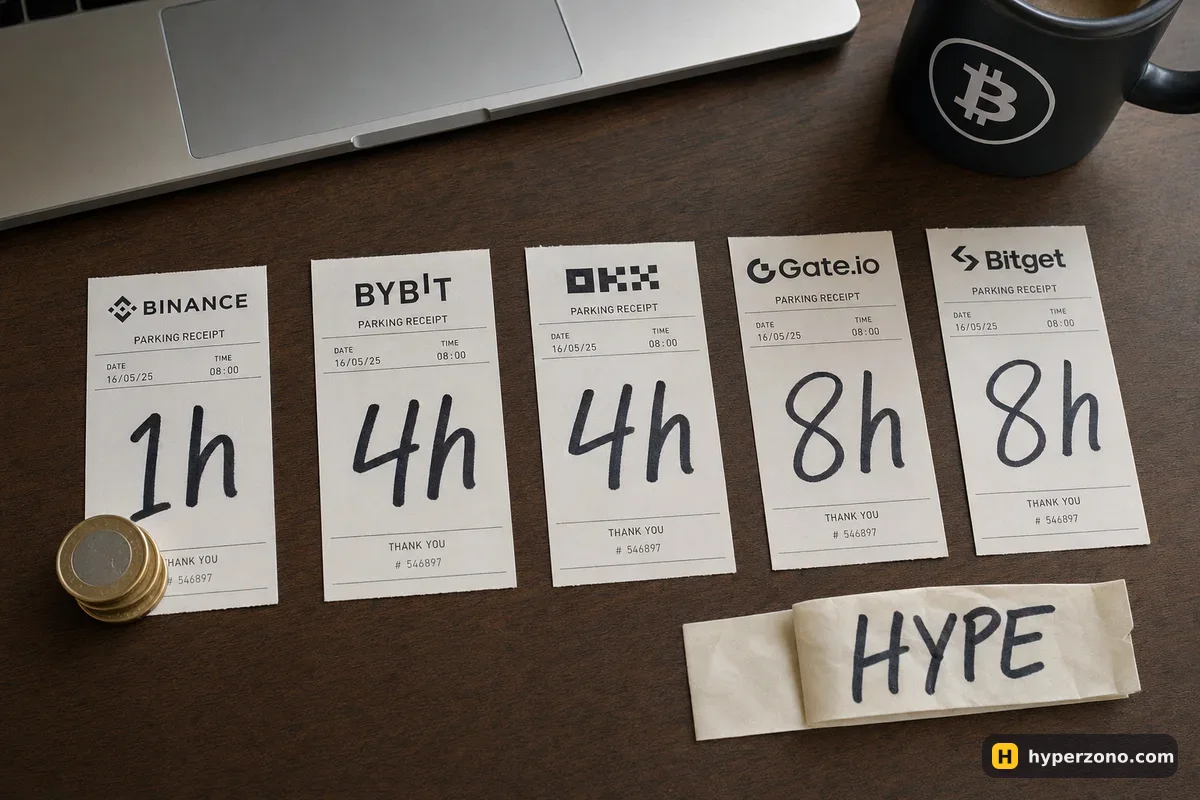
The intervals themselves are stable, and they are the first thing to look at. Hyperliquid pays funding every hour; it computes an 8-hour rate and then charges one eighth of it each hour. Binance Futures and the Binance Wallet Perpetuals tab settle HYPE every 4 hours, Bybit and OKX every 8. Hyperliquid's number is the rate for one hour: to put it next to Bybit's 8-hour number, multiply it by 8, and to work out what a whole day of holding costs you, multiply it by 24 — that is how many times you pay. There is more on that in comparing 1-hour and 8-hour funding.
What holding HYPE has actually cost in money
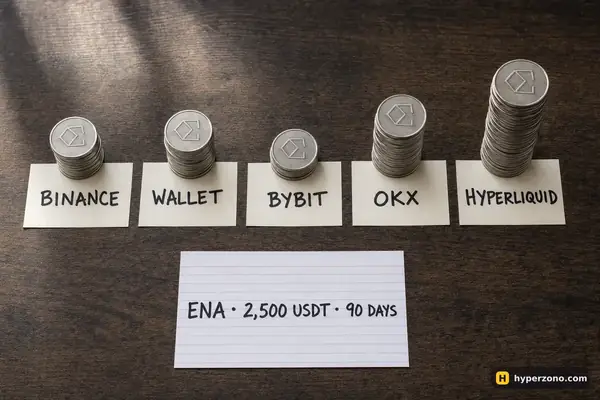
Rates in percent are easy to shrug off, so here is the same thing in USDT. Hold a HYPE long for a year and the bill is very different depending on where you opened it — on Bybit it was the cheapest, on Hyperliquid about three times that, with Binance Futures in between and the Binance Wallet tab close to Bybit. The numbers below use the example we run across the site: a 500 USDT deposit at 5x, which gives a 2,500 USDT position. Funding is charged on the 2,500, not on your margin.
| Where you hold it | Interval | 30 days | 90 days | 12 months |
|---|---|---|---|---|
| Bybit | 8 h | 2.85 USDT | 25.33 USDT | 78.63 USDT |
| Binance Wallet (Perpetuals tab) | 4 h | 9.80 USDT | 40.05 USDT | 81.40 USDT |
| OKX | 8 h | 9.35 USDT | 35.55 USDT | no 12-month history |
| Binance Futures | 4 h | 8.85 USDT | 43.45 USDT | 134.13 USDT |
| Hyperliquid | 1 h | 17.20 USDT | 60.60 USDT | 243.43 USDT |
Two things to keep in mind when you read that last column. OKX's public funding history for HYPE only reaches back about three months, so there is no year figure for it. And the Binance Wallet Perpetuals tab itself only opened during 2026, so its earlier months come from the same order book behind it, from before the tab existed.
A year of funding on Hyperliquid would have cost close to half of your 500 USDT margin, while on Bybit it stayed under a fifth of it. These totals count funding only — they ignore what the price of HYPE did, and they ignore trading fees on the way in and out. Nobody actually keeps one perpetual position untouched for twelve months, but the comparison tells you which venue has been charging more for the same idea. For your own size and your own expected holding time, run them through the funding calculator.
Month by month: when longs paid most, and when they got paid
Funding on HYPE has not leaned one way evenly. Over the 90 days to 2026-10-24, longs paid in 91% of settlements on Hyperliquid, 80% on OKX, 79% on Binance Futures, 73% in the Binance Wallet tab and 68% on Bybit. August 2026 was the worst month for longs almost everywhere: on our 2,500 USDT position that month cost about 20 USDT on Binance Futures, 19 USDT in the Binance Wallet tab and 13 USDT on Bybit. May 2026 was the quietest — well under a dollar on Binance Futures and on Bybit, and in the Binance Wallet tab a long actually received around 13 USDT that month, because the rate spent enough time negative for shorts to be paying longs.
On Hyperliquid even the calmest month in the whole set, October 2025, still cost a long about 7.50 USDT on the same position. The month-by-month table breaks all of this out per venue. Look at it the way you would look at a utility bill history: not to predict next month, but to see how big the swings get. A 20 USDT month is a real dent in a trade you expected to make 50 on.
| Month | Binance Futures | Binance Wallet (Aster book) | Bybit | Hyperliquid |
|---|---|---|---|---|
| October 2026 | 3.84 USDT | 4.37 USDT | 2.38 USDT | 5.45 USDT |
| September 2026 | 4.81 USDT | 2.98 USDT | 2.22 USDT | 7.50 USDT |
| August 2026 | 8.11 USDT | 7.66 USDT | 5.36 USDT | 9.98 USDT |
| July 2026 | 3.78 USDT | 5.47 USDT | 1.48 USDT | 7.98 USDT |
| June 2026 | 4.42 USDT | 3.58 USDT | 3.29 USDT | 11.46 USDT |
| May 2026 | 0.26 USDT | −5.34 USDT | 0.21 USDT | 6.31 USDT |
| April 2026 | 2.92 USDT | 1.49 USDT | 1.98 USDT | 4.18 USDT |
| March 2026 | 2.74 USDT | 1.65 USDT | 1.57 USDT | 5.83 USDT |
| February 2026 | 1.91 USDT | −1.72 USDT | 0.94 USDT | 5.39 USDT |
| January 2026 | 4.60 USDT | 2.25 USDT | 3.63 USDT | 9.95 USDT |
| December 2025 | 7.34 USDT | 4.16 USDT | 3.30 USDT | 10.24 USDT |
| November 2025 | 7.93 USDT | 5.70 USDT | 3.27 USDT | 10.09 USDT |
| October 2025 | 0.98 USDT | 0.32 USDT | 1.83 USDT | 3.01 USDT |
What a 1,000 USDT long paid in each month (minus means it received). The current month is not over yet. OKX is left out: its API keeps only 3 months of history.
Updated 24 Oct 2026, 10:56 UTC from the exchanges’ public APIs.
Why holding a HYPE long has cost the most on Hyperliquid
Part of the answer is built into Hyperliquid's formula. On top of the gap between the contract price and the spot price the venue uses as its reference (Hyperliquid calls that the oracle price), the rate has a fixed interest part of 0.01% per 8 hours — Hyperliquid's own docs put it at 11.6% a year — and that part goes to shorts. So even when the contract trades exactly at the reference price, a long still pays a small amount every hour, and that quietly sets a floor under the cost of staying long. Add a crowd that mostly wants to be long HYPE on the chain the token belongs to, and you get the 91% figure above.
The rest is that gap between contract price and spot price, and it is local to each order book. The Binance Wallet Perpetuals tab is priced on the Aster book, so its funding is Aster's funding, not Binance Futures'. None of this is permanent. If sentiment on HYPE flips and the contract starts trading below the reference price, the rate goes negative and shorts pay longs; Hyperliquid's hourly settlement then works in a long's favor just as fast as it worked against them. Don't assume today's cheapest venue stays cheapest next month — check the live table each time.
How to check HYPE funding before you open the trade
Find the rate on the contract page
Open the HYPE perpetual in your exchange app. Near the price at the top of the screen you will see the current funding rate and a countdown to the next payment. That countdown tells you the interval without reading any documentation.
Turn it into money for your size
Payment = your position size × the rate at the settlement moment. On a 2,500 USDT position, 0.01% is 0.25 USDT per payment. On Bybit, where you pay every 8 hours, that's 0.75 USDT a day. Hyperliquid shows the hourly rate, so the same cost looks like 0.00125% an hour — about 0.03 USDT each time, and you pay 24 times.
Multiply by how long you plan to hold
A day trade closed before the next payment pays nothing at all. A swing trade held for a week pays the rate many times over, so compare it with the profit you are actually aiming for.
Check the countdown before you enter
Only a trader holding the position at the settlement moment pays or receives. Opening a minute before settlement means you pay for a position you have barely held.
Funding comes out of your balance, not out of thin air. If your free balance is short, some venues take the payment out of the margin backing your position, and a smaller margin means your liquidation price moves closer to the current price. Keep a little spare balance, especially if you are holding HYPE through several settlements. Lower leverage gives you that buffer automatically: see what leverage to use for a first trade.
If you want to see all of this on a live screen rather than in a table, you can open a Binance Futures account or sign up on Bybit — on HYPE, Bybit has been the cheaper place to hold a long — find the HYPE perpetual and watch the funding field and its countdown for a day. The number the exchange values your position at while you wait is the mark price, and it sits on the same line. For the longer study of how funding behaved across BTC, ETH and SOL over a full year, with a calculator attached, see our funding rate history, and for other coins there are pages like BTC funding.
Is the HYPE funding rate the same on every exchange?
No. Each venue calculates it from its own order book and its own reference price, so the rates differ — and the settlement interval differs too. That is exactly why the same 2,500 USDT long cost about 79 USDT of funding on Bybit and about 243 USDT on Hyperliquid over the 12 months to 2026-10-24.
How often is HYPE funding paid?
Every hour on Hyperliquid, every 4 hours on Binance Futures and in the Binance Wallet Perpetuals tab, every 8 hours on Bybit and OKX. These intervals are stable, though exchanges reserve the right to change them in extreme conditions.
How do I compare an hourly rate with an 8-hour one?
Multiply the hourly rate by 8 and you have a number you can put side by side with Bybit's or OKX's. If instead you want to know the cost of holding for a full day, multiply the hourly rate by 24, because that is how many payments you make.
Can I earn the funding instead of paying it?
Yes — whoever is on the receiving side gets the payment. On HYPE that has mostly meant shorts, since longs paid in 68% to 91% of settlements over the last 90 days depending on the venue. But a short position still loses money if the price rises, so funding alone is a poor reason to pick a direction.
If I close before the settlement time, do I pay anything?
Only traders holding the position at the settlement moment pay or receive, so closing before the countdown hits zero costs you nothing for that interval. Some venues apply a few seconds of tolerance around the exact time, so don't cut it to the last second.
Can I trade HYPE perpetuals where I live?
Availability differs by exchange and by country, and futures are limited or unavailable in some places. Check during sign-up in the app itself, and look at the exchange's own country pages rather than assuming.
Sources and fact-check
Exchange terms were checked against official documents on October 24, 2026. Terms change — before you trade, check what matters to you in the exchange app and in your contract’s specs.
Hyperliquid Docs: FundingAster Docs: Funding RateBinance: Introduction to Binance Futures Funding Rates