Contents
Aster and Binance Wallet fees in percent and in USDTMarket or limit: the same trade, two pricesHow to pay less when your trade is smallWhere to see your own rateHow it compares with the other venuesAster and Binance Wallet fees in percent and in USDT
There are three fee groups, and which one you are in depends on the pair you pick. Regular crypto pairs (the "General" group) are 0% maker and 0.04% taker. Stock and commodity pairs — gold, silver, oil, Tesla, Nvidia and the rest, which the fee page calls real-world assets — are 0% maker and 0.0125% taker. A smaller list of crypto pairs, which the fee page labels Group B, costs 0.1% instead of 0.04% when your order fills immediately. The rates below are the base ones as of 24 October 2026 — an exchange can change them, and if you ever start trading large size, look at the fee page again for any volume levels.
| Level | 30-day volume from | Maker | Taker | A 2,500 USDT trade at market |
|---|---|---|---|---|
| Base | — | 0% | 0.04% | 2.00 USDT |
That is the crypto General group. Stock and commodity (RWA) perpetuals: 0% maker, 0.0125% taker; the crypto Group B list: 0% maker, 0.1% taker.
fees checked 24 Oct 2026 on the exchanges’ fee pages, Binance Wallet / Aster.
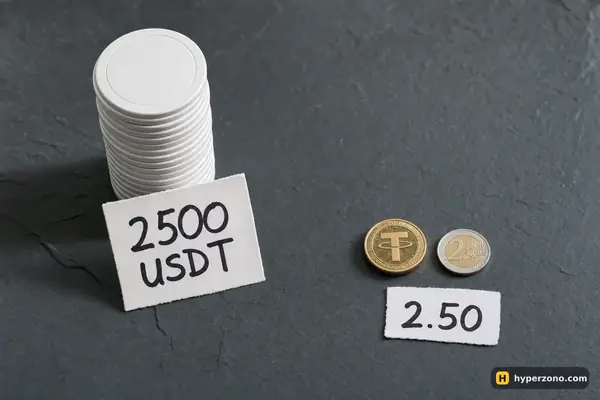
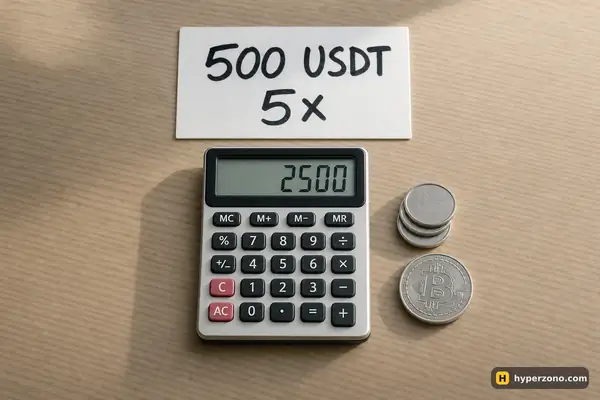
The fee is charged on the size of the position, not on the money you put up. With 500 USDT of your own money at 5x you control a 2,500 USDT position, and both entry and exit are charged separately on that 2,500 USDT. So a market order in and a market order out on a crypto pair is 2,500 × 0.04% = 1 USDT each way, 2 USDT in total. On a gold or Tesla pair the same round trip is 2,500 × 0.0125% = 0.3125 USDT each way, about 0.63 USDT in total. On one of the expensive crypto pairs it is 2.50 USDT each way, 5 USDT in total — eight times the gold or Tesla rate for exactly the same trade size.
Market or limit: the same trade, two prices
What you pay depends on how your order fills. If you take a price that someone has already put up, you pay the taker rate — here 0.04% on a normal crypto pair. If your order sits and waits until someone else trades against it, you pay nothing, because the maker rate is 0%. A limit order placed right at the current price fills instantly, so it is still charged as a taker.
Here is what that means on the same 2,500 USDT position. Market in, market out: 2 USDT. Limit order in that waits, market out when you want to be done: 1 USDT. Both sides placed as patient limit orders: 0 USDT in trading fees. That last line is the whole appeal of this venue for a small account — you really can open and close a crypto position without paying a trading fee, as long as you are willing to wait for your price. The trade-off is simple: while you wait, the price may run away from you, and the move you miss can cost far more than the 1 USDT you saved.
Put your own numbers into the calculator above — your margin, your leverage, the rate for the pair you are trading. If you have never looked at how fees work in general, what fees you pay on crypto futures covers the mechanics on any exchange.
How to pay less when your trade is small
At 2,500 USDT of position size you are talking about one or two dollars, so the goal is not to chase decimals — it is to avoid paying the expensive version of the same trade. Three things actually move the number.
- Use a limit order for the side you are not in a hurry about. Entries are usually the patient side: you decide the price in advance, place the order and let it fill. Exits are often urgent, and that is fine — paying 1 USDT to get out cleanly is cheaper than arguing with the market.
- When two pairs suit the same idea, take the cheaper one. On the stock and commodity side a market order costs 0.0125%, which makes gold, oil and the stock pairs the cheapest contracts in the whole tab — about 0.31 USDT per side instead of 1 USDT.
- Trade less often. Two round trips a day on a 2,500 USDT position is roughly 4 USDT of taker fees — about 0.8% of a 500 USDT account every day, before you have been right or wrong about anything.
The trading fee is not the only cost. A perpetual also charges or pays funding while you hold it, every 8, 4 or 1 hour depending on the contract. On a 2,500 USDT position a 0.01% settlement is 0.25 USDT — small on its own, bigger than your entry fee if you hold for days. See how funding works and the live Aster funding rates before you plan a long hold.
Where to see your own rate
The rates are published in Aster's own fee documentation, and the Perpetuals tab in the wallet charges those same rates — the tab says "Provided by Aster" on the screen because the order book is shared. The practical check takes a minute: open Binance Wallet, go to the Perpetuals tab and open the pair you have in mind, then check the fee details in the order window or on Aster's fee page. If you don't see a number in USDT, multiply your position size by the rate yourself. After the trade closes, the exact charge is in your trade history.
If you are still deciding whether to use the tab inside the wallet or the Aster app itself, the short version is that the fee schedule is the same and the difference is in the route and the interface — Aster directly vs Aster inside Binance Wallet goes through it properly. For how the tab works as a product, start at the Binance Wallet guide, and for the first trade itself there is a step-by-step walkthrough with gold.
How it compares with the other venues
Read the table below with your own 2,500 USDT position in mind. Multiply the taker percentage by 2,500 and you get the cost of one side; double it for a market-in, market-out round trip. At the base level on 24 October 2026 that works out at 2 USDT on Binance Wallet / Aster, 2.25 USDT on Hyperliquid, 2.50 USDT on Binance Futures and OKX, and 2.75 USDT on Bybit.
| Where | Maker | Taker | How to pay less | A 2,500 USDT trade: market in and out | Limit in, market out |
|---|---|---|---|---|---|
| Binance Futures | 0.02% | 0.05% | pay fees in BNB: 0.018% / 0.045% | 2.50 USDT | 1.75 USDT |
| Bybit | 0.02% | 0.055% | — | 2.75 USDT | 1.88 USDT |
| OKX | 0.02% | 0.05% | — | 2.50 USDT | 1.75 USDT |
| Hyperliquid | 0.015% | 0.045% | up to 40% off for staking HYPE: 0.009% / 0.027% | 2.25 USDT | 1.50 USDT |
| Binance Wallet / Aster | 0% | 0.04% | — | 2.00 USDT | 1.00 USDT |
Base level for a new account. 2,500 USDT is 500 USDT at 5x leverage; the fee is charged on the position size, not on your 500. Taker is the rate when an order fills at once, maker when a limit order waits in the book.
fees checked 24 Oct 2026 on the exchanges’ fee pages, Binance Futures, Bybit, OKX, Hyperliquid, Binance Wallet / Aster.
Against the four exchanges above, nobody else charges 0% to a patient limit order: two waiting orders cost you nothing here, about 1 USDT on Binance, Bybit or OKX, and 0.75 USDT on Hyperliquid. The difference is bigger again on stocks and commodities, where 0.0125% is a fraction of what a market order on a crypto pair costs anywhere. None of this makes one venue "the cheapest" for everyone — liquidity on your specific pair, funding and whether the contract exists there at all matter more than a quarter of a dollar. The per-exchange numbers are in Bybit's fee page and in the overall lowest-fee comparison.
One more thing before you plan around these rates: Aster's terms exclude people living in a number of countries, including Russia, Ukraine, the USA, Canada, the UK, China, North Korea, Cuba, Iran, Venezuela and Syria — so check the tab opens for you first.
Does Aster really charge 0% maker fees?
Yes — at the base level an order that waits in the book pays 0%, and that applies both in the Aster app and in the Binance Wallet Perpetuals tab. You only get that rate if your order sits there until someone else trades against it. A limit order placed at the current price fills immediately and is charged as a taker.
Do I pay the fee on my 500 USDT or on the 2,500 USDT position?
On the position. Leverage turns your own 500 USDT into a 2,500 USDT position, and the fee is calculated on that full size, separately when you open and when you close. That is also why raising leverage raises your costs even when your own money stays the same.
Why are stock and gold perpetuals cheaper than bitcoin there?
Stock, index and commodity pairs — what the fee page calls real-world assets — have their own schedule: 0% maker and 0.0125% taker, against 0.04% taker for regular crypto. On a 2,500 USDT position that is about 0.31 USDT per side instead of 1 USDT. The pairs themselves are described in the stocks, gold and oil guide.
Which crypto pairs cost 0.1% instead of 0.04%?
Aster's fee documentation lists them as Group B — a smaller set of crypto pairs where an order that fills straight away costs 0.1%. On a 2,500 USDT round trip that is 5 USDT instead of 2 USDT, so it is worth reading the list before you pick an unfamiliar coin.
Are the fees in Binance Wallet different from trading on Aster directly?
The Perpetuals tab shares Aster's order book and charges Aster's rates, so the schedule is the same. What differs is the route in, the interface and where your support questions go — the comparison page explains that side.
What else should I count besides the trading fee?
Funding while the position is open, and the spread you cross when you take a price with a market order. On short trades the fee dominates; on a position held for days, funding usually costs more than both entries and exits together.