
Contents
The technical minimum is smaller than you thinkWhy the minimum is not the same as enoughWhy 100–300 USDT is the practical starting rangeThe one rule that matters more than the numberBorrowed money and rent money: an instant noWhat to do with the number you pickedThe technical minimum is smaller than you think
The exchange never asks how much you deposited. It only checks whether the order you are trying to place is big enough. On Binance's USDⓈ-M futures, most altcoin contracts accept orders from about 5 USDT. That 5 USDT is the size of the trade itself — not the money taken from your balance, which with leverage is a lot less. Ether starts at 20 USDT of trade size, and bitcoin at 0.001 BTC, which at a bitcoin price of, say, 83,500 USDT works out to about 83.5 USDT and moves with the price.
What actually leaves your balance is much smaller. With 10x leverage, a 100 USDT trade only needs about 10 USDT of your own money held aside while it is open — that held-aside part is called margin. This is why a 25 USDT balance can open even the minimum bitcoin position on Binance, as long as you set leverage to 5x or higher. Other exchanges have their own minimums, and you'll see them instantly: type an amount that's too small and the order window simply won't let you confirm.
Why the minimum is not the same as enough
With 10 or 20 USDT, every single trade is your whole account. With 10x leverage, a 1% move against you already costs 10% of the money you put into the trade — on a 20 USDT account that's 2 USDT gone on an ordinary price swing, the kind bitcoin makes several times a day. You also pay a small fee when you open and again when you close, and on tiny positions those cents are a bigger share of your result than the price move you were trying to catch. We looked at exactly what a ten-dollar account can and can't do on a separate page about trading with $10.
The real problem is not the money. It's that you only get two or three attempts before the account is gone, and two or three attempts teach you nothing. Learning futures means making many small, boring, controlled mistakes — and for that you need enough balance to survive a losing run.
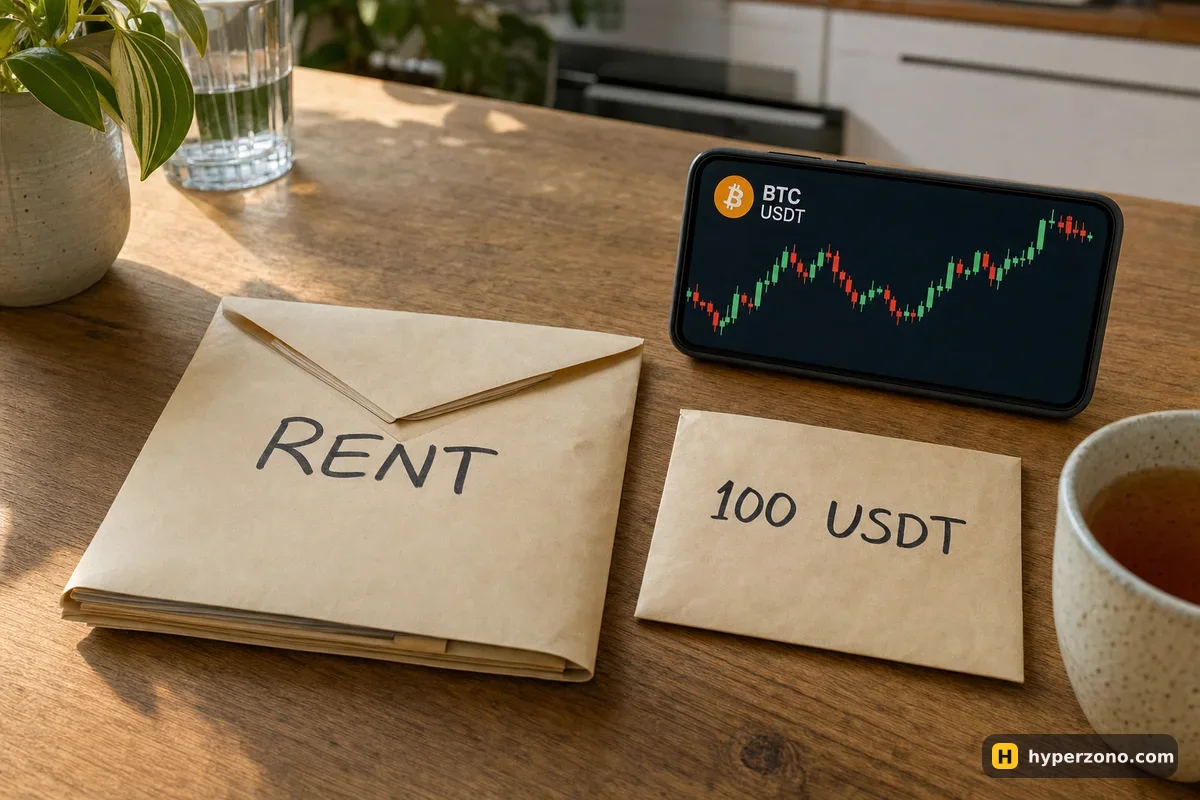
Why 100–300 USDT is the practical starting range
At 100 USDT you can do something that actually resembles trading. A sensible beginner habit is risking about 1% of your balance on a single trade, which here means 1 USDT. If your stop-loss sits 1% away from your entry price, a trade of 100 USDT does exactly that: price goes against you by 1%, you lose 1 USDT and you're out. That size is comfortably above the minimums above, and the fee on it is a few cents.
At 300 USDT you get breathing room. You can risk 3 USDT, which means a stop you can place further from your entry, so a small random price swing doesn't close your trade before the move you expected even starts. Bigger than that doesn't teach you anything extra in your first months — a 1,000 USDT account just makes the same beginner mistakes cost ten times more. You can always add money once you know how you behave after a losing trade.
| Your deposit | 1% risk per trade | What that looks like in practice |
|---|---|---|
| 20 USDT | 0.20 USDT | Too tight to work with. Fees and minimum sizes dominate the result. |
| 100 USDT | 1 USDT | A 100 USDT trade with a stop 1% away. Small, but a real trade. |
| 300 USDT | 3 USDT | Room for a wider stop or a bigger trade. Mistakes stay survivable. |
| 1,000 USDT | 10 USDT | Comfortable to trade — but every beginner mistake now costs ten times more than it would at 100 USDT. |
The arithmetic runs both ways, and that's the useful part: pick your risk per trade first, then check whether your deposit can produce a trade above the exchange minimum. If 1% of your balance can't buy a sane position, your deposit is too small for that coin. How to turn risk into an exact size is covered in the guide on working out your position size.
The one rule that matters more than the number
It has to be money you can fully lose. Not "probably won't lose". Fully. Imagine the balance goes to zero tomorrow morning — if that would mean a difficult conversation at home, a missed payment or a bad week, the amount is too big, and you should pick a smaller one. This isn't a disclaimer, it's the practical condition for trading well: people who are trading money they need make rushed, fearful decisions, and those decisions are exactly what empties accounts.
If losing it would change your month, the amount is too big. Cut it in half and ask again. Trading 50 USDT calmly beats trading 500 USDT with your stomach in knots — the second one costs you more, and faster.
Borrowed money and rent money: an instant no
Don't fund a futures account with a loan, a credit card you can't clear, money from family, or anything set aside for rent, school fees or medicine. Futures have no schedule — a position that needed two days to work out doesn't care that your repayment is due on Friday. Borrowed money forces you to need a result by a certain date, and needing a result is how people switch to high leverage and no stop-loss.
There's also a simpler version of the same point. Nobody's first months of futures trading are profitable in a reliable way, and anyone promising otherwise is selling something. Treat your starting deposit as the price of an education, and read about what a $100 account can realistically earn before you build expectations around it.
What to do with the number you picked
Start below it. If your honest "can lose it all" figure is 300 USDT, deposit 100 and leave the rest where it is until you've made twenty or thirty small trades and know how you behave when one goes wrong. You can always add later; you can never un-lose money you added too early. Pair this with modest leverage — the page on what leverage a beginner should use explains why the first trades should feel almost dull.
When you're ready to see the actual numbers instead of reading about them, the fastest way is to open a Binance Futures account, go to the futures order window and type in a small amount. The minimums you just read about are right there on the screen.
Before you confirm, the window shows two numbers worth finding: how much of your balance the trade will hold, and roughly the price at which the exchange would close you out. The wording differs between apps.
Many exchanges also have a demo mode where you can do all of this with play money first. And while you sign up, check that futures are actually offered where you live — in some countries they are limited or not offered at all.
What is the minimum deposit for crypto futures?
Exchanges usually don't set a deposit minimum at all — they set a minimum order size. On Binance that's about 5 USDT of trade size for many altcoin contracts, 20 USDT for ether, and 0.001 BTC for bitcoin. With leverage, the money actually held from your balance is a fraction of that, so a balance of 25–50 USDT can already open a position. Other exchanges have their own minimums, which you'll see in the order window.
How much money do I need to start trading crypto with leverage?
Enough that 1% of your balance is still a workable trade. That lands around 100 USDT as a sensible floor and 300 USDT as a comfortable learning amount. Leverage lets you control a bigger trade with less money, but it doesn't fix a balance that's too small to absorb a few losses in a row.
Can I start with $50?
You can, and the exchange will let you. Expect small trades on cheaper coins, a tight risk budget of about 0.50 USDT per trade at 1%, and fees taking a visible share of each result. It works as a way to feel the real thing, but don't expect it to show you much about profit.
Should I practise on demo before depositing anything?
It's a good way to learn where the buttons are and how orders behave, and it costs nothing. Just know that demo trading doesn't reproduce the feeling of real money, so your behaviour will change when you switch over. Many people do a week on demo and then start small for real.
Does a bigger deposit make trading easier?
Up to a point. More balance means you can place your stop-loss further from your entry and make more trades before you run out, which genuinely helps. Past a few hundred dollars it mostly just raises the cost of your beginner mistakes, so there's no reason to rush it — add money later, once you've seen how you handle a losing trade.