
Contents
The three ways to use a falling priceWhy a futures short is the easiest routeWhat a 1,000 USDT short actually earnsThe risks that are specific to being shortWhen doing nothing beats shorting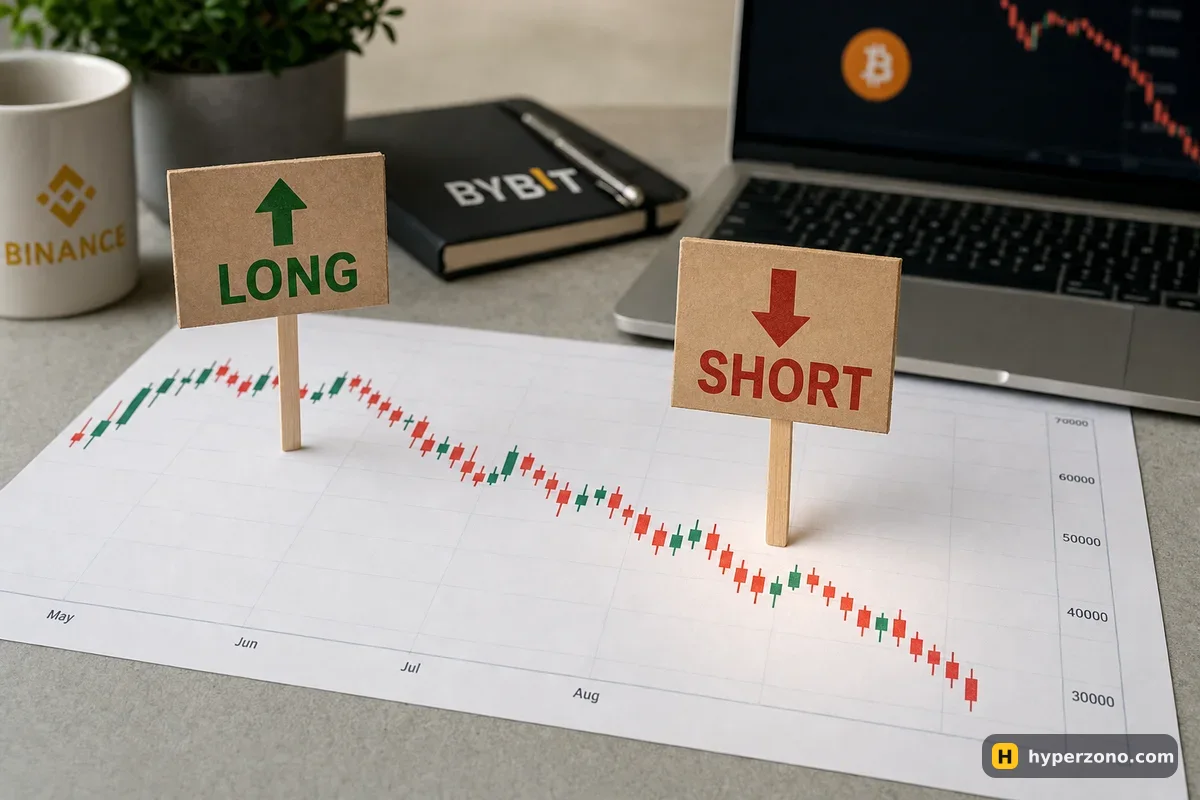
The three ways to use a falling price
The first way costs nothing to understand: if you already hold bitcoin on spot and you think it is going lower, you sell it and hold USDT instead. That is not profit — it is a loss you avoided, and later you can buy the same coins back cheaper. The problem is obvious: this only works if you own coins in the first place.
The second way is margin borrowing. You borrow bitcoin from the exchange, sell it immediately at today's price, and buy it back later to return it. If the price fell in between, the difference is yours. It works, but you are carrying a loan: interest keeps accruing while the borrow is open (on Binance margin accounts it is charged hourly), and there is paperwork around opening a margin account.
The third way is a short on a perpetual futures contract. You tell the exchange you want to sell a certain amount of bitcoin now and buy it back later, and the exchange settles the difference in USDT. Nothing is borrowed, nothing is delivered, and you never touch an actual bitcoin. If the term itself is new to you, the plain-words version lives on the page about long and short.
Why a futures short is the easiest route
A short on a perpetual needs only USDT in your futures wallet — no coins, no loan, no waiting. You open it from the same order window you would use to buy, just on the sell side, and you close it whenever you want. That is why it is usually the simplest route: fewer steps, no loan, and you can do the whole thing on a phone in under a minute.
The other advantage is size. On spot you can only sell what you hold; with futures you choose the position size yourself, from a small one to one bigger than your balance. The easiest way to see this is to open a Binance Futures account, pull up the bitcoin perpetual and look at the order window — the sell button and the buy button sit side by side with exactly the same fields, and nothing there asks whether you own any bitcoin.
What a 1,000 USDT short actually earns
Say you short 1,000 USDT worth of bitcoin and the price falls 3% while you are in the trade. Your profit is 3% of 1,000, so about 30 USDT, minus the exchange fee charged on the way in and again on the way out. If the price had gone up 3% instead, that same 30 USDT would have come out of your account.
Here is the part people get wrong. If you use 1x leverage, that 1,000 USDT position locks up 1,000 USDT of your money as the deposit, and 30 USDT is a 3% return on it. At 5x, the same position only locks up about 200 USDT, so 30 USDT is a 15% return on the money you set aside. The money result is identical — leverage changed how much of your balance was tied up and how fast a move against you eats it, nothing else. The fee is charged on the full 1,000 either way: at Binance's base taker rate of 0.05% that is about 0.50 USDT to get in and the same to get out.
The risks that are specific to being short
When you buy, the worst case is that the price goes to zero. When you short, there is no ceiling on how far the price can rise above your entry, so the loss side has no natural limit — your position simply gets closed by the exchange when your deposit runs out, and that is called liquidation. This is exactly why a stop-loss matters more on a short than almost anywhere else.
Falling markets also bounce violently. A coin can drop for days and then jump 8% in twenty minutes because a lot of shorts are being closed at once — traders call that a squeeze, and it hurts most when you are holding without a stop. And while your short is open you either pay or receive funding, a small payment between longs and shorts settled every few hours. When most traders are betting on the price going up, the people holding shorts receive that payment; when the market is already falling hard and almost everyone is short, it usually turns the other way and you pay.
Decide your exit before you click sell. Write down the price where you admit you were wrong, and set the stop-loss there in the same order window where you open the trade. On a short, a bounce can arrive while you sleep, and a stop is the only thing that acts for you at 3 a.m.
When doing nothing beats shorting
A red chart is not automatically an opportunity. If the price has already fallen 15% and you are only now looking for a way in, you are joining the move late, right where bounces happen. Shorting after a long drop, with no plan and no stop, is how a lot of beginners hand back the gains they made on the way down.
Selling on spot means the drop no longer touches you; a short means you earn from it — and that you lose if the price goes up instead. Sitting in USDT and waiting costs you nothing, and that is a real choice, not a failure.
When you are ready for the buttons rather than the theory, the walkthrough with the exact fields and the sell side of the order window is in how to open a short position. Start small. On Binance the smallest bitcoin position is 0.001 BTC — with bitcoin near 83,500 USDT that is about 83 USDT of position size, and it moves with the price. Minimums differ by exchange and by coin, so check the contract you pick in the app; many altcoin contracts start from a few dollars. Either way, a tiny trade teaches you the same lesson as a 1,000 USDT one.
How do I short bitcoin if I don't own any?
That is the normal case. On a perpetual futures contract you post USDT as your deposit and the exchange settles the price difference in USDT — no bitcoin ever changes hands. You open the trade on the sell side of the order window and close it with the opposite action.
Is shorting riskier than buying?
In one specific way, yes: a price can rise without limit, while it can only fall to zero. In practice the risk you actually face comes from your position size and whether you set a stop-loss, not from the direction. The same stop-loss discipline applies to both sides.
How much money do I need to profit from a falling price?
Less than most people expect — on bitcoin the smallest position on Binance is 0.001 BTC, and many altcoin contracts start from a few dollars. Check the one you pick in the app before you plan the trade.
Do I get paid for holding a short position?
Sometimes. Funding is a payment between longs and shorts every few hours; when the rate is positive, longs pay shorts, and you receive it. When the rate is negative, you pay. It is calculated on your position size, not on your deposit, and only whoever holds the position at the settlement moment pays or receives.
What if the price turns around after I open a short?
Your position starts losing, and if it keeps going the exchange closes it when your deposit is exhausted. A stop-loss placed when you open the trade ends it earlier, at a price you chose, which is the whole point of setting one in advance.
Can I short bitcoin from any country?
No — futures are not offered everywhere, and some exchanges serve certain regions through a separate local entity with different products and leverage limits. The simplest check is to start the sign-up process: the app will tell you whether derivatives are available at your location. Never try to get around a restriction.