Contents
The DOGE funding rate today on five exchangesWhat DOGE funding has cost in money: 30 days, 90 days, 12 monthsMonth by month: when longs paid most and when shorts got paidWhere it has been cheapest, and why that can flipHow to check DOGE funding before you open the tradeThe DOGE funding rate today on five exchanges
Funding is a payment between traders holding the perpetual contract: when the rate is positive, longs pay shorts, and when it is negative, shorts pay longs. None of these venues takes a cut of it — the money goes from one trader to the other. If the mechanism is new to you, how funding is charged explains it properly; here we stay on Dogecoin.
The table below pulls the current DOGE funding rate and the next settlement from each venue's public data. Read the sign first: a positive number means your long pays at the next settlement, a negative one means your long receives. Then look at the interval — Binance, Bybit, OKX and the Binance Wallet Perpetuals tab settle DOGE every 8 hours, Hyperliquid every hour. An hourly rate looks tiny next to an 8-hour one, so to compare Hyperliquid with the rest, multiply its hourly rate by 8, which is covered in detail in comparing 1-hour and 8-hour funding.
| Where | Paid | Rate now | A 1,000 USDT long: 30 days | 90 days | 12 months | Longs paid (90 days) |
|---|---|---|---|---|---|---|
| Binance Futures | every 8 h | -0.0022% | pays 4.10 USDT | pays 15.78 USDT | pays 30.41 USDT | in 68% of settlements |
| Binance Wallet (Aster book) | every 8 h | +0.0053% | pays 4.26 USDT | pays 16.91 USDT | pays 47.33 USDT | in 78% of settlements |
| Bybit | every 8 h | +0.0064% | pays 2.84 USDT | pays 10.90 USDT | pays 28.10 USDT | in 67% of settlements |
| OKX | every 8 h | +0.0014% | pays 5.58 USDT | pays 17.32 USDT | — | in 91% of settlements |
| Hyperliquid | every hour | -0.0002% | pays 8.64 USDT | pays 28.67 USDT | pays 60.39 USDT | in 78% of settlements |
Rate now is what the venue shows for the next settlement. The totals are what a 1,000 USDT long would have paid holding the whole time (price changes aside); a short would have received the same. "Longs paid" is the share of settlements over 90 days when the rate was above zero. OKX only publishes 3 months of history.
Updated 24 Oct 2026, 20:12 UTC from the exchanges’ public APIs.
What DOGE funding has cost in money: 30 days, 90 days, 12 months
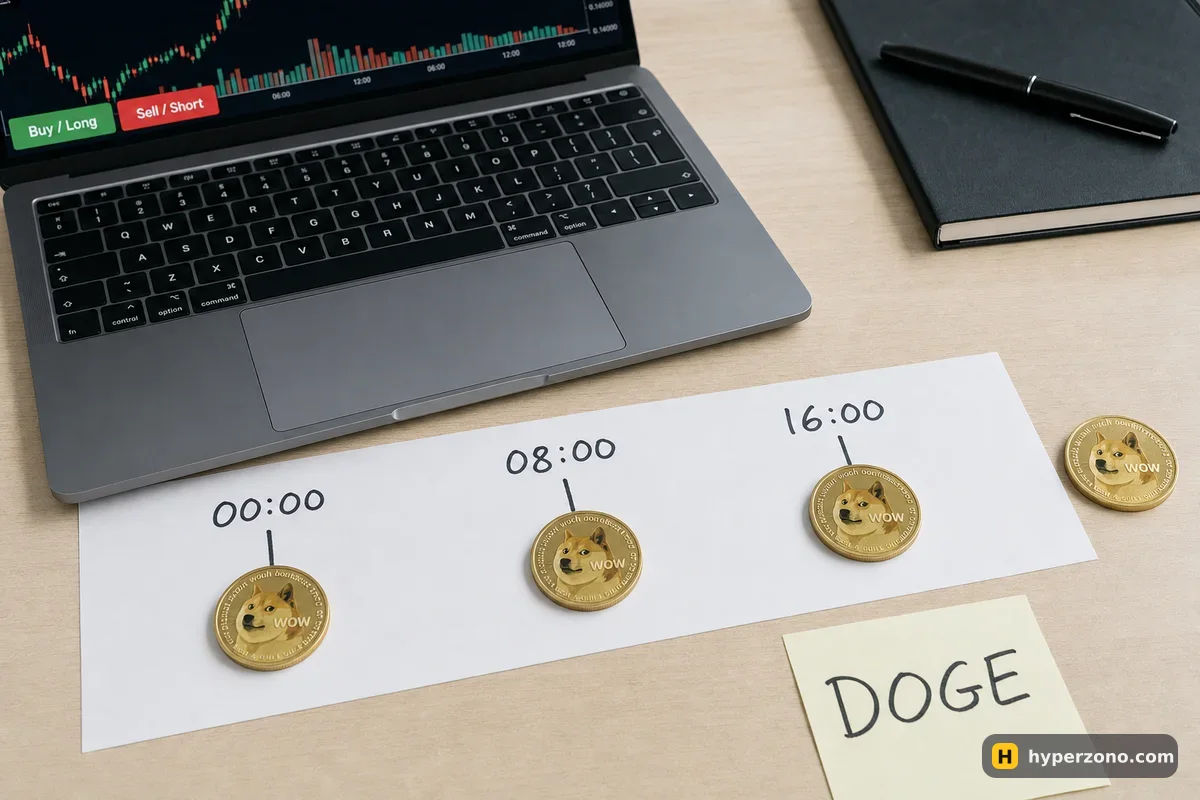
Here is the part most people never check. The numbers below are what a long position worth 1,000 USDT would have paid in funding if it had simply been held through the whole period, with every settlement counted. They say nothing about whether the price of Dogecoin went up or down — this is the holding cost on its own.
| Exchange | Interval | 30 days | 90 days | 12 months |
|---|---|---|---|---|
| Bybit (DOGEUSDT) | 8 h | paid 2.84 | paid 10.90 | paid 28.10 |
| Binance Futures (DOGEUSDT) | 8 h | paid 4.10 | paid 15.78 | paid 30.41 |
| Binance Wallet Perpetuals (DOGEUSDT) | 8 h | paid 4.26 | paid 16.91 | paid 47.33 |
| OKX (DOGE-USDT-SWAP) | 8 h | paid 5.58 | paid 17.32 | no data |
| Hyperliquid (DOGE) | 1 h | paid 8.64 | paid 28.67 | paid 60.39 |
The Binance Wallet row uses the funding history of Aster, the protocol that provides execution in the wallet's Perpetuals tab — the tab itself has only been open since early 2026, so the longer windows come from the protocol rather than from the tab.
Now put it on the size you would actually trade. Our running example is 500 USDT of your own money at 5x leverage, which is a 2,500 USDT position — and funding is charged on the position, not on your 500 USDT. So multiply every number above by 2.5. Ninety days of a DOGE long would have cost roughly 27 USDT on Bybit, 39 USDT on Binance, 43 USDT on OKX and 72 USDT on Hyperliquid. Against 500 USDT of your own money, that top figure is about 14% — gone before the price has done anything at all.
That is the honest answer to "the DOGE funding rate is too small to matter". One settlement is small. Ninety days is 270 settlements on an 8-hour contract and over 2,100 on an hourly one. You can run your own position size through the funding calculator in a few seconds before you open anything. If you would rather watch a live countdown than read a table, you can open a Binance Futures account and look at the DOGEUSDT page before you put any money in.
Month by month: when longs paid most and when shorts got paid
The yearly total hides the shape of it. Look down the months in the table below and you will see long stretches where DOGE longs paid a steady small amount, and a few months where the sign flipped and shorts were the ones paying. The worst month for longs was August 2026 — a 1,000 USDT long paid about 6 USDT on Binance that month. On Hyperliquid the heaviest month came later, September, at around 11 USDT. Scroll the table to see the other months.
| Month | Binance Futures | Binance Wallet (Aster book) | Bybit | Hyperliquid |
|---|---|---|---|---|
| October 2026 | 2.76 USDT | 3.02 USDT | 1.84 USDT | 6.04 USDT |
| September 2026 | 6.12 USDT | 5.90 USDT | 3.81 USDT | 10.99 USDT |
| August 2026 | 6.28 USDT | 7.16 USDT | 4.65 USDT | 10.74 USDT |
| July 2026 | 4.35 USDT | 5.24 USDT | 3.22 USDT | 5.74 USDT |
| June 2026 | 1.31 USDT | 3.06 USDT | 1.43 USDT | 1.58 USDT |
| May 2026 | 2.72 USDT | 5.95 USDT | 2.91 USDT | 6.59 USDT |
| April 2026 | 3.15 USDT | 4.76 USDT | 2.75 USDT | 6.26 USDT |
| March 2026 | −1.41 USDT | 1.04 USDT | 0.02 USDT | −1.10 USDT |
| February 2026 | −2.30 USDT | −2.34 USDT | −0.44 USDT | −0.08 USDT |
| January 2026 | 2.27 USDT | 5.08 USDT | 2.47 USDT | 4.31 USDT |
| December 2025 | 1.75 USDT | 3.02 USDT | 1.97 USDT | 2.95 USDT |
| November 2025 | 2.69 USDT | 3.83 USDT | 2.85 USDT | 6.24 USDT |
| October 2025 | 0.74 USDT | 1.61 USDT | 0.63 USDT | 0.13 USDT |
What a 1,000 USDT long paid in each month (minus means it received). The current month is not over yet. OKX is left out: its API keeps only 3 months of history.
Updated 24 Oct 2026, 10:56 UTC from the exchanges’ public APIs.
February 2026 went the other way. More traders were betting on a fall than on a rise, so the shorts paid: a 1,000 USDT DOGE long got about 2.30 USDT back on Binance that month instead of paying. A month where longs get paid is possible, but over the last year it has been the exception, not the pattern.
Where it has been cheapest, and why that can flip
Over all three windows, Bybit was the cheapest place to hold a DOGE long and Hyperliquid the most expensive, with Binance and the Binance Wallet tab in between. Count how often a long was the paying side over those 90 days. On Bybit and Binance it was about two settlements out of three. On Hyperliquid and in the Binance Wallet tab, closer to four out of five. On OKX a long paid at 91% of settlements — almost every single time.
Do not read that as a permanent ranking. Each venue works its rate out from the gap between the price of its own DOGE contract and the ordinary spot price of Dogecoin, so a crowd of longs arriving on one exchange can push that exchange's rate above the others within a day. If you want the detail on those prices, why a contract shows several prices covers it. The order in the table above describes the past 12 months and nothing more — check the live rates before you open, and check them again if you plan to hold for weeks.
One payment has a ceiling, a long run of them does not. Binance caps a single DOGE funding payment at 0.4875% of your position size — on a 2,500 USDT position that is a maximum of about 12 USDT for one settlement. Bigger markets have tighter ceilings: bitcoin and ether are capped at 0.30%. The cap only limits one payment, though. A rate can stay high settlement after settlement, and if it does hit the cap the contract can start settling every hour instead of every 8, going back to the longer interval when things calm down. The countdown above the chart always shows the interval actually in force.
How to check DOGE funding before you open the trade
Look above the chart
On the futures screen for DOGEUSDT, the current funding rate and a countdown to the next settlement sit right above the chart. That one line tells you the sign, the size and how long you have before the next payment.
Open the history
Under Data, in the futures data area, Binance publishes a real-time funding rate page and a funding rate history page. If the last few weeks are a line of positive numbers, a long will keep paying.
Turn the rate into money
Multiply the rate by your position size, not by your margin. On a 2,500 USDT position, a rate of 0.01% is 0.25 USDT per settlement, or 0.75 USDT a day on an 8-hour contract.
Decide the holding time
You only pay if you are holding the position at the settlement moment, so a trade you close before the countdown runs out pays nothing. Give yourself a minute or two of margin rather than trying to slip out on the last second.
Set a reminder
In the USDⓈ-M futures notification settings you can switch on a funding fee alert and pick the rate level that triggers it — the available options are shown in the app. Delivery is not guaranteed, so treat it as a helper, not a safety net.
One more thing worth knowing: funding comes out of your available futures balance first, and if that is empty, it is taken from the margin backing your position — which moves your liquidation price closer. That is one practical reason not to run a DOGE position with no spare balance, and a good reason to read what leverage to pick for a first trade. If you want the long-run picture across other coins, the 12-month funding study with its calculator covers BTC, ETH and SOL.
What is the DOGE funding rate right now?
It is in the live table at the top of this page, pulled from each exchange's public data and refreshed through the day. There is no fixed "today's rate" — DOGE funding is recalculated for every settlement, three times a day on most venues and every hour on Hyperliquid.
Do I pay DOGE funding if I close before the settlement time?
No. You only pay or receive if you are holding the position at the moment funding settles. Close a couple of minutes early rather than cutting it fine — in the Binance Wallet Perpetuals tab, Aster's own documentation says the charge can land about 15 seconds away from the scheduled time.
Can a DOGE short earn funding instead of paying it?
Yes, whenever the rate is positive the shorts are the receiving side, and over the past 90 days that was the case in roughly two thirds to nine tenths of settlements depending on the venue. But funding moves slowly and price moves fast — a short that collects funding and then gets caught in a rally still ends up losing money.
Is Dogecoin funding higher than Bitcoin funding?
They are different markets with different crowds, and the answer changes week to week. Compare them side by side in the live tables on this page and on the BTC funding page rather than assuming one is always dearer.
Why is Hyperliquid's DOGE rate so much smaller on screen?
Because it settles every hour and the other four settle every 8 hours. Multiply the Hyperliquid number by 8 and you are comparing like with like — and when you do, its 12-month total for DOGE was the highest of the five.
Where do the 30-day, 90-day and 12-month funding totals come from?
From each exchange's own published funding history: every settlement in the period, added up for a 1,000 USDT long, to 24 October 2026. The source pages are listed at the bottom of this page, and the same method is used in our funding history study.
Sources and fact-check
Exchange terms were checked against official documents on October 24, 2026. Terms change — before you trade, check what matters to you in the exchange app and in your contract’s specs.
Binance: Introduction to Binance Futures Funding RatesHyperliquid Docs: FundingAster Docs: Funding Rate