
Contents
What happens the moment you open the tradeThe trade: 100 USDT, 5x leverage, bitcoinWhat the screen shows when bitcoin moves 2%Closing the trade: what the fees really takeWhere would this trade be liquidated?What this example leaves out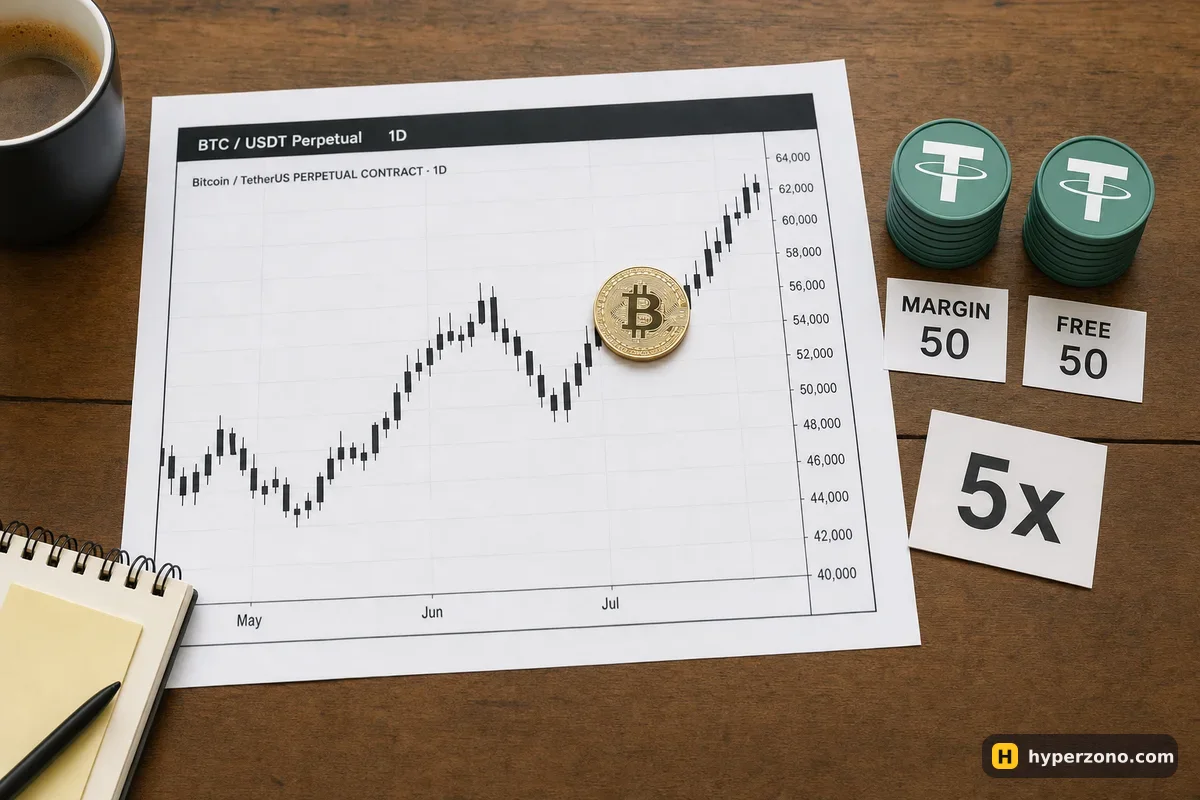
What happens the moment you open the trade
When you open a futures trade on bitcoin, no bitcoin moves anywhere and nothing arrives in your wallet. You are agreeing with the exchange on the price of bitcoin: if it goes up from where you entered, money is added to your account, and if it goes down, money is taken away. That's why you can also earn when the price falls — that direction is called a short, and the normal upward one is a long. If those two words are new, the short version is on our page about long and short in simple words.
While the trade is open, the exchange asks you to set part of your balance aside as a deposit. That deposit is your margin. It isn't a payment and it isn't gone — it sits frozen as cover for the trade and comes back to your free balance the moment you close. The only money that genuinely leaves you is the fee and, if the price went against you, the loss.
The trade: 100 USDT, 5x leverage, bitcoin
Say your futures account has 100 USDT and bitcoin is trading at 100,000 USDT. These are illustrative round numbers, chosen so the arithmetic stays readable; your real prices will be messier. You decide to go long with half your money, so you set leverage to 5x and put up 50 USDT of margin.
Five times 50 USDT is a position of 250 USDT, which at a price of 100,000 is 0.0025 BTC. That 0.0025 BTC is what your profit and loss is counted on. Your balance still shows 100 USDT in total: 50 locked as margin for this trade, 50 free and available for anything else. Leverage did not add money to your account — it let the same 50 USDT carry a 250 USDT position, so every price move counts five times harder against your deposit.
What the screen shows when bitcoin moves 2%
Bitcoin goes from 100,000 to 102,000, a rise of 2%. Your 0.0025 BTC is now worth 255 USDT instead of 250, so the position line on your screen shows about +5.00 USDT in floating profit. Next to it you'll see a percentage, and it will look much bigger: +5 USDT on 50 USDT of margin is +10%. The price moved 2%, your deposit moved 10%, and that factor of five is the whole story of leverage.
Now run it the other way. Bitcoin slips to 98,000 and the same line shows −5.00 USDT, so the margin behind your trade is effectively 45 USDT instead of 50. Nothing has actually been paid yet — this number breathes up and down with every tick, and it only becomes real money when you close. One small detail worth knowing: the exchange calculates this floating number from its own fair price, called the mark price, not from the last trade on the screen, which is explained in why a contract shows several prices.
Closing the trade: what the fees really take
You tap close at 102,000. The 50 USDT margin is released back to your balance, the 5 USDT of profit is added, and the exchange takes its fee. Here is the part beginners get wrong: the fee is charged on the size of the position, not on your margin. If you open and close with a market order — taking the price that is already on the screen — Binance charges 0.05% of the position each time, so 250 USDT in costs about 0.13 USDT and 255 USDT out costs about 0.13 USDT, roughly a quarter of a dollar for the round trip. That 0.05% rate is called the taker fee; a limit order that waits in the queue until someone trades against it is cheaper, 0.02% at the same base level. Other venues work the same way with their own rates, so look up the numbers on the fee page of whichever exchange you use.
| Price goes up 2% | Price goes down 2% | |
|---|---|---|
| Entry price | 100,000 | 100,000 |
| Exit price | 102,000 | 98,000 |
| Position | 0.0025 BTC (250 USDT) | 0.0025 BTC (250 USDT) |
| Price difference | +5.00 USDT | −5.00 USDT |
| Entry + exit fees | −0.25 USDT | −0.25 USDT |
| Net result | +4.75 USDT | −5.25 USDT |
| Balance afterwards | 104.75 USDT | 94.75 USDT |
Notice the small asymmetry. A win gives you slightly less than the price move, a loss costs you slightly more, because the fee is paid either way. On a 250 USDT position that's pennies; on larger positions and many trades a day it becomes the main reason a balance slowly shrinks even when most of the trades looked like winners. The easiest way to feel this is to open a Binance Futures account, take one small position and watch the fee appear the moment you enter and again when you close.
Where would this trade be liquidated?
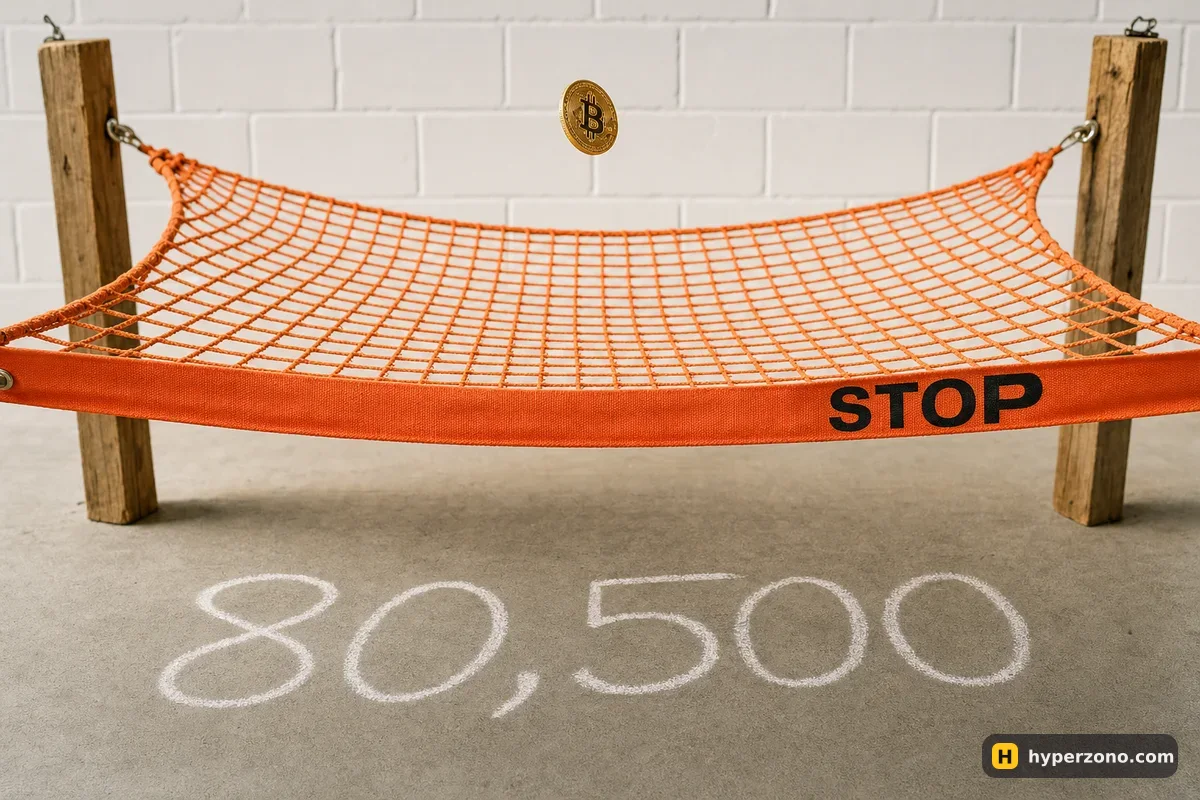
Your margin is 50 USDT and your position is 250 USDT, so a fall of about 20% in the price would use up the whole deposit. From 100,000 that points at roughly 80,000 — and the exchange steps in a little earlier than that, because it always keeps a small part of your margin untouched as a safety buffer. How big that buffer is depends on your position size, your margin mode and the exchange's own rules, so the only number you should trust is the estimated liquidation price shown in the order window before you confirm. For this illustration, picture the close happening somewhere around 80,500.
That automatic close is called liquidation. The estimate on your screen shifts as your position and your other trades change, so treat it as a boundary you never want to approach rather than a fixed line. Our page on how to see the liquidation price in advance walks through where to find it.
Isolated long of 250.00 USDT, 5× leverage, maintenance margin 0.50% of position size (example). Simplified model without closing fees, risk-limit tiers or other positions — the exchange will show its own price.
If you chose isolated margin when you opened the trade, that liquidation costs you the 50 USDT behind this position and nothing else — the other 50 stays free. With cross margin the whole balance stands behind the trade, so the price would have to fall much further, but you would be risking all 100 USDT. The better habit is not to rely on either: decide your exit before you enter, and place a stop-loss far above the liquidation level so the trade ends on your terms.
Change the leverage, keep the position the same. If you had set 10x instead of 5x but still opened 0.0025 BTC, your profit and loss in USDT would be identical — 5 USDT on a 2% move. Only the locked margin would drop to 25 USDT and the liquidation price would sit much closer to your entry. Higher leverage doesn't earn more on the same position; it just gives the price less room to breathe.
What this example leaves out
Two things. On perpetual contracts, every few hours longs and shorts pay each other a small amount called funding, so a trade held for days has one more line in the maths — the full picture, with funding included, is in how to calculate your real profit. And market orders don't always fill at the exact price you saw, especially on fast moves or thin coins, so the real entry can be a few dollars off.
Everything else you just read is the whole mechanism: margin locked, position size set by leverage, profit counted on the coin amount, fees taken on the position, margin returned at the close. The buttons differ between exchanges, and if you want the taps in order, follow trading futures on Binance step by step. Then try the same 250 USDT trade in demo mode or with an amount you would not miss, and see whether the numbers land where this page says they will. If you are still deciding how much to bring, how much you can make with $100 is the honest version of that answer.
How much money do I need to open one bitcoin futures trade?
Less than most people expect. In the example above, 50 USDT of margin at 5x opened a 250 USDT position. Each exchange sets a minimum position size per contract — on Binance, for instance, bitcoin futures start at 0.001 BTC — so check the minimum for your chosen coin in the app before you plan the amount.
Do I get my margin back when I close the trade?
Yes. The margin is a deposit, not a payment. The moment you close, it returns to your free balance, adjusted by your profit or loss and reduced by the fees. The only way you don't get it back is if the price moves far enough against you to wipe it out and the trade is liquidated.
Why is my profit smaller than the calculator showed?
Almost always the fees, charged twice — once when you open and once when you close — and on the full position size, not on your margin. On a perpetual contract held for a while, funding can take or add a small amount too. On a 250 USDT position those are cents, but they scale with position size and with how often you trade.
What happens if I just leave the trade open?
A perpetual contract has no end date, so it stays open until you close it or the price reaches your liquidation level. While it's open you pay or receive funding every few hours, and the floating profit on the screen keeps changing. Leaving a leveraged trade unattended overnight without a stop-loss is how small losses quietly become liquidations.
Is 5x the right leverage for a first trade?
There is no right number — 5x was chosen here because the arithmetic is easy. What matters is the distance between your entry and your liquidation price: lower leverage pushes it further away and gives the price room to wobble. Decide how many USDT you are willing to lose on the trade first, then pick a size and leverage that fit that number.
Does this work the same on other exchanges?
The mechanics are the same everywhere: margin locked, position size set by leverage, profit counted on the coin amount, fees on each execution. What differs is the fee level, the minimum position size and which contracts you can reach from your country. Compare the conditions on Bybit or OKX and read the numbers on their own fee pages before you trade.