Contents
The SOL funding rate right now, on five exchangesWhat funding can add up to over weeksMonth by month: when longs paid most and when shorts got paidWhere to hold a SOL position, and how to check funding before you open itThe SOL funding rate right now, on five exchanges
The number you are searching for is not fixed for the day. Each venue recalculates it for its own payment moments — those moments are called settlements — and publishes its own figure. A positive rate means longs pay shorts; a negative one means shorts pay longs, and the exchange keeps nothing either way. If the mechanism itself is new to you, the short version lives on our page about funding; here we stay with Solana and the money.
| Where | Paid | Rate now | A 1,000 USDT long: 30 days | 90 days | 12 months | Longs paid (90 days) |
|---|---|---|---|---|---|---|
| Binance Futures | every 8 h | -0.0063% | pays 2.63 USDT | pays 9.15 USDT | receives 3.89 USDT | in 55% of settlements |
| Binance Wallet (Aster book) | every 8 h | -0.0028% | pays 3.21 USDT | pays 10.45 USDT | pays 3.02 USDT | in 60% of settlements |
| Bybit | every 8 h | -0.0072% | pays 1.94 USDT | pays 6.40 USDT | pays 0.53 USDT | in 56% of settlements |
| OKX | every 8 h | +0.0012% | pays 2.93 USDT | pays 8.49 USDT | — | in 69% of settlements |
| Hyperliquid | every hour | +0.0013% | pays 5.70 USDT | pays 17.59 USDT | pays 8.55 USDT | in 64% of settlements |
Rate now is what the venue shows for the next settlement. The totals are what a 1,000 USDT long would have paid holding the whole time (price changes aside); a short would have received the same. "Longs paid" is the share of settlements over 90 days when the rate was above zero. OKX only publishes 3 months of history.
Updated 24 Oct 2026, 20:12 UTC from the exchanges’ public APIs.
Read the table like this: find the exchange you use, look at the current rate, and check the interval shown next to it. On Binance, SOL settles every 8 hours by default — three payments a day — and the other venues show their own interval beside the rate. Hyperliquid pays every hour and its rate is sized for one hour, which is why the number looks tiny: to compare it fairly with the others, multiply the hourly rate by 8, not by 24, which is exactly what the page on 1-hour versus 8-hour funding walks through.
Paying more often is not the same as paying more. Eight hourly payments on Hyperliquid and one 8-hour payment on Binance cover the same stretch of time, so the clock alone decides nothing. What decides your cost is how high the rate sits once both are expressed over the same period. Don't trust memory on the interval either — Binance can move a contract to a shorter interval when the rate reaches its limit, so read it off the table or the countdown in the app.
It helps to know where the rate tends to rest when nothing dramatic is happening. The Binance formula carries an interest part of 0.01% per 8 hours, roughly 0.03% a day, and when the contract trades close to the index price the rate settles right on that number. On a 4-hour or 1-hour interval the same part is split in proportion, so a quiet hourly reading is a very small number by design.
Turning a rate into money takes one multiplication: your position size × the rate. Say you open 2,500 USDT of SOL — that is 500 USDT of your own money at 5x — and the rate is 0.01%. You pay 0.25 USDT at that settlement, about 0.75 USDT a day if it stays there. Those are illustrative numbers to show the arithmetic; put the rate from the table above and your own size into the funding calculator to get yours.
What funding can add up to over weeks
A single settlement is pocket change. A position held for weeks is where it starts to matter, because the payments keep landing three times a day. Carrying that same illustrative 2,500 USDT position through a calm month at 0.01% per 8 hours would cost roughly 22 USDT — small against a target measured in tens of USDT, but no longer invisible.
Rates do not stay calm, though, and that is why we don't print a fixed cost here. When traders crowd into longs, the rate climbs well above the quiet baseline and stays there for days; when the mood flips, it turns negative and longs get paid to hold. Binance does cap a single SOLUSDT settlement at ±0.375%, but a cap only limits one payment — it does not stop an expensive rate from repeating settlement after settlement.
So the honest way to estimate your own cost is to take today's rate from the live table, multiply by your position size, multiply by the number of payments you expect to sit through, and then look at the month-by-month table below to see how far the rate has swung in the past.
Month by month: when longs paid most and when shorts got paid
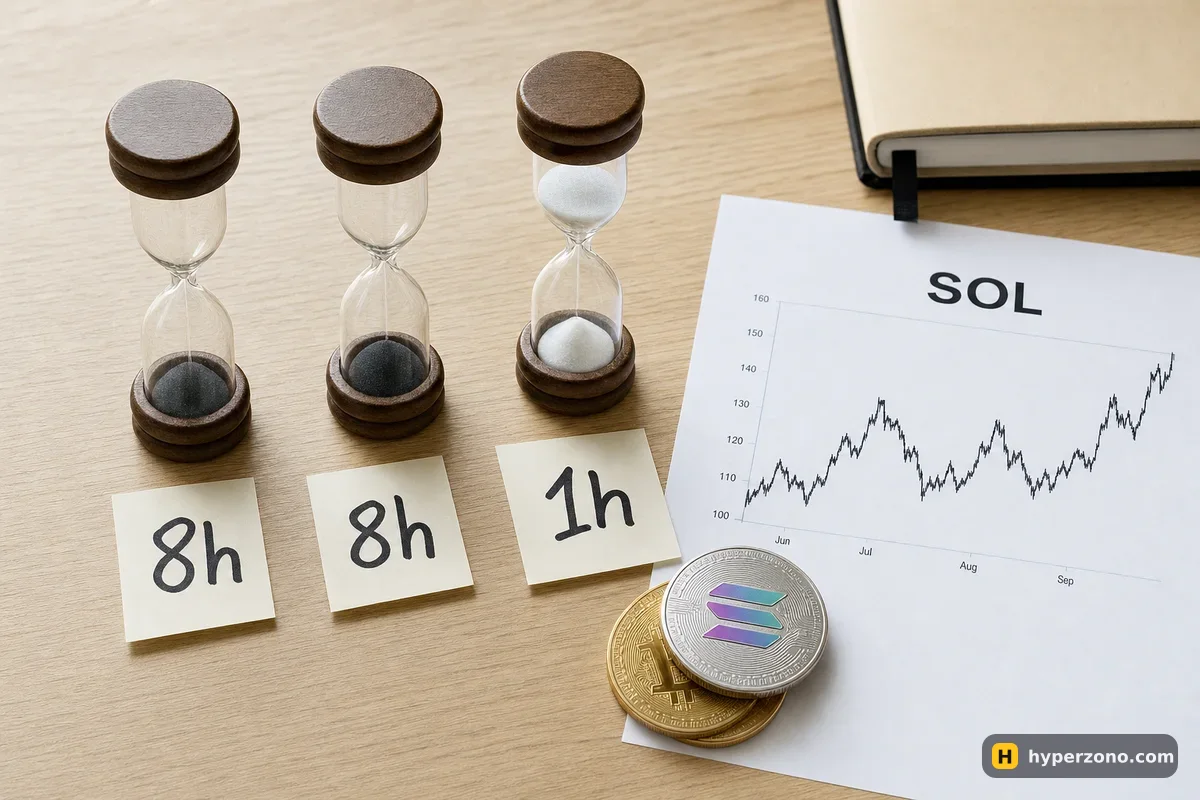
A single rate tells you about today. The table below breaks the history into months for the same 1,000 USDT long on SOL, so you can see which stretches were expensive to hold and which ones paid you instead, exchange by exchange.
| Month | Binance Futures | Binance Wallet (Aster book) | Bybit | Hyperliquid |
|---|---|---|---|---|
| October 2026 | 2.18 USDT | 2.89 USDT | 1.01 USDT | 4.10 USDT |
| September 2026 | 2.64 USDT | 2.87 USDT | 1.50 USDT | 5.88 USDT |
| August 2026 | 3.94 USDT | 4.43 USDT | 3.74 USDT | 7.38 USDT |
| July 2026 | 1.92 USDT | 2.91 USDT | 0.79 USDT | 4.97 USDT |
| June 2026 | −3.84 USDT | −2.28 USDT | −2.79 USDT | −1.82 USDT |
| May 2026 | 0.49 USDT | 1.15 USDT | 2.57 USDT | 2.75 USDT |
| April 2026 | −0.08 USDT | 1.18 USDT | 1.34 USDT | −0.43 USDT |
| March 2026 | −5.05 USDT | −3.83 USDT | −3.80 USDT | −8.27 USDT |
| February 2026 | −10.28 USDT | −10.58 USDT | −5.50 USDT | −13.52 USDT |
| January 2026 | 1.76 USDT | 0.24 USDT | 1.05 USDT | 2.65 USDT |
| December 2025 | 2.47 USDT | 2.83 USDT | 1.36 USDT | 4.68 USDT |
| November 2025 | −0.59 USDT | 0.18 USDT | −1.10 USDT | −2.00 USDT |
| October 2025 | 0.53 USDT | 1.02 USDT | 0.35 USDT | 2.18 USDT |
What a 1,000 USDT long paid in each month (minus means it received). The current month is not over yet. OKX is left out: its API keeps only 3 months of history.
Updated 24 Oct 2026, 10:56 UTC from the exchanges’ public APIs.
Two things are worth reading out of it. First, the months where every venue is in the same column: when the crowd leans long, longs pay everywhere; when the crowd leans short, longs get paid everywhere. Second, the gap between the cheapest and the most expensive venue in the same month — that is what switching exchange would actually have saved you, and on a trade you close the same day it is usually nothing at all. If you want the longer study across several coins, the funding rate history page covers it with a calculator.
What the history does not give you is a permanently cheapest exchange. A venue that looks expensive over the past year can be the one paying longs this month, so treat the ranking as something to check each time rather than a setting you choose once.
Funding can nudge your liquidation price. The payment is settled against your futures balance first. If there is no free balance there, it comes out of the margin sitting under your position — and that moves your liquidation price closer. Aster, the order book behind the Binance Wallet Perpetuals tab, works the same way. Keeping a little spare USDT outside the position is the easy fix.
Where to hold a SOL position, and how to check funding before you open it
For a trade you plan to hold for an hour or a day, funding is noise — worry about your stop and your size instead. For a position you intend to keep for weeks, spend thirty seconds on it before you click. The simplest way to see all of this on a real screen is to open a Binance Futures account, pull up SOLUSDT and look above the chart: the current rate and a countdown to the next payment sit right there. Futures are not offered in every country, so check during sign-up that they are available where you live.
Find the current rate and the countdown
On the futures screen for SOLUSDT, the current rate and the time left to the next payment are shown above the chart. Binance also publishes a funding rate history page in its market data section if you want to scroll back through past settlements.
Check the interval, don't assume it
SOL settles every 8 hours by default on Binance, but a contract can be moved to a shorter interval when the rate reaches its cap, so glance at the countdown rather than trusting memory.
Turn the rate into money for your size
Multiply your position size by the rate, then by the number of payments you expect to sit through. As an example, a 2,500 USDT position at 0.01% every 8 hours is about 0.75 USDT a day.
Compare venues over the same period
An hourly rate times 8 gives you the 8-hour equivalent. Put the numbers side by side that way and you can see which venue is genuinely charging more, instead of being misled by how often it bills you.
Decide whether it changes your plan
If the expected funding is a few USDT against a target measured in tens, carry on. If it is eating a quarter of your target, either shorten the hold or cut the size — the page on choosing leverage helps with the second part.
Set your own reminder for the next payment
The countdown tells you when the next settlement lands; if you plan to be out before it, set a timer on your phone. Some apps also offer a funding notification in their futures notification settings — check whether yours has one, and treat it as a bonus rather than something to rely on.
You only pay if the position is still open when the payment moment arrives, so closing a few minutes earlier costs you nothing. Don't try to cut it to the last seconds, though: in the Binance Wallet Perpetuals tab, Aster's own documentation says the charge can land up to 15 seconds after the scheduled time.
If you prefer the Binance Wallet route, the Perpetuals tab uses the Aster order book, so its SOL funding is Aster's funding — that is why its line in the tables above can differ from Binance Futures on the same coin. How that tab works is covered in the Binance Wallet perpetuals guide, and the same comparison for other coins is on BTC and ETH.
Is the SOL funding rate high compared with other coins?
It moves with how heavily traders are leaning one way, so it is high in some weeks and negative in others. On a quiet contract it tends to sit near the baseline of 0.01% per 8 hours, which is a mild cost for holding. The live table at the top of this page shows where SOL sits today on each exchange.
Do I pay funding if I close my SOL position before the settlement time?
No. Funding only touches positions that are open at the payment moment, so a trade opened and closed between payments pays none. Just don't plan it down to the last seconds — in the Binance Wallet tab the charge can land a few seconds late.
Why does Hyperliquid's SOL funding rate look so much smaller?
Because it is an hourly rate, while Binance, Bybit and OKX usually quote an 8-hour one. Multiply the hourly number by 8 and you have a figure you can compare directly. After that comparison, Hyperliquid may turn out cheaper or more expensive — the clock itself decides nothing.
Does a positive funding rate mean I should short SOL instead?
Collecting funding is a small amount per month on a small position, while the price can move that much in an hour. Funding is a cost or a small credit on top of your trade, not a reason to pick a direction on its own.
Where can I look up the Solana funding rate history myself?
Each exchange publishes its own funding history in its market data section, and the current rate with its countdown sits above the chart on the futures screen. The tables on this page pull the same public data for five venues so you don't have to open five apps.
Do these tables include what the price did?
No, and that is deliberate. Everything here is funding only, so you can see the holding cost separately from the trade result. Your actual profit or loss is the price move, minus trading fees, plus or minus this funding line.
Sources and fact-check
Exchange terms were checked against official documents on October 24, 2026. Terms change — before you trade, check what matters to you in the exchange app and in your contract’s specs.
Binance: Introduction to Binance Futures Funding RatesHyperliquid Docs: FundingAster Docs: Funding Rate