
Contents
Why 2x to 5x is the right place to startHow big should your first trade be?How your stop distance and leverage fit togetherIsolated or cross: the setting changes what the number meansWhen higher leverage is acceptable, and when it never is
Why 2x to 5x is the right place to start
On your first trades you are not really trying to make money. You are finding out how you behave when the price moves against you, whether your stop actually works, and how it feels to watch a number go red. A stop-loss is an order you set in advance: if the price goes against you to a level you picked, the exchange closes the trade for you. That order, not the leverage slider, is what caps your loss — there is more on what a stop loss is if the idea is new to you.
Low leverage buys you room to be wrong, and room to be wrong is what keeps you in the game long enough to learn something. The exchanges themselves hint at this. When you open a Binance Futures account, the default leverage depends on the experience level you pick: 2x for a beginner, 5x for experienced, 20x for advanced. And on a new Binance futures account, anything above 20x is simply not available for the first 30 days. If you want the plain meaning of those x numbers first, read what 5x, 10x and 20x actually mean and come back.
How big should your first trade be?
Two numbers decide your first trade: how much money you are ready to lose, and how far away your stop sits. The leverage comes last — it only decides how much of your balance the exchange holds as a deposit while the trade is open. On the screen that deposit is called margin.
Say you have 200 USDT in your futures account and you decide you are willing to lose 4 USDT on one trade. You look at the chart and decide your stop belongs about 2% below your entry. Now just divide what you are willing to lose by the stop distance: 4 USDT divided by 2% gives a 200 USDT position. That is the size you take. Leverage never entered that calculation. It only decides whether the exchange holds 100 USDT, 40 USDT or 10 USDT of your balance behind that same 200 USDT position.
This is the part most beginners get backwards. They set 20x first and then ask how big a trade they can open, which is how a 200 USDT account ends up with a 4,000 USDT position and a stop that is never used. Start from the money you are willing to lose, and work out how much to put into one trade from there.
One more word before the numbers below. If the price moves far enough against you, the exchange closes the trade itself so you cannot lose more than the money standing behind it — that is liquidation. The higher the leverage, the smaller the move it takes to get there.
| Leverage | Margin held for a 200 USDT position | Loss if your 2% stop hits | Rough distance to liquidation |
|---|---|---|---|
| 2x | 100 USDT | 4 USDT | about 50% away |
| 5x | 40 USDT | 4 USDT | about 20% away |
| 10x | 20 USDT | 4 USDT | about 10% away |
| 20x | 10 USDT | 4 USDT | about 5% away |
Notice something about that table: with 200 USDT in your account and a 200 USDT position, 1x already covers it, and higher leverage only frees up margin you have nothing else to do with. Leverage starts to matter when your stop sits closer to your entry. With the same 4 USDT of risk and a stop just 1% away, the size becomes 4 divided by 1%, which is a 400 USDT position — and on a 200 USDT balance you need at least 2x to open that at all.
How your stop distance and leverage fit together
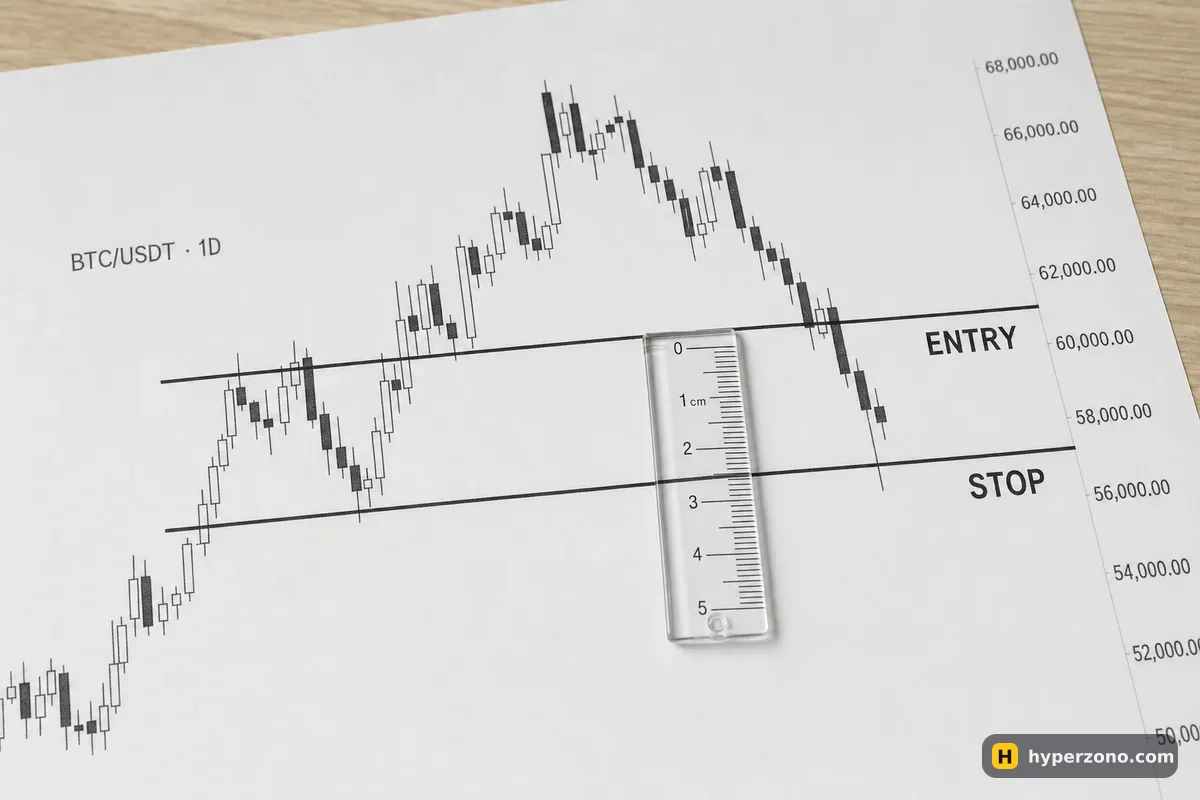
Here is the catch with high leverage. The rough guide is that a move of about 1/leverage against you wipes out the margin behind the position: roughly 20% at 5x, 10% at 10x, 5% at 20x. Your stop needs to sit comfortably inside that distance, with spare room left over, because liquidation is calculated on the mark price, which can briefly differ from the last traded price, and fees eat into your margin too.
A simple habit that works: pick leverage so your stop distance is no more than about a quarter of the distance to liquidation. A 2% stop at 5x clears that easily. At 20x it does not — your stop and your liquidation price end up almost on top of each other.
Normally your stop fires first, but in a fast move the price can jump straight past it, and at 20x there is almost nothing left between the two. At 5x the same bad fill costs you a little extra, not the whole margin. The easiest way to see this on your own numbers is to sign up on Bybit, open the order window and watch the estimated liquidation price change as you drag the slider.
Isolated or cross: the setting changes what the number means
On isolated margin you choose the leverage for that one position, and only the margin you allocated to it is at risk — the rest of your balance is not pulled in, unless you turned on the setting that lets the exchange top up that position automatically from your balance. Leave that one off while you are learning. On cross margin your whole free balance stands behind the trade, so liquidation sits much further away, but a single bad position can reach into every coin you hold in that account.
For your first trades, isolated is the sane choice: you can see exactly how much is on the table, and the worst case is a number you chose yourself. There is a fuller comparison on cross margin vs isolated margin if you want the details.
Moving the slider up does not make the trade better. Raising leverage does not improve a trade. It just lets you open a bigger one with the same money, and makes the bigger one feel affordable. If you move the slider up, keep your position size exactly where it was.
When higher leverage is acceptable, and when it never is
Higher leverage is defensible when your position is genuinely small compared to your account, your stop is already placed, you are on isolated margin, and the extra leverage exists only to meet a minimum. That last case is real: on Binance the smallest bitcoin position is 0.001 BTC, which at a price around 83,500 USDT is roughly 83.5 USDT of position value — with 25 USDT of margin such a position can be opened from 5x. That is leverage as a technical necessity, not as a bet. If your account is tiny, trading with 10 dollars covers what is and is not possible there.
There is never a good version of high leverage without a stop-loss, and never a good version of adding margin to a losing position to push liquidation further away. The same goes for raising leverage right after a loss to win the money back, or holding a 20x position through a scheduled news event. Those are the situations that empty accounts, and the leverage number is only the accelerator.
Is 10x leverage too much for a beginner?
For a first trade, yes — not because 10x is evil, but because it leaves only about 10% of room before liquidation, and beginners tend to place stops that are closer than that while sizing the position too big. Get a few trades behind you at 2x–5x first, with the stop actually hitting a couple of times, then decide.
What is the safest leverage for a first futures trade?
2x. Your position is twice the deposit the exchange holds, a normal daily swing in bitcoin cannot come near liquidation, and your loss is whatever you set your stop to. The trade will feel slow, which is exactly the point while you are learning.
Does higher leverage mean more profit?
Only if you also make the position bigger — and then the loss grows by exactly the same amount. On the same position size, 5x and 20x give you the identical result in dollars; the only difference is how much margin is tied up and how close you are to being closed out.
Can I trade futures at 1x?
On most exchanges yes, and it behaves a lot like buying on spot, except you can still go short and you still pay funding on a perpetual contract. It is a reasonable way to learn the terminal — see futures without leverage.
Should I change leverage while a trade is open?
Better not. Changing it mid-trade moves your liquidation price and is usually an emotional reaction to a position going the wrong way. Decide the leverage before you enter, along with your stop, and leave both alone.
Does leverage change the fees I pay?
No. Fees are charged on the size of the position on entry and on exit, so a 200 USDT position costs the same whether you opened it at 3x or 25x. Only your held margin and your liquidation price change.