Contents
How to read the change logA new pair appeared: how to size the first tradeA pair stops trading: what happens to an open positionLeverage cap or funding interval changed: what it does to your marginA routine that makes these changes boring
How to read the change log
The table below is refreshed every hour from the venue's public data. It records four kinds of event: a pair that started trading, a pair that stopped, a change in the maximum leverage shown on the pair, and a change in the funding interval. Read it by date first — anything older than your trade is history, anything dated after you opened is a change you are living with.
Say you opened 500 USDT on gold at 5x, so 100 USDT of your own money is held as margin. A brand-new pair appearing somewhere else in the list changes nothing for that trade; it just adds something to the menu. The other three events reach your money in different ways. A pair you hold stopping trading is the one that asks you to act, because the position cannot stay open in a contract that no longer trades. A lower leverage cap bites if your own leverage sits close to the old maximum — at 5x on a pair capped at 20x you have plenty of room. A funding-interval change decides how often you pay, not how much each payment is, and the payment is worked out on the 500 USDT position and comes out of your balance.
| Date | Pair | What happened | Leverage |
|---|---|---|---|
| 23 Oct 2026 | SOLUSDC | new pair | 50x |
| 23 Oct 2026 | IOSTUSDT | new pair | 10x |
| 23 Oct 2026 | ETHUSDC | new pair | 50x |
| 23 Oct 2026 | BTCUSDC | new pair | 50x |
| 21 Oct 2026 | PREDICTUSDT | new pair | 5x |
| 21 Oct 2026 | AXISUSDT | new pair | 5x |
| 19 Oct 2026 | OPENAIUSD1 | new pair | 20x |
| 19 Oct 2026 | ANTHROPICUSD1 | new pair | 10x |
| 16 Oct 2026 | DNAUSDT | new pair | 5x |
| 15 Oct 2026 | WALUSDT | new pair | 10x |
| 13 Oct 2026 | NVDAUSD1 | new pair | 20x |
| 13 Oct 2026 | KORUUSD1 | new pair | 20x |
| 13 Oct 2026 | CRCLUSD1 | new pair | 20x |
| 12 Oct 2026 | XAGUSD1 | new pair | 100x |
| 12 Oct 2026 | WUSDT | new pair | 10x |
| 12 Oct 2026 | SQQQUSD1 | new pair | 20x |
| 12 Oct 2026 | SOXLUSD1 | new pair | 50x |
| 12 Oct 2026 | RSRUSDT | new pair | 5x |
| 12 Oct 2026 | QQQUSD1 | new pair | 20x |
| 12 Oct 2026 | BZUSD1 | new pair | 50x |
| 11 Oct 2026 | BATUSDT | new pair | 10x |
| 9 Oct 2026 | PEARLUSDT | new pair | 5x |
| 7 Oct 2026 | RLCUSDT | new pair | 5x |
| 6 Oct 2026 | SDEVUSD1 | new pair | 5x |
| 3 Oct 2026 | PODUSDT | new pair | 5x |
| 3 Oct 2026 | NULLMASKUSDT | new pair | 5x |
| 2 Oct 2026 | SCRUSDT | new pair | 5x |
| 1 Oct 2026 | ACNUSD1 | new pair | 20x |
| 30 Sept 2026 | SIUSDT | new pair | 5x |
| 30 Sept 2026 | CTUSDT | new pair | 10x |
| 28 Sept 2026 | XDPUSDT | new pair | 5x |
| 27 Sept 2026 | QNTUSDT | new pair | 50x |
| 26 Sept 2026 | PAIDUSDT | new pair | 5x |
| 24 Sept 2026 | METAUSD1 | new pair | 20x |
| 23 Sept 2026 | OURAUSD1 | new pair | 20x |
| 22 Sept 2026 | MOONSHOTUSD1 | new pair | 20x |
| 21 Sept 2026 | VERONAUSDT | new pair | 3x |
| 21 Sept 2026 | POLYMARKETUSD1 | new pair | 5x |
| 20 Sept 2026 | GSTOCKUSDT | new pair | 5x |
| 19 Sept 2026 | FUSDT | new pair | 5x |
| 19 Sept 2026 | DRVUSDT | new pair | 5x |
| 18 Sept 2026 | ONEUSDT | new pair | 5x |
| 18 Sept 2026 | BNCUSD1 | new pair | 10x |
| 18 Sept 2026 | AVAUSDT | new pair | 5x |
| 18 Sept 2026 | APMUSDT | new pair | 5x |
| 16 Sept 2026 | ARGUSUSDT | new pair | 5x |
| 15 Sept 2026 | MTLUSDT | new pair | 5x |
| 13 Sept 2026 | POWRUSDT | new pair | 5x |
| 13 Sept 2026 | LSKUSDT | new pair | 5x |
| 12 Sept 2026 | ZZZUSDT | new pair | 5x |
| 9 Sept 2026 | LAPTOPUSDT | new pair | 5x |
| 8 Sept 2026 | MAXUSDT | new pair | 3x |
| 8 Sept 2026 | 4STOCKUSDT | new pair | 5x |
| 7 Sept 2026 | STONKUSDT | new pair | 10x |
| 7 Sept 2026 | BREWUSDT | new pair | 3x |
| 7 Sept 2026 | BONERUSDT | new pair | 5x |
| 6 Sept 2026 | 哈基米USDT | new pair | 10x |
| 6 Sept 2026 | ZCATUSDT | new pair | 5x |
| 6 Sept 2026 | PAIRUSDT | new pair | 5x |
| 5 Sept 2026 | STONKSUSDT | new pair | 3x |
| 5 Sept 2026 | SHROOMUSDT | new pair | 5x |
| 4 Sept 2026 | MEMEUSDT | new pair | 5x |
| 3 Sept 2026 | FLORKUSDT | new pair | 5x |
| 2 Sept 2026 | GPROUSD1 | new pair | 20x |
| 1 Sept 2026 | AIW3USDT | new pair | 5x |
| 31 Aug 2026 | AIUSDT | new pair | 10x |
| 30 Aug 2026 | MUUSD1 | new pair | 20x |
| 30 Aug 2026 | DELTAUSDT | new pair | 5x |
| 28 Aug 2026 | FONEUSDT | new pair | 5x |
Updated 24 Oct 2026, 12:12 UTC from Binance Wallet Perpetuals tab (Aster order book).
If you want the current state rather than the changes — every pair, its leverage and its 24-hour volume — that lives in the live table of Binance Wallet markets. That table shows how things are right now; this page shows what changed and when.
A new pair appeared: how to size the first trade
New pairs arrive in groups you can see as tabs in the Perps list — Gainers, Pre-launch, Stock, Commodities, AI, Meme. Each one carries a max-leverage badge, and the badge is per pair, not per company. SPCXUSD1 shows 20x while SPCXUSDT shows 50x; PREDICTUSDT shows 5x and ANTHROPICUSDT 10x. Two pairs on the same underlying can also differ a lot in daily volume, so when you pick between a USDT and a USD1 version, open both and compare the 24-hour figure.
In its first days a new pair has fewer buyers and sellers, so the price jumps around more. Judge it by its own 24-hour volume rather than by its age — on 21 October 2026 the gold pair XAUUSD1 turned over roughly $330M in a day while SpaceX in USD1 did about $34M, and both are perfectly tradable at the size a beginner uses. The honest first step is a small position with a stop, not a conviction trade.
Here is what a careful first entry looks like in numbers. You open 500 USDT of a stock or commodity pair at 5x, so 100 USDT of your own money is set aside as margin. On stock and commodity pairs the taker fee is 0.0125%, so entry on 500 USDT costs about 6 cents and the round trip about 13 cents; on a crypto pair the taker fee is 0.04%, which makes the same round trip about 40 cents. Fees like these are small change. The price moving against you is not — that is what a stop-loss is for, and you set it in the same order ticket, not later.
A leverage cap is a ceiling, not a target. A pair showing 50x does not suggest 50x. The badge tells you the most the venue will allow on that pair; it says nothing about what is sensible for your 100 USDT of margin. If a cap is later reduced, a trader sitting at 5x has little to worry about, while a trader sitting at the old maximum has to check their position straight away.
A pair stops trading: what happens to an open position
This is the change that matters most while you hold something, so let's be straight about it. Venues that list hundreds of perpetual contracts add and remove them over time — that is normal across the whole industry, and the Perpetuals tab is no exception. A pair you can trade today is not guaranteed to still be there in six months, and a position in it will not simply sit there forever: at some point it gets closed or settled under the venue's rules rather than at a price you chose.
The one published rule that is worth knowing covers pre-IPO contracts: if a company's IPO is postponed or cancelled, Binance says it gives advance notice and settles the contracts through a transparent process. For other pairs we have not found a published rule about notice periods, so check the announcements in the app and treat "this pair could stop trading" as a risk you size for. In practice that means a stop-loss on every position, no large margin parked in a pair you do not check, and closing yourself as soon as you see a removal date.
It also helps to know that a contract changing is not the same as a contract closing. Binance launched the SPCXUSDT pre-IPO perpetual on 21 May 2026; SpaceX listed on Nasdaq on 12 June 2026 at $135 a share, and Binance moved the contract to a standard stock perpetual. Trading carried on without a break and the contract was not closed. The log entry for that day reads like a big change, but nobody holding a position had to do anything — which is exactly why it is worth reading what a log entry actually says before reacting. For how the pre-IPO group works in general, see the page on pre-IPO perpetuals in Binance Wallet; pre-launch token pairs are covered separately in pre-launch token perpetuals.
Leverage cap or funding interval changed: what it does to your margin
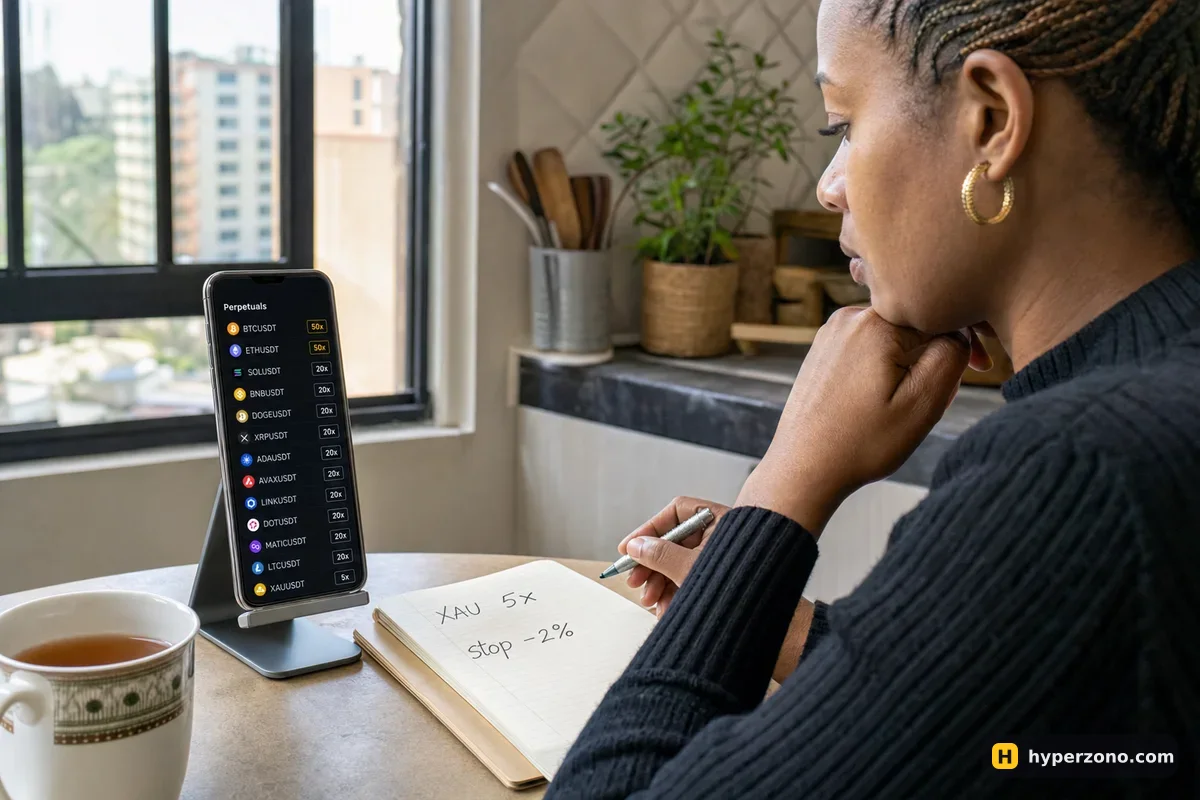
When a venue lowers the maximum leverage on a pair, it is usually a risk decision about that market, not a message about your trade. If the cap on your pair is lowered, don't guess what happens to your open trade — open the position details in the app and look at your margin and liquidation price right then. A lower cap definitely affects the next trade you open, and it hurts most if you were sitting near the old maximum; if that is you, the two practical moves are to add margin or reduce the size.
Funding is the other change you will see in the log. On these pairs funding is paid every 8, 4 or 1 hours depending on the contract: when the rate is positive, longs pay shorts, and when it is negative the shorts pay. The payment itself is the position size multiplied by the rate at that moment, and only someone holding at that moment pays or receives. Shortening the interval does not make each payment bigger — it makes them more frequent.
One funding payment on a 500.00 USDT position. Traders pay each other, not the exchange. Each contract has its own rate and interval.
If the rate per payment stayed the same, a 4-hour contract would cost a multi-day hold about twice as much as an 8-hour one. In practice the rate shown per payment is usually smaller on a shorter interval, so don't compare the percentages directly — here is how to compare them properly. The general mechanics are in what funding is.
A routine that makes these changes boring
Check the pair before you open it
Open the pair in the Perps tab and read three things: the max-leverage badge, the 24-hour volume, and the funding interval shown on the contract. Write them down. That is your "before" snapshot.
Open small, with a stop already set
500 USDT of position at 5x means 100 USDT of margin. Set the stop in the same order ticket, not later. The step-by-step version is in how to open a trade in the Perpetuals tab.
Keep leverage far from the cap
Trading at a quarter of the allowed maximum means a tightened cap or a wider price swing is an inconvenience, not an emergency.
Glance at the log, not at the chart
Once a day is enough for a position you plan to hold. If the log shows a change on your pair, open the position details in the app and compare them with your snapshot.
Close rather than hope
If a pair you hold shows up as removed or scheduled to stop, close the position yourself at a price you can see, instead of waiting to find out how it would otherwise be settled.
None of this needs a separate app or account: futures trade right inside Binance Wallet, with your own wallet and balance, and execution comes from Binance's partner Aster. If you have not set the wallet up yet, start with creating and backing up Binance Wallet — and if you already have, the fastest way to see what a change log entry looks like in real life is to open the pair in the Perpetuals tab and compare its badge with what the table above says it used to be.
One availability note: Aster's terms exclude residents of, and people located in, Russia, Ukraine, the USA, Canada, the United Kingdom, China, North Korea, Cuba, Iran, Venezuela and Syria, so check that the tab opens for you where you live before you plan anything around it. The broader risk picture — custody, liquidation, who answers trade questions — is on risks of futures in Binance Wallet.
Where do new pairs come from?
They simply appear in the Perps tab of Binance Wallet, each with its own leverage badge and its own 24-hour volume. Execution and liquidity come from Binance's partner Aster, but you trade everything from your own wallet inside the Binance app — no separate account, website or extra app is needed.
Will my position be closed if a pair is delisted while I hold it?
A position cannot keep running in a contract that stops trading, so yes — at some point it is closed or settled under the venue's rules. For pre-IPO contracts Binance has said that a postponed or cancelled IPO means advance notice and settlement through a transparent process; for other pairs we have not found a published rule about notice periods, so watch the announcements in the app. The safe habit is to close the position yourself at a price you can see as soon as you learn the pair is going away.
Can the maximum leverage change while my trade is open?
Caps are per pair and can change. Open your position details and check margin and liquidation price; if you were trading near the old maximum, add margin or cut the size.
Why does the same company show two pairs with different leverage?
Some assets are listed both in USDT and in USD1, and each pair has its own badge and its own daily volume — SPCXUSD1 shows 20x while SPCXUSDT shows 50x. Compare the 24-hour volume of both in the live markets table and trade the one with more activity.
Does a funding interval change make holding more expensive?
Each payment stays the same size; you simply make them more often. Whether a day of holding costs more depends on the rate at each payment, and on a shorter interval that rate is usually smaller, so add up the cost over a full day instead of comparing the percentages side by side.
Where do I see the current full list of pairs?
In the Perps tab of the app, or in our live table of every Binance Wallet pair, which shows the leverage and volume of each one and is refreshed from the venue's data. This page only records what changed and what the change means for you.