Contents
Binance vs OKX in one tableFees on the same trade: 2,500 USDT in and outFunding on the same coin: where the real gap appearsAccount, deposits and accessChoose Binance if…, choose OKX if…
Binance vs OKX in one table
Below is what each exchange charges and allows on the same trade: 500 USDT of your own money at 5x, which is a position of 2,500 USDT. Two fee numbers are shown everywhere. You pay the taker fee when your order fills straight away at the current price, and the lower maker fee when your order waits in the queue until someone trades against it. Read the fee row first, then the funding row — on a trade you hold for days the funding row matters more than the fee.
| What you pay or get | Binance Futures | OKX perpetual swaps |
|---|---|---|
| Base maker / taker fee | 0.02% / 0.05% | 0.02% / 0.05% |
| Discount at the base level | Pay fees in BNB: 0.018% / 0.045% | Your own rate and any discounts show up in the app after verification; some new listings have their own fee schedule |
| Funding interval | Usually every 8 hours; some contracts every 4 hours | Check the interval on the contract page in the app |
| Leverage | Up to 150x on BTC and ETH for small positions; above 20x is locked for the first 30 days of a futures account | No single published maximum — check the contract page; in Australia retail clients get up to 2:1 through the local entity |
| Where futures are not offered | USA, Canada, Netherlands and other prohibited countries; derivatives unavailable in the UK, Brazil, Australia, South Korea, New Zealand, Hong Kong | Restricted countries include Canada, Hong Kong, India, Japan, Malaysia, Nepal, Uzbekistan; derivatives restricted in the UK, Brazil, South Korea |
Fees on the same trade: 2,500 USDT in and out
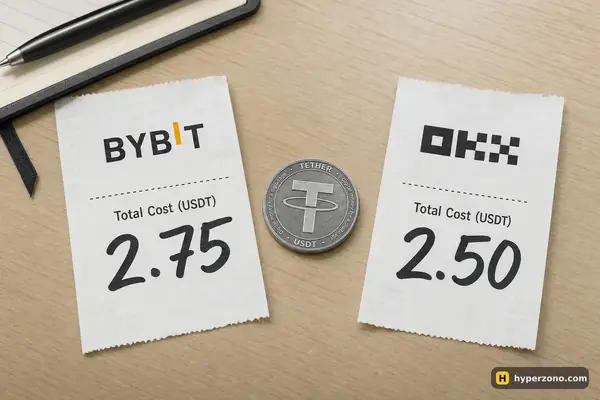
The fee is charged on the whole 2,500 USDT position, separately when you open and when you close — not on the 500 USDT you put up. A market order in and a market order out at 0.05% means 1.25 USDT each way, 2.50 USDT round trip, the same on Binance and on OKX.
| Where | Maker | Taker | How to pay less | A 2,500 USDT trade: market in and out | Limit in, market out |
|---|---|---|---|---|---|
| Binance Futures | 0.02% | 0.05% | pay fees in BNB: 0.018% / 0.045% | 2.50 USDT | 1.75 USDT |
| Bybit | 0.02% | 0.055% | — | 2.75 USDT | 1.88 USDT |
| OKX | 0.02% | 0.05% | — | 2.50 USDT | 1.75 USDT |
| Hyperliquid | 0.015% | 0.045% | up to 40% off for staking HYPE: 0.009% / 0.027% | 2.25 USDT | 1.50 USDT |
| Binance Wallet / Aster | 0% | 0.04% | — | 2.00 USDT | 1.00 USDT |
Base level for a new account. 2,500 USDT is 500 USDT at 5x leverage; the fee is charged on the position size, not on your 500. Taker is the rate when an order fills at once, maker when a limit order waits in the book.
fees checked 24 Oct 2026 on the exchanges’ fee pages, Binance Futures, Bybit, OKX, Hyperliquid, Binance Wallet / Aster.
Two things can move that number. If both your orders wait in the book and fill at the maker rate of 0.02%, the round trip drops to 1.00 USDT. And on Binance, switching on fee payment in BNB takes the taker rate to 0.045%, so the same trade costs 2.25 USDT instead of 2.50 — a saving of a quarter of a dollar, which only adds up if you trade often. To run the arithmetic on your own numbers, use the fee calculator, and the wider picture is in which exchanges have the lowest fees.
Funding on the same coin: where the real gap appears
A perpetual contract has no expiry, so every few hours longs and shorts pay each other a small amount called funding. The exchange does not keep that money, but it still leaves your balance when the rate is against you — and you receive it when the rate is in your favour. This is the line where the two venues stop looking identical.
| Coin | Binance Futures | Binance Wallet | Bybit | OKX | Hyperliquid |
|---|---|---|---|---|---|
| BTC | 2.91 USDT | 4.23 USDT | 2.91 USDT | 3.48 USDT | 6.85 USDT |
| ETH | 3.17 USDT | 5.11 USDT | 2.85 USDT | 3.13 USDT | 6.73 USDT |
| XRP | 2.48 USDT | 4.48 USDT | 2.61 USDT | 3.54 USDT | 7.42 USDT |
| BNB | 1.59 USDT | 1.26 USDT | −0.06 USDT | 4.53 USDT | 5.96 USDT |
| SOL | 2.63 USDT | 3.21 USDT | 1.94 USDT | 2.93 USDT | 5.70 USDT |
| HYPE | 3.54 USDT | 3.92 USDT | 1.14 USDT | 3.74 USDT | 6.88 USDT |
| DOGE | 4.10 USDT | 4.26 USDT | 2.84 USDT | 5.58 USDT | 8.64 USDT |
| ENA | 6.42 USDT | 8.01 USDT | 4.71 USDT | 5.11 USDT | 9.18 USDT |
What a 1,000 USDT long paid over the last 30 days on each venue (minus means it received). The coin name opens its page with month-by-month history.
Updated 25 Oct 2026, 01:20 UTC from the exchanges’ public APIs.
The funding column in the table above shows what each exchange has been charging on the coin you want. Read it for your own position size, because the cheaper venue changes from coin to coin and from month to month, and a rate that is positive this week can turn negative the next. If you already know which coin you will trade, the per-coin pages go deeper — for example BTC funding across exchanges.
To feel the size of it, take the most common rate on Binance's BTC perpetual: 0.01% per 8 hours, which is 0.03% a day. On our 2,500 USDT position that is about 0.75 USDT a day. Hold it for three or four days and the funding has already cost you more than opening and closing the trade. Smaller coins often run well above that, and the rate can stay high for days — Binance caps a single BTC or ETH settlement at 0.30%, but a cap does not stop a run of expensive payments.
Holding costs more than opening. The 2.50 USDT round trip is paid once. Funding is paid again and again for as long as the position is open, on the full 2,500 USDT. If you plan to hold for days rather than minutes, compare the funding numbers before you compare the fees.
Account, deposits and access
On Binance you open futures inside your existing account: you pick an experience level, sign the agreement and verify your identity, then move USDT from the spot wallet to the futures wallet as an internal transfer. The experience level sets your starting leverage — Beginner 2x, Experienced 5x, Advanced 20x — and leverage above 20x is unavailable for the first 30 days of a futures account. The smallest bitcoin position is 0.001 BTC, so with 25 USDT of margin you can open it from 5x. The quickest way to see all of this is to open a Binance Futures account and look at the order window before you deposit anything.
OKX looks much the same from the outside: an account, identity check, then a futures balance you top up yourself. What's different is its country rules. Its compliance disclosure lists Canada, Hong Kong, India, Japan, Malaysia, Nepal and Uzbekistan among restricted places, and names the UK, Brazil and South Korea as restricted for derivatives specifically. Australia and the UAE are served by separate local entities with their own tests and limits. If you are in Australia or the UAE, the only way to see your real terms is to start the sign-up on OKX — the local entity will show you its own test and its own leverage cap. If your country is on the restricted list, assume futures are not on offer and do not try to get around it. Binance has its own gaps: no derivatives for users in the UK, Brazil, Australia, South Korea, New Zealand or Hong Kong, and a prohibited-country list that includes the USA, Canada and the Netherlands.
Neither list is exhaustive and both change, so treat them as a reason to check rather than a final answer. The test that counts is whether the futures section actually opens for your country during sign-up — more on how to do that in which futures exchanges are available in my country. Funding your account by card, bank transfer or P2P follows the same rule: the methods that appear in the app are the ones you really have.
Choose Binance if…, choose OKX if…
- Choose Binance if you want to pay fees in BNB (0.018% / 0.045%), if the coin you plan to hold has had the friendlier funding there in the table above, or if you want the beginner setup that starts you at 2x and keeps leverage under 20x for the first month.
- Choose OKX if its app and layout simply suit you better, if the funding on your coin has been friendlier there, or if your country is served by one of its local entities and not by Binance's global futures.
- Choose neither yet if you have not tried a demo account. The fee difference between these two is a quarter of a dollar on our example trade — the difference between a planned trade and an unplanned one is your whole 500 USDT.
If Bybit is also on your shortlist, we compare it with Binance in Binance or Bybit for your first futures trades, and the OKX side of that pair is covered in Bybit or OKX. If you were weighing a wallet-based venue instead of an exchange account, that is a different trade-off and we walk through it in Binance Futures or Hyperliquid.
Is Binance or OKX cheaper for futures?
At the base level the trading fee is identical: 0.05% when your order fills at the current price, 0.02% when it waits in the queue, as of 2026-10-24. That is 2.50 USDT to open and close a 2,500 USDT position on either. Binance can go slightly lower if you pay fees in BNB, at 0.045%. Over a longer hold the funding payments decide it, and those swing by coin and by month — compare them in the live table above.
Binance vs OKX vs Bybit — which one should a beginner pick?
All three charge roughly the same at the base level; Bybit takes 0.055% when your order fills immediately, a touch more than the 0.05% at Binance and OKX. For most beginners the deciding factors are whether futures are available in your country, whether the app makes sense to you, and how funding looks on the coin you plan to trade. Our Binance-versus-Bybit and Bybit-versus-OKX pages go through each pair in detail.
Can I keep accounts on both Binance and OKX?
Yes, nothing stops you, as long as both serve your country and you pass verification on each. In practice one account is enough to start — splitting a small balance across two venues just means two sets of minimums and two sets of records to keep for tax.
Does OKX offer futures in India?
OKX's own compliance disclosure lists India among its restricted jurisdictions, so you should assume futures are not offered there. Rules and exchange policies change, so check inside the app during sign-up and read our India page before depositing anything.
Which has higher leverage, Binance or OKX?
Binance publishes up to 150x on BTC and ETH for small positions, with anything above 20x locked for the first 30 days of a futures account. OKX does not publish a single global maximum, and in some countries its local entity caps retail leverage far lower — up to 2:1 in Australia. Check the contract page for the exact number on your market, and remember that high leverage mainly shortens the distance to liquidation.
How often is funding charged on each exchange?
On Binance the default is every 8 hours, with some contracts settling every 4 hours, so the same position can be charged more times a day depending on the market you pick. For OKX, open the contract page in the app and look at the funding interval and the countdown to the next payment before you hold a position overnight.
Sources and fact-check
Exchange terms were checked against official documents on October 24, 2026. Terms change — before you trade, check what matters to you in the exchange app and in your contract’s specs.
Binance: USDⓈ-M Futures Trading Fee RateOKX: What is OKX Perpetual Futures: Fees, Trading, Features