Contents
Three layers behind the ticker xyz:TSLAWho decides what: Hyperliquid or trade.xyzWhat a team has to put up to run these marketsWhat trades there, and how busy those markets areWhat you actually pay on one of these marketsWhat can go wrong on a market someone else runsA checklist before your first trade on one of these markets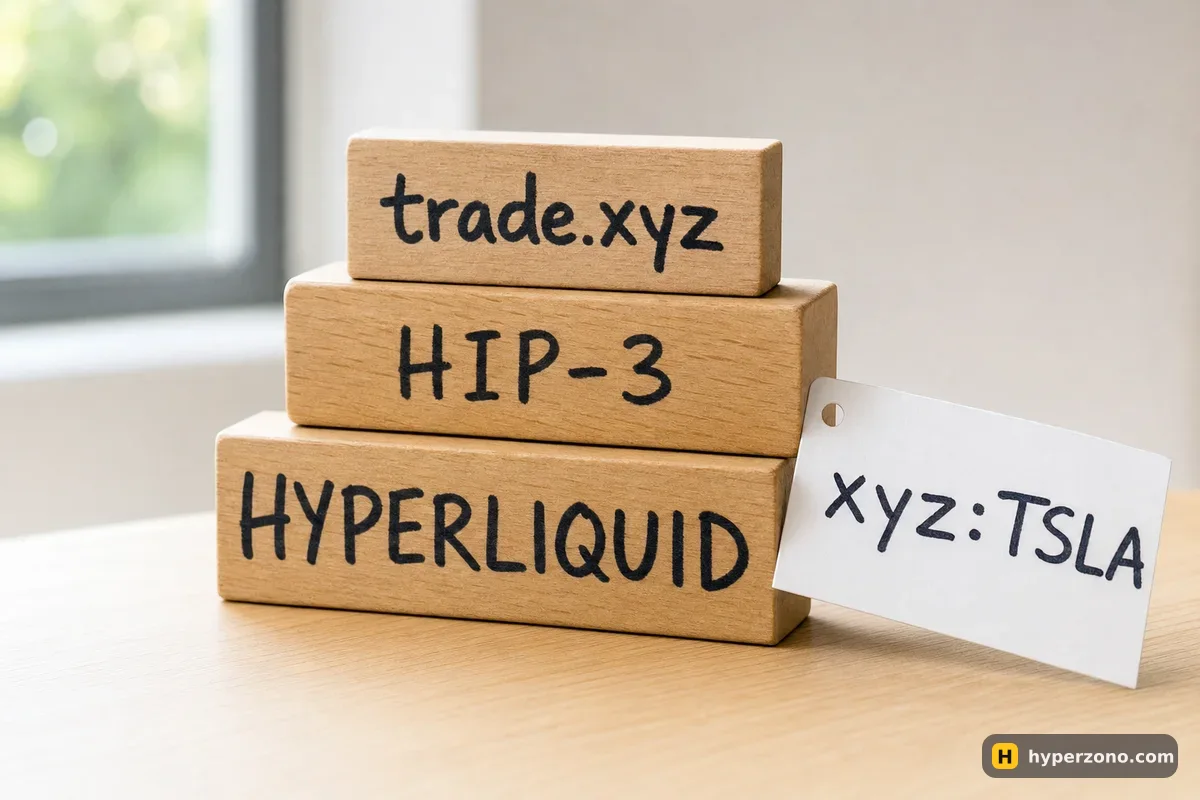
Three layers behind the ticker xyz:TSLA
Underneath everything is Hyperliquid: the chain, the order book, the margin rules. These markets use the same books, the same calculations and the same app as Hyperliquid's crypto contracts, so if you have already placed an order on BTC there, this will feel identical. How the venue works in general is covered in our Hyperliquid guide; this page stays on the part above it.
On top of Hyperliquid sits the HIP-3 standard. It lets an outside team open its own perpetual markets on Hyperliquid, and that team — not Hyperliquid's validators — writes the contract, decides where the price comes from and sets the leverage cap. The price source is the feed that tells the contract what Tesla is worth right now; that feed is called the oracle.
On top of HIP-3 sits trade.xyz, the team that created this particular market and keeps it running. Every ticker that starts with xyz: belongs to them. The screen you click on is just a window into all three layers: it can be app.hyperliquid.xyz, trade.xyz's own interface or another front end, and trade[XYZ] says plainly that its interface does not hold your assets and is not the only way to reach its markets. Change the screen and your position does not move anywhere — it stays on the chain, under your wallet.
Who decides what: Hyperliquid or trade.xyz
The split matters because it tells you where to look when something surprises you. Hyperliquid pairs your order with someone on the other side, holds your money and works out your liquidation price. What the market follows, at what price and with how much leverage — that is trade.xyz.
| The decision | Who makes it |
|---|---|
| Pairing your order with someone, holding your money, working out liquidation | Hyperliquid — the same system as its own crypto perpetuals |
| Which market exists at all, and what it follows | trade.xyz, for every xyz: ticker |
| Where the price comes from (the oracle) | trade.xyz publishes it; the design of that feed is its responsibility |
| Maximum leverage on the market | trade.xyz sets the ceiling |
| Your fee tier and discounts | Hyperliquid: one tier across everything you trade, from your 14-day volume |
| Any extra fee share added on top | trade.xyz, within the limits Hyperliquid allows; the fee shown in your own order window is the number that counts |
| Stopping a market and settling open positions | trade.xyz, at the current mark price |
| Punishing a team that runs its market badly | Hyperliquid's validators, by vote; the locked HYPE is destroyed |
One more practical detail about your money. Each of these market sets lives in its own separate shop on Hyperliquid — the documentation calls that shop a dex, short for decentralized exchange. Every shop picks the coin you put up as money: on trade.xyz's dex that is USDC, the same asset you would deposit for Hyperliquid's crypto perpetuals, and the steps are in our guide to depositing USDC. On a dex run by a different team, check this first, because the answer can be different.
What a team has to put up to run these markets
Any team that wants to run markets like these has to lock 500,000 HYPE and keep it locked for at least 183 days after launch — Hyperliquid says that number may come down over time. Validators can vote to take that money away from a team that runs its markets badly. One thing to know: the stake is destroyed, not paid out to traders who lost out. So it is a reason for the team to behave, not compensation for you.
trade[XYZ] runs two kinds of products: perpetual contracts on stocks, equity indices, commodities, currencies and pre-IPO companies, and a separate events product with fixed settlement rules and no leverage. This page is about the first one.
What trades there, and how busy those markets are
As of 22 October 2026 Hyperliquid's crypto side has 178 markets, while the xyz dex carries 99 stocks, 7 indices and funds, and 9 commodities. The bigger ones move real money in a day: SpaceX about $343M, SK Hynix about $331M, Meta about $212M, Nvidia about $120M, Tesla about $117M. Among indices, XYZ100 is around $271M and the S&P 500 market around $241M; among commodities, WTI crude about $244M, Brent about $161M, silver about $138M and gold about $34M.
Leverage ceilings come from trade.xyz and differ by market: most stocks are 10x or 20x (Tesla, Nvidia and SpaceX at 20x), gold 25x, WTI oil 20x, and the S&P 500 market up to 50x. Those are limits, not suggestions. Current caps, hourly funding rates and volumes for every market sit in our live Hyperliquid market table, and if you plan anything bigger than a test size it is worth reading about price impact on a DEX first.
What you actually pay on one of these markets
The base fee on Hyperliquid is 0.045% of the trade size if you take a price already sitting in the order book, and 0.015% if you place an order and wait for someone to come to you. One fee tier covers everything you trade there, based on your volume over the past 14 days, and staking HYPE lowers it — from 5% off for a small stake up to 40% for a very large one. Hyperliquid also lets the team that created the market take a cut on top, and the rules allow a lot: your real fee on an xyz market can be several times the 0.045% base rate. How much of that the team adds can change, so the number that counts is the fee shown in your own order window — read it before you confirm.
In money, using the base rate — treat these numbers as a floor, not a quote. Say you have 200 USDC on the dex and open a 200 USDC position on a stock at 2x. That sets aside 100 USDC as your deposit and leaves 100 USDC free as a buffer. The entry costs about 0.09 USDC and the exit about the same, and every hour the contract settles funding — depending on which side the market is leaning, that small amount either leaves your balance or arrives in it. If the stock then drops 3% and you close, you are down about 6 USDC on the move plus roughly 0.18 in fees.
What can go wrong on a market someone else runs
The first thing is the price feed. Hyperliquid's own documentation notes that most published price indexes are not suitable as a perpetual's price source, which is exactly why the oracle described in the market specification is worth reading rather than skipping. If you want the longer version, see where a DEX gets the price of a stock or gold.
The second is settlement. trade.xyz can halt one of its markets: all orders are cancelled and open positions are settled at the current mark price, the fair price the contract marks against rather than the last trade. Your money does not disappear, but the trade can end at a moment you did not choose and at a price that is not your target.
The third is a backup system every dex has for extreme moments: it can close a winning position of yours to pay for someone else's loss. That is called auto-deleveraging, and we explain how it works and what it looks like on your screen in why a position gets closed by ADL.
Keep this first trade on its own. If you let one pot of money back positions on markets run by different teams, a problem on one of them can pull on the others — that is cross margin, and Hyperliquid's own documentation says it carries more risk there. For a first trade, keep one position, on one market, with its own margin and a stop set at the same time.
Trading hours, and what happens when the underlying stock exchange is closed, are set in each market's own specification, so look them up for the exact ticker instead of assuming. Hyperliquid also blocks access from certain places and shows a restricted-jurisdiction message without naming countries, so check that you can use it where you live before you move any money.
A checklist before your first trade on one of these markets
Look at the prefix
A ticker like xyz:GOLD tells you this market was created by trade.xyz, not by Hyperliquid's crypto side. Different creator, different rule-setter.
Open the market specification
That is where the price source, the trading hours and the settlement rules live. trade[XYZ] itself tells users to read them before trading.
Check the volume of that exact market
Meta and Nvidia turn over hundreds of millions a day; a quiet market on the same dex may not. Pick the one that actually trades.
Read the fee line in the order window
The base rate is only the starting point on these markets, and the window shows what you will really be charged before you confirm.
Note the leverage ceiling, then stay well below it
A 20x cap is the maximum the screen allows, not a target. Your size should come from the loss you are ready to accept.
Fund the right collateral and open small
On the xyz dex that is USDC. Send a small amount first, confirm it shows up, then open one position with a stop-loss set at the same time as the entry.
Once the layers are clear, the quickest way to make it concrete is to open Hyperliquid, switch to the xyz markets and compare two tickers side by side — one crypto contract and one stock contract — looking at the leverage cap, the hourly funding and the volume. A few minutes of that tells you more than any description.
Is trade.xyz a different exchange from Hyperliquid?
No. trade.xyz creates markets on Hyperliquid through HIP-3, and those markets use Hyperliquid's order books and the same margin rules. trade.xyz also runs its own interface, but it says itself that it does not hold your assets and is not the only way to reach its markets.
What does dex mean here?
It is short for decentralized exchange. On Hyperliquid each team's set of markets lives in its own separate shop with its own collateral asset, and the documentation calls that shop a dex. trade.xyz's dex is the one with the xyz: tickers, and it takes USDC.
Do I own Tesla shares if I hold xyz:TSLA?
No. It is a perpetual contract: your result is the price difference, settled in the dex's collateral asset, and you are not a shareholder. The price it follows comes from the feed trade.xyz publishes, which is why the market specification is worth five minutes.
Why is my fee bigger than the 0.045% I read about?
Because Hyperliquid lets the team that created the market add a share on top of the base rate, and that share can change. The order window shows what you will actually be charged on that market, so check it there rather than assuming the base rate.
Can the team close my position?
It can halt its market, which cancels all orders and settles open positions at the current mark price, and it can start trading again later. That is a documented part of how these markets work, so size your trade knowing it exists.
Do I need HYPE to trade these markets?
No. Staking HYPE only lowers your fees, from a small discount for a small stake up to 40% for a very large one. The 500,000 HYPE lock-up is what a team needs to run its own dex, not what you need to place an order.
Are these markets riskier than Hyperliquid's own crypto contracts?
They add one more party: a team that writes the contract, publishes the price, sets the leverage cap, can take an extra fee share and can halt the market. Validators can punish a team that behaves badly, but the money taken is destroyed rather than paid to traders — so the specification, the fee line, the volume and your own position size are your real protection.
Sources and fact-check
Exchange terms were checked against official documents on October 22, 2026. Terms change — before you trade, check what matters to you in the exchange app and in your contract’s specs.
Hyperliquid Docs: HIP-3: Builder-deployed perpetualsHyperliquid Docs: Feestrade[XYZ] Docs: About trade[XYZ]