
Contents
What kind of exchange Gate isWhich markets you can actually tradeFees, leverage and what the numbers mean for youThe honest part: thin markets on exotic pairsOpening an account, verification and practiceIs Gate available where you live?So is Gate good for a beginner?
What kind of exchange Gate is
Gate is a centralised exchange: you create an account, pass identity checks, deposit money, and the exchange holds it and matches your trades. That is the same model as Binance, Bybit or OKX, so nothing about the basic flow will feel strange if you have seen one of them. You do not need a broker anywhere in this — a crypto exchange account is the whole setup.
Where Gate stands out is coverage. It lists a lot of coins the bigger exchanges have not listed, and that carries over into its futures section — you can see it yourself by scrolling the markets list. If your reason for choosing an exchange is "I want a contract on a coin nobody else lists", Gate is a reasonable answer; if your reason is "I want the calmest place to learn", it is not the obvious first stop.
Which markets you can actually trade
Gate's futures section is built around perpetual contracts on crypto — bitcoin, ethereum and hundreds of smaller coins. Which coins, in what settlement currency and with what minimum size, you read on the contract's own specification page in the app. Perpetuals have no expiry date: you can hold them as long as your margin survives, and you pay or receive funding every few hours depending on which side of the market is crowded.
Crypto exchanges have also been adding contracts on stocks, indices and gold, and these come and go fast. Open the futures markets page, type the ticker you want into the search box, and you will see in a second whether it is there. If trading share tickers is the whole point for you, read how stock futures on crypto exchanges work first, so you know what you are actually buying when you tap long.
One habit is worth building on any exchange: before you trade a contract, tap through to its contract specification. That page gives you the minimum order size, the leverage tiers, the funding schedule and how the contract is settled. To know what normal looks like, Binance's smallest bitcoin position is 0.001 BTC, ether contracts start from about 20 USDT of position size and most altcoins from 5 USDT — numbers in that range are usual, and they decide whether your 20 or 50 USDT is enough to open anything at all.
Fees, leverage and what the numbers mean for you
Fees on futures are charged on the size of your position, not on the money you put up as margin, and you pay them twice — once going in, once coming out. How much you pay depends on the way your order gets filled, and the exchange keeps a list of orders waiting at different prices. If your order joins that list and waits, you are a maker and pay less; if it takes a price someone is already offering, you are a taker and pay more. A market order is always a taker.
To give you a sense of scale: on Binance's USDT futures the base rates are 0.02% for a maker order and 0.05% for a taker order — on a 500 USDT position that taker rate is about 25 cents each way. Gate has its own levels, so look at the fee page inside your account; if cost is your deciding factor, compare where futures fees are actually lowest before you commit.
Leverage works in tiers on every serious exchange: the big headline number applies only to small positions, and as your position grows the exchange lowers the leverage it allows. That is why the number on the slider matters less than people think. What really decides how your account does is how much of your money you risk on one trade, and whether you set a stop before you enter.
The honest part: thin markets on exotic pairs
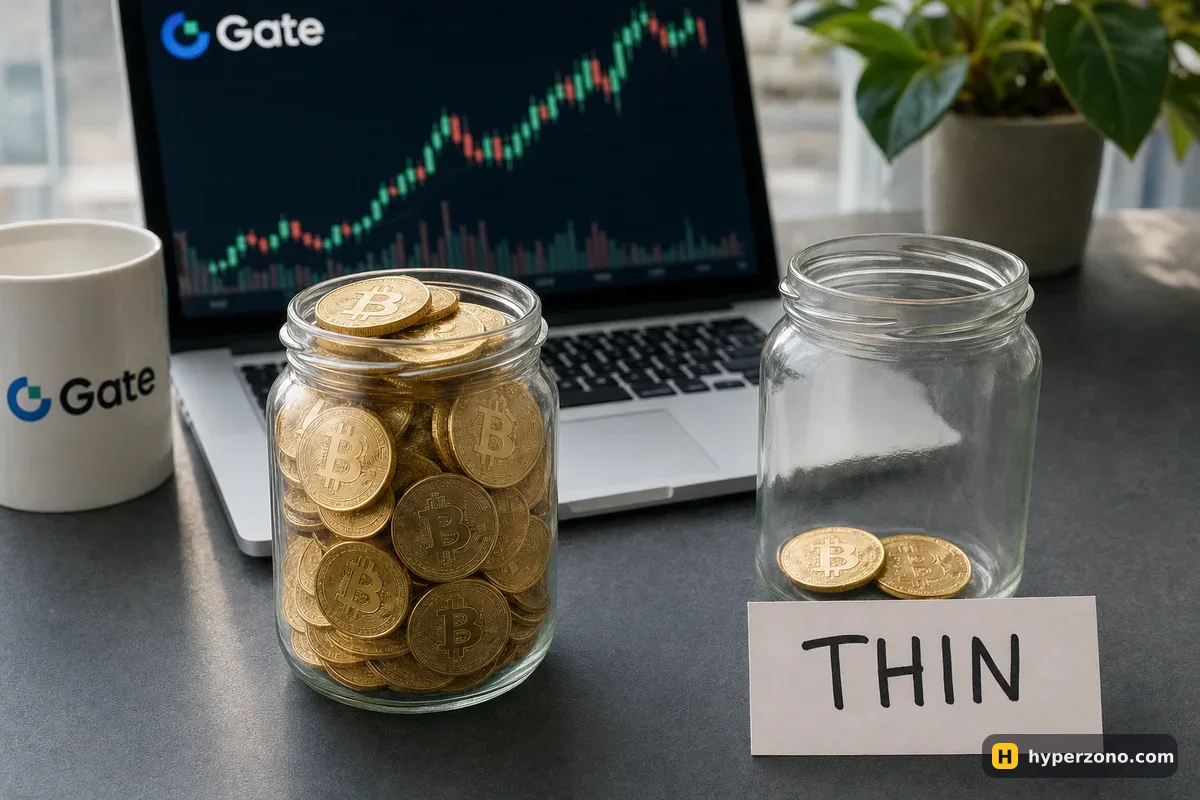
On a busy bitcoin contract there are thousands of orders stacked close together, so a market order fills at almost exactly the price you saw. On a small altcoin perpetual that waiting list can be nearly empty: a handful of orders, with visible gaps between them. Your order then walks through those gaps and fills at an average price noticeably worse than the one on screen. That difference is slippage, and it is the real cost of trading exotic contracts.
| Ask price | Available, BTC | Taken by market order |
|---|---|---|
| 0.421 | 1,500 | 1,500 |
| 0.4216 | 900 | 900 |
| 0.4224 | 2,200 | 1,600 |
| 0.4239 | 600 | — |
Buying 4,000 BTC with a market order. Average fill ≈ 0.42 while the best price was 0.421: the difference is slippage.
The same thinness shows up when things go wrong. A stop-market order triggers at your price but fills at whatever is available, which on a quiet contract can be several percent away. That is not a Gate problem specifically — it is what every low-volume contract does — but an exchange built around small coins is exactly where you will meet it. Starting with the most liquid coins for your first trades removes most of this risk for free.
Small contracts do not always stay listed. If volume dries up, an exchange can announce that a contract is going away — so treat an exotic perpetual as a trade you are watching, not something you open and leave for three months. If you ever see such an announcement, read exactly what it says will happen to open positions.
Opening an account, verification and practice
On any big exchange the path is the same: email or phone, a password, two-factor authentication, then an identity check. Futures access usually waits until that check is done — the sign-up flow will tell you exactly what Gate asks for. Have a document ready, since the same papers work almost everywhere, and why exchanges ask at all is worth two minutes of reading if this is your first account. Turn on two-factor authentication the moment the account exists, not later.
Check your country first
Before you spend time on documents, start the sign-up form from where you live and see whether the exchange accepts you. It usually tells you straight away.
Create and secure the account
Email or phone, a strong unique password, two-factor authentication turned on immediately.
Verify your identity
ID document and a selfie check. Futures access usually waits until this is finished.
Look for a practice mode
If a simulated futures mode appears in the futures menu, spend a week there before real money. Availability varies by exchange — see which exchanges offer demo futures.
Fund small and read one contract spec
Move a small amount to the futures wallet, open the specification of the contract you want, and only then place an order.
The futures screen itself has the usual pieces: chart, order window, leverage selector, long and short buttons, and a language setting — whether your language is in there is something to look at while you sign up; we cover trading in your own language separately. The one thing really worth saying about the interface here is that a contract list this long makes the search box your main tool. Type the ticker instead of scrolling, or you will end up trading whatever happened to catch your eye.
Is Gate available where you live?
This is the part most reviews skip, and for Gate it matters a lot. Gate's User Agreement (the version dated 22 July 2026) names a long list of Restricted Locations, and it includes places where a lot of our readers live: India, Indonesia, Japan, the Philippines, Vietnam, Pakistan, Thailand, South Korea, Malaysia, Singapore, the United Arab Emirates, Argentina, Cambodia, Russia, plus the United Kingdom, Germany, France, Spain, Austria, Malta and the Netherlands, and of course the United States, Canada, mainland China and Hong Kong.
Two caveats come from Gate's own wording. The list "includes but is not limited to" those countries and can change without notice, and a restriction may cover only part of the services rather than everything — so a listed country is not automatically a blanket ban, and an unlisted one is not a guarantee either. The only reliable check is the sign-up flow itself. Our page on which futures exchanges are available in which countries walks through the same question for the other venues.
So is Gate good for a beginner?
It depends on why you are there. If you want the widest possible choice of coins and you already understand stops, position size and what a thin market does to your fills, Gate lists contracts other exchanges simply do not, and you can open a Gate account and go through the list yourself in ten minutes. If this is your first week with futures, all those small coins further down the list are a distraction — a beginner learns faster on one liquid contract, and our comparison of exchanges for beginners explains what to weigh up.
Whatever you pick, the discipline is the same: small size, a stop-loss set before you enter, a contract you can actually get out of, and the margin mode that walls off one trade from the rest of your money — isolated margin. The exchange decides your fees and your menu. Everything that decides whether you keep your money is on your side of the screen.
Is Gate good for beginners?
It can work, but it is not the gentlest starting point. The huge contract list is a temptation to trade coins with almost no volume, and that is where beginners get hurt by bad fills and sudden moves. If you do start here, stick to the biggest two or three contracts for your first month.
What are Gate futures fees?
Rates differ by level and by contract type, so the fee page inside your account is the one to read. The mechanic is the same everywhere: the fee is a percentage of the position size, charged once when you open and once when you close, and it is higher if your order takes a price that is already on offer instead of waiting for its own.
Where can I see the full Gate perpetual contracts list?
In the futures section of the app or website, in the markets list — use the search box and type the ticker rather than scrolling. Each contract has its own specification page with the minimum order size, leverage tiers and funding schedule, and that page is what your trade will actually follow.
Does Gate have a demo futures mode?
Practice modes get added and removed and are not offered in every country, so look in the futures menu of your own account for a simulated or demo switch. If there is none, you can learn the mechanics on another venue's demo — Bybit and Binance both offer one — and then trade here with a very small amount.
Is Gate safe to use?
It is a centralised exchange, which means your money sits with a company rather than in your own wallet — that is true of Binance, Bybit and OKX too. Turn on two-factor authentication, withdraw profits you do not need for trading, and run through the usual checks that an exchange is legitimate before depositing anything substantial.
What happens if a contract I hold gets delisted?
Exchanges announce it ahead of time, and the announcement spells out what will happen to open positions — read it carefully, because the exchange sets those terms. The cleanest move is usually to close the position yourself while the market is still trading normally. That only works if you are watching, which is one more reason not to leave exotic positions open and forgotten.