Contents
Why the smaller number can be the more expensive onePut both rates over the same number of hoursFive steps to compare two exchanges honestlyThe rate will change while you holdWhere to check the schedule on each exchangeWhat to do with the answer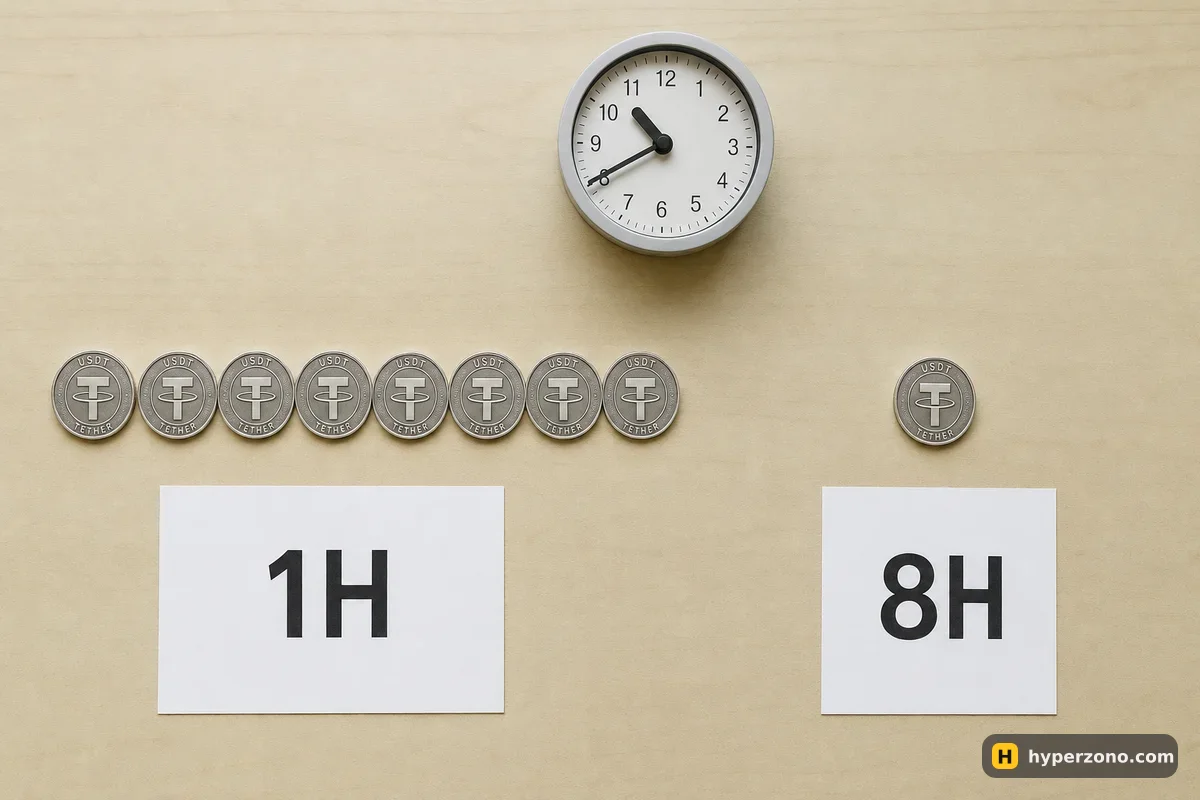
Why the smaller number can be the more expensive one
When you open two tabs and one exchange shows 0.0015% while the other shows 0.009%, your eye picks the small number straight away. But those two figures are not measured over the same stretch of time. The first one may be charged every single hour, the second once every eight hours, and that difference is bigger than the gap between the numbers themselves.
Funding itself is just a payment between the two sides of the contract — longs pay shorts or shorts pay longs, depending on the sign. Hyperliquid states this plainly in its documentation: funding there goes from trader to trader and the exchange collects no fee on the payments. If that whole idea is new to you, read what funding is and when you pay it first; this page is only about putting two different intervals side by side.
The unit on the screen is the first thing to find, before you compare anything. Hyperliquid's own documentation writes the same number two ways: 0.01% every 8 hours, or 0.00125% every hour. Same cost, two labels. See one on one screen and the other on a second screen and you could easily think one place is eight times cheaper.
Put both rates over the same number of hours
Pick a holding time first. Not a theoretical one — the time you really expect to keep the trade open: a few hours, overnight, three days. Then count how many funding payments fall inside that window on each exchange and add them up.
Here is the comparison with illustrative numbers. Say you hold a 2,000 USDT position, you are on the paying side, and exchange A charges 0.0015% every hour while exchange B charges 0.009% every 8 hours. Both of those rates are made up for the example, but the arithmetic is the real thing.
| If you hold for | Exchange A: 0.0015% every hour | Exchange B: 0.009% every 8 hours |
|---|---|---|
| 8 hours | 8 charges = 0.012% = 0.24 USDT | 1 charge = 0.009% = 0.18 USDT |
| 24 hours | 24 charges = 0.036% = 0.72 USDT | 3 charges = 0.027% = 0.54 USDT |
| 3 days (72 hours) | 72 charges = 0.108% = 2.16 USDT | 9 charges = 0.081% = 1.62 USDT |
The shortcut is simple arithmetic: an hourly rate multiplied by 8 gives you the equivalent 8-hour figure. In the example, 0.0015% × 8 = 0.012%, which sits next to 0.009% and immediately looks like what it is — about a third more expensive. You can do the same the other way round by dividing the 8-hour rate by 8 and comparing hourly numbers.
Try your own numbers here. Put in the rate as it appears on the screen, your position size, and then do it a second time with the rate converted to the other interval so the two results are directly comparable.
Five steps to compare two exchanges honestly
Find the unit next to the rate
On the contract page or the funding tab, look for words like "per hour", "8h" or "interval". If you see only a percentage with no period, open the contract specification before you assume anything.
Write down your planned holding time
Two hours, one night, four days. This is the number that makes the whole comparison possible, so decide it before you look at the rates.
Count the payments inside that window
Hourly funding over 24 hours is 24 charges. Eight-hour funding over 24 hours is three charges. Dated futures have no funding at all.
Multiply rate by payments, then by your position size
0.0015% × 24 = 0.036%, and 0.036% of a 2,000 USDT position is 0.72 USDT. Funding is charged on the size of your position, not on the margin you put up.
Check the sign, not just the size
A positive rate means longs pay shorts; a negative one means the opposite. If you plan to be on the receiving side, the same arithmetic tells you roughly what you would collect — if the sign stays where it is.
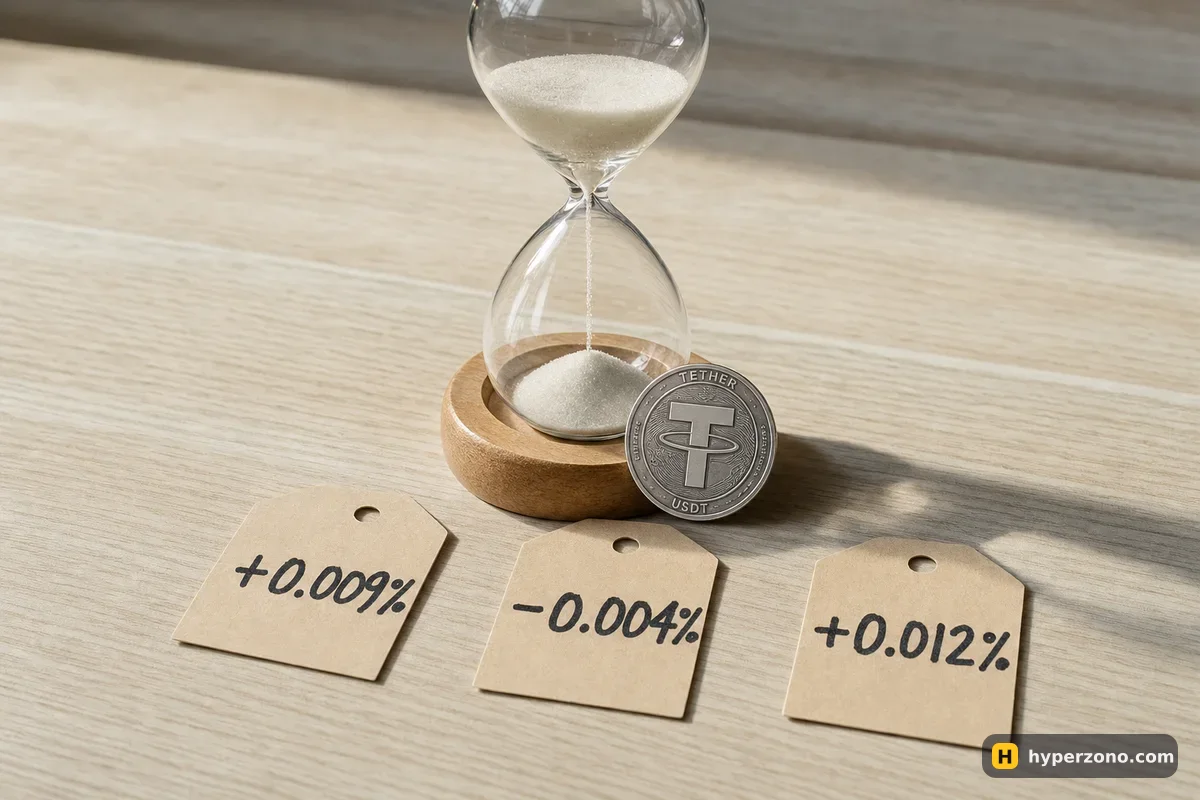
Only the holder at the payment moment pays. Funding is not charged by the minute. If you open and close between two settlements, you pay nothing and receive nothing. That is why an exchange with hourly funding touches quick trades more often, while one with 8-hour funding can leave a trade that lasts half an hour completely untouched — and then hit you with a single bigger charge if you hold through the settlement time.
The rate will change while you hold
The number you see belongs to one period only. On Hyperliquid, the rate is worked out from how far the perpetual price sits away from the spot price its own price feed reports, so it drifts as the market drifts. Stretch today's rate across a week and you have not worked out what the week will cost — you have worked out what it would cost if nothing changed. Nothing stays unchanged for a week.
What the arithmetic does give you is a sense of size. It tells you whether holding costs you small change or real money at your position size, and which of two exchanges is likely to be the cheaper home for your kind of trade. If you want to see how these costs behaved over months rather than minutes, the funding rate history by coin and exchange is a better guide than any single live number.
Both exchanges also put a ceiling on how extreme the rate can get, and that ceiling matters more than it sounds. Hyperliquid caps funding at 4% per hour and says the cap and the interval do not depend on the asset. On Binance, funding runs every 8 hours by default at 00:00, 08:00 and 16:00 UTC, some contracts settle every 4 hours, and if the rate reaches its cap the interval can switch to 1 hour. In other words, the interval you compared this morning is not guaranteed to be the interval you live with during a violent day.
Where to check the schedule on each exchange
Every exchange publishes this, but not always in the same place and not always with the unit spelled out. Open the contract you actually intend to trade — not the general help page — and look at the funding row in the contract details or specification. If Hyperliquid is on your shortlist, it is an on-chain venue you trade from a wallet, so the way you get in differs from the rest.
- Hyperliquid: the docs say funding is paid every hour, with one eighth of the 8-hour rate charged each time. The amount you pay is worked out from your position size times the price Hyperliquid's own price feed shows at that moment, times the rate. Some markets there are set up by outside teams, so check the funding row on the exact market you picked.
- Binance: the FAQ gives 8 hours by default, 4 hours on some contracts, and 1 hour when the rate hits its cap. Check the funding row on the contract page rather than assuming "always 8 hours".
- Bybit: the fees help page covers trading fees, not funding. Open the contract details for the pair you want in the app and read the funding row there.
If a screen gives you a percentage with no period attached, treat the number as unusable until you find the unit. The fastest way to see the unit for yourself is to open a Binance Futures account and read the funding row on the BTCUSDT contract page, then compare it with the same coin on another exchange you are considering. Seeing both screens at once makes the unit problem obvious in a way no article can.
What to do with the answer
If you are in and out within an hour or two, funding is usually a few cents next to what you pay in entry and exit fees, and the interval barely changes anything. For positions you intend to hold for days it moves from background noise to a line in your plan, and the cheaper exchange over your holding time saves you a small but real amount. Fee levels and funding pull in different directions on different exchanges, which is why choosing a beginner-friendly exchange is never a one-number decision.
Run your scenario twice before you commit: once with the holding time you expect, once with a holding time three times longer, because trades usually last longer than you planned, not shorter. If the longer version still looks acceptable, the interval difference is not your problem. If it does not, either pick the cheaper exchange for that trade or plan to be out before the costs pile up.
Is a 1-hour funding rate cheaper than an 8-hour one?
Not by itself. A rate charged every hour is applied eight times in the space of one 8-hour charge, so multiply it by 8 before you compare. In the illustrative example above, 0.0015% hourly works out at 0.012% over eight hours, which is more expensive than 0.009% charged once.
How do I turn an hourly funding rate into a yearly figure?
Multiply by 24 and then by 365 — that is 8,760 hours. An hourly rate of 0.0015% comes to about 13.1% a year at that pace. Treat it as a size check only: the rate changes every period, and nobody holds a position at the same rate for a year.
Do I pay funding if I close the trade before the settlement time?
No. Only a trader holding the position at the moment of settlement pays or receives it. Close ten minutes before and you skip that payment entirely; hold ten minutes past it and you pay the full amount for the period.
Who gets the money I pay in funding?
The traders on the other side of the contract. Hyperliquid's docs say funding there goes from trader to trader and the exchange collects no fee on those payments. When the rate is positive, longs pay shorts; when it is negative, shorts pay longs.
What if the exchange screen shows a percentage with no interval?
Open the contract specification for that exact contract instead of the general help page. The interval belongs to the contract, not to the exchange as a whole — on Binance some contracts settle every 4 hours rather than 8, and the interval can shift to 1 hour when the rate hits its cap.
Does any of this apply to futures with an expiry date?
No. Dated futures have no funding at all — the contract price simply converges towards spot as expiry approaches. If holding cost over several days is your main worry, that is one of the differences between a perpetual and a dated contract worth weighing up.
Sources and fact-check
Exchange terms were checked against official documents on October 21, 2026. Terms change — before you trade, check what matters to you in the exchange app and in your contract’s specs.
Hyperliquid Docs: Funding