
Contents
Nothing is borrowed, nothing lands in your balanceWhat the leverage slider really changesThe same 100 USDT at 1x, 5x and 20xLeverage pulls your liquidation price closerWhy the exchange caps leverage on bigger positionsSee it in the order window yourself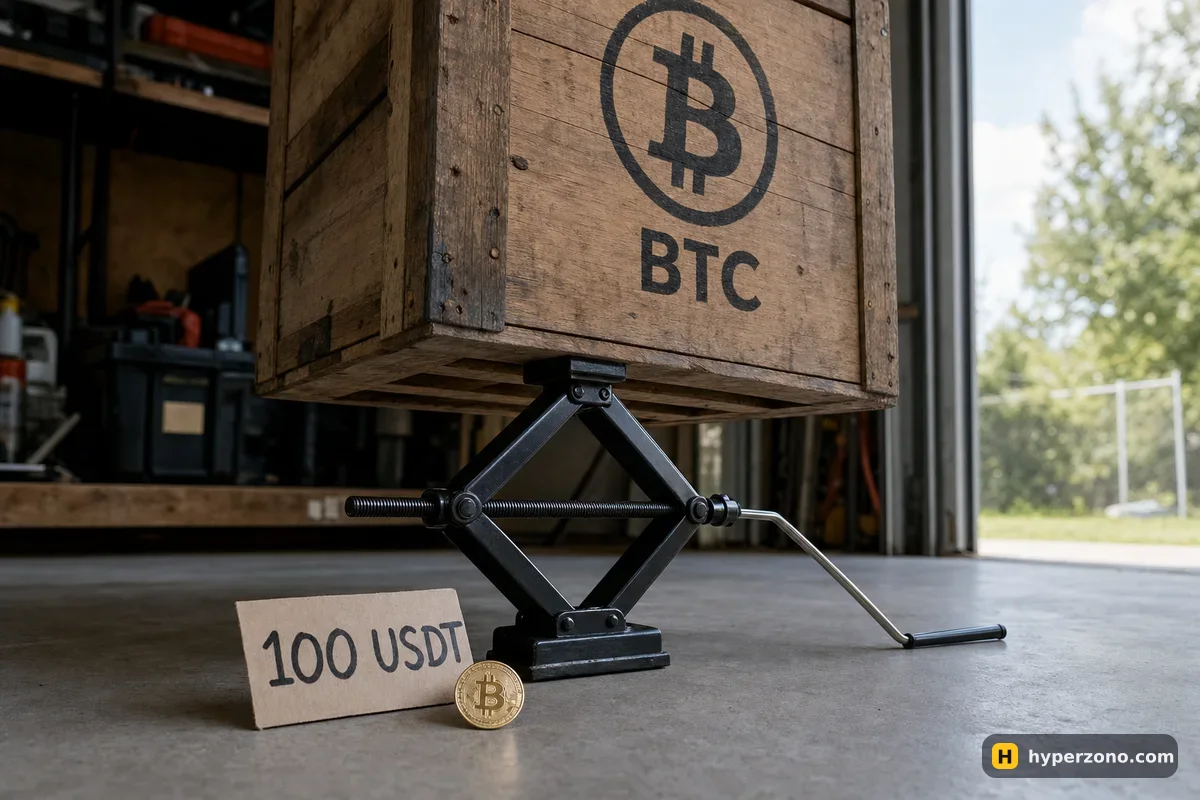
Nothing is borrowed, nothing lands in your balance
When people hear "leverage trading", they usually picture a loan: you put in 100, someone hands you 900, and now you have 1,000 to spend. Futures do not work like that. You agree with the exchange on a contract of a certain size, and the exchange holds part of your money as a deposit while that contract is open. That deposit is your margin, and leverage is simply the ratio between the size of the contract and the margin behind it.
So with 100 USDT of margin at 10x, the number "1,000 USDT" exists only as the size of your open position. You cannot withdraw 900 USDT, buy a coin with it, or send it anywhere. What you do get is the full price movement of a 1,000 USDT position — up and down. If you want the deposit side of this in more detail, that is covered in what margin is and how it differs from the trade size.
What the leverage slider really changes
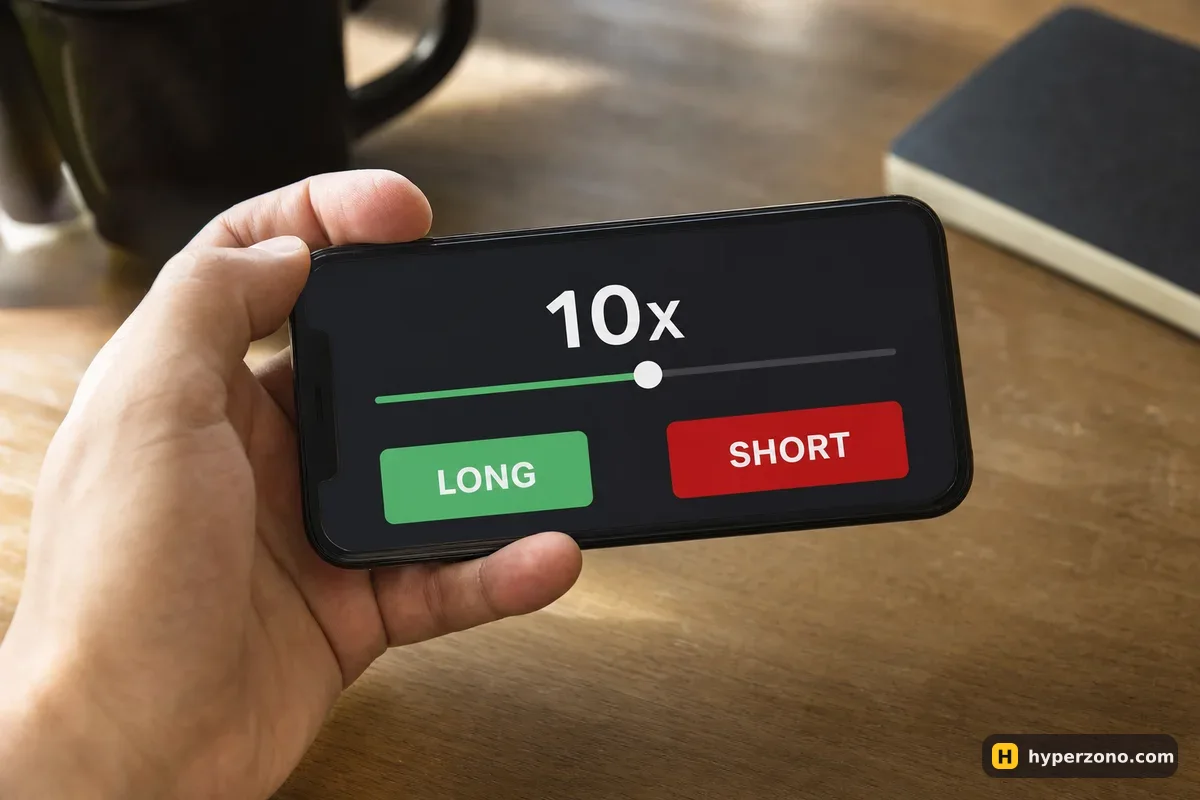
On every exchange there is a small leverage control next to the buy and sell buttons, usually showing something like 5x or 10x. Moving it does not add buying power to your account and does not make your prediction any better. It changes one thing: how much of your balance the exchange locks up for the position you want.
Read it in whichever direction suits you. If you decide the position should be 1,000 USDT, then 5x locks 200 USDT of margin and 20x locks 50 USDT. If instead you decide to commit 100 USDT of margin, then 5x gives you a 500 USDT position and 20x a 2,000 USDT one. Same slider, two ways of looking at it.
The same 100 USDT at 1x, 5x and 20x
Say bitcoin moves 2% in your favour. Here is what that 2% is worth when you commit the same 100 USDT of margin at different leverage settings — and how far the price would have to go against you to use up that margin.
| Leverage | Position size | Result of a 2% move | Rough move that wipes out your margin |
|---|---|---|---|
| 1x | 100 USDT | ±2 USDT | about 100% |
| 5x | 500 USDT | ±10 USDT | about 20% |
| 10x | 1,000 USDT | ±20 USDT | about 10% |
| 20x | 2,000 USDT | ±40 USDT | about 5% |
Two things the table leaves out. The first is fees. They are charged on the size of the position, not on your margin. On Binance futures, a market order at the starting fee level costs 0.05% — that is about 0.50 USDT on a 1,000 USDT position and 1 USDT on a 2,000 USDT one, and the same again when you close.
The second is how different the result looks as a percentage of your own money. That same 2% move is 2% of your margin at 1x and 40% of it at 20x. What 5x, 10x and 20x actually mean goes through those numbers setting by setting.
The number that matters is the position size, not the leverage. A 500 USDT position behaves exactly the same whether you opened it with 100 USDT at 5x or 250 USDT at 2x — the price move pays or costs you the same money. Leverage only decides how much of your balance is tied up and how close the exchange's forced exit sits.
Leverage pulls your liquidation price closer
This is the part that catches beginners. The exchange doesn't want your loss to grow past the margin behind the position, so it steps in and closes the trade for you — that is liquidation. In fast markets the close can land worse than planned, which is why putting a stop-loss in earlier is the safer habit. The bigger your position relative to your margin, the smaller the price move needed to reach that point.
At 20x, roughly a 5% move against you is enough; at 5x you have about four times more room. Bitcoin can travel 5% in a quiet afternoon.
The exchange doesn't use the last trade for this, it uses the mark price — a fair price calculated from the wider market. And it always wants a small part of your margin left over, so in practice you get closed a bit earlier than the simple "100 divided by your leverage" estimate suggests. Try a few combinations here and the pattern becomes obvious:
Two habits keep this under control: put a stop-loss well before the liquidation level, and use isolated margin so one bad trade cannot reach into the rest of your balance — the difference is explained in cross margin vs isolated margin. Picking a number for your first trade is a separate question, answered in what leverage a beginner should use.
Why the exchange caps leverage on bigger positions
You may notice that the maximum leverage drops as you increase the position size. A small bitcoin position on Binance can go up to 150x, but push the size higher and the ceiling falls step by step. The reason is practical: a huge leveraged position is hard to close quickly without pushing the price around, so the exchange demands a thicker cushion of margin behind it.
There are account-level limits too. On Binance, leverage above 20x is not available during the first 30 days of a futures account, and the starting setting depends on the experience level you choose when you open it — 2x for Beginner, 5x for Experienced, 20x for Advanced. None of this is punishment; it is the exchange giving new accounts a slower start.
See it in the order window yourself
Reading about leverage only gets you so far. The quickest way to understand it is to open a Binance Futures account, go to a bitcoin perpetual contract and watch the required margin change as you move the slider — you do not have to send the order.
Open a futures contract
In the app, choose USDⓈ-M futures and the BTCUSDT perpetual. You will see a chart, a price, and an order panel below it.
Type in the smallest size the app accepts
In the order panel, where you choose the amount, enter a small amount — on bitcoin the smallest position Binance allows is 0.001 BTC, so type that or the smallest size the app lets you through with. Right away it shows how much margin it will lock for it.
Move the leverage control
Tap the leverage number next to the buy and sell buttons and slide it from 2x to 10x. The position size stays where you typed it; the required margin shrinks.
Check the liquidation estimate
Before confirming anything, look at the estimated liquidation price the app shows. Raise the leverage and watch it creep toward the current price.
Start small or in demo
If you do trade, keep the position tiny at first. Binance also has Demo Trading, though it is not available in every country — check what the app offers where you live.
Also check during sign-up that futures are offered in your country. Availability differs by exchange and region, and in some places you get a local entity with different products or lower leverage caps.
Does leverage mean I am borrowing money from the exchange?
Not in the way a bank loan works. Nothing is credited to your balance and you cannot spend or withdraw the extra size. You are agreeing to a contract of a certain size while the exchange holds part of your money as a deposit for it.
Can I lose more than the margin I put in?
With isolated margin, the amount at stake on that position is the margin you assigned to it, and the exchange aims to close the trade before the loss goes further. In very fast moves or price gaps the closing can happen worse than planned, so treat a negative balance as unlikely rather than impossible, and read your exchange's own rules on it.
If I keep the position size the same and raise leverage, do I earn more?
No — the money result follows the position size and the price move, not the slider. Raising leverage at the same size only frees up margin and moves the liquidation price closer — the numbers are in does profit change when you raise leverage.
Can I trade futures at 1x, with no leverage at all?
Yes, and plenty of people do. Your position is then the same size as your margin and behaves much like buying on spot, with the extra option of going short. The one thing to watch is the minimum size of the contract you pick, since that sets how small your first trade can be.
Does high leverage let me start with less money?
It lets you open a position that is bigger than your balance, which is not the same thing as needing less money. A small account lasts longer with small positions. A 2% move against a 2,000 USDT position takes 40 USDT off your balance whether you have 100 USDT or 10,000 USDT in the account.
Do fees go up when I raise the leverage?
Not by themselves. The fee is a percentage of the position size, so it only grows if the bigger leverage leads you to open a bigger position. At the same size, 5x and 20x cost the same to open and close.