
Contents
What you actually get: a coin or a bet on the priceSpot and futures side by sideLeverage and liquidation exist only on futuresWhat each one costs youThe risks are shaped differentlyHow long a position lives, and betting on a fall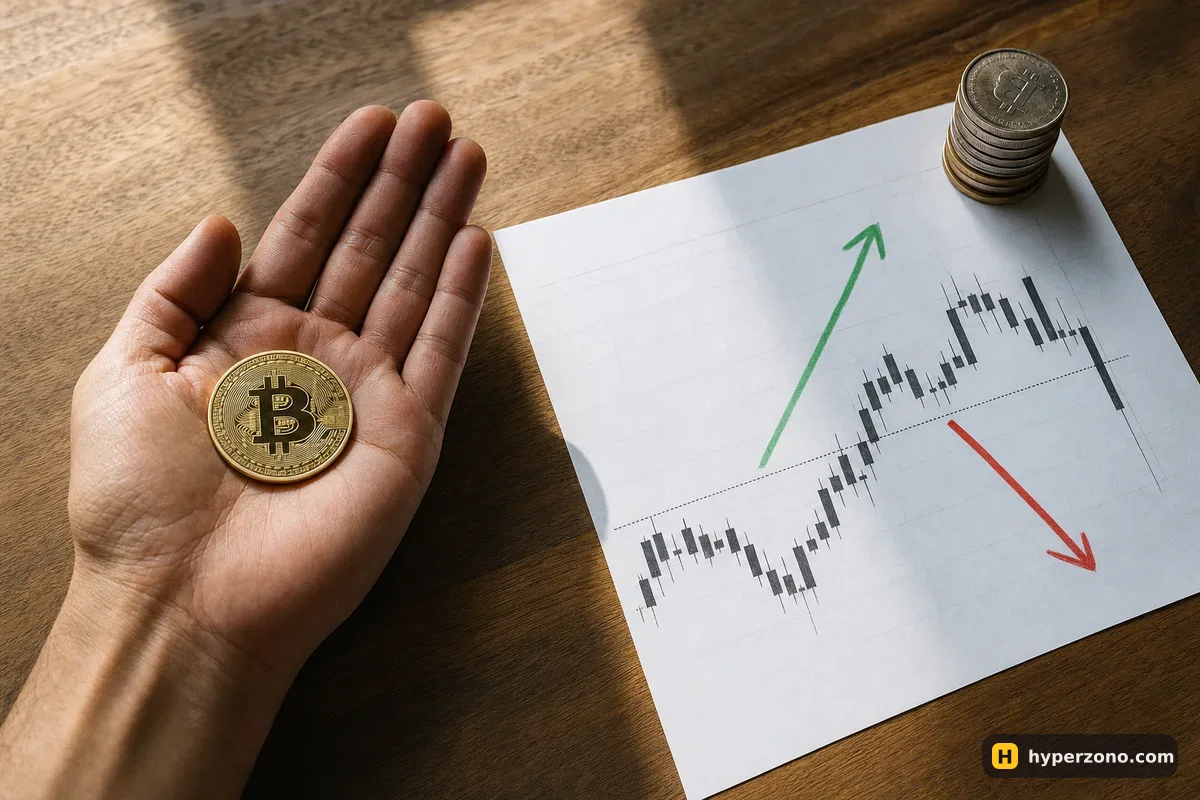
What you actually get: a coin or a bet on the price
Say you spend 100 USDT on bitcoin on the spot market. You now own roughly 100 dollars' worth of bitcoin. It is yours, you can send it to your own wallet, hold it for three years, and nobody will close that position for you. If the price drops 40%, you still have exactly the same amount of bitcoin — just worth less today.
Futures work differently. You open a position on the bitcoin price and the exchange sets part of your money aside as a deposit, called margin. Your profit or loss is the price difference on the size of your position, paid out in USDT. You are trading the price, not buying the asset — which is why you can also bet on a fall. If the whole idea is still new, start with what crypto futures are in simple words.
Spot and futures side by side
| Spot | Futures | |
|---|---|---|
| What you hold | The coin itself, in your exchange account or your own wallet | Nothing you can hold or send anywhere — just an open trade. When you close it, the price difference lands in your account as USDT |
| If the price falls | You lose value while you hold; you only gain if it rises | You can open a short and gain when the price falls |
| Leverage | None in ordinary spot buying | Yes — a small deposit controls a bigger position |
| Can the exchange close it for you | No | Yes, if your margin runs out. This is liquidation |
| Costs | A fee when you buy and when you sell | A fee on entry and on exit, plus funding every few hours on perpetuals |
| How long it can stay open | As long as you want, even years | Until you close it, your margin runs out, or a dated contract expires |
Leverage and liquidation exist only on futures
On futures you pick leverage before you open the trade. With 100 USDT and 10x you control a position worth about 1,000 USDT, so a 1% move is worth about 10 USDT to you instead of 1 — and a 1% move the wrong way costs you the same 10. Spot has no such slider. If you want to see exactly what each setting changes, read what 5x, 10x and 20x really mean.
The other side of leverage is that the exchange watches your margin. If the price goes far enough the wrong way, the exchange closes your trade for you, and the idea is that the loss stops at the margin you put behind that position. If the price jumps a long way in one step, the close can happen at a worse price than planned, so the loss can be bigger than you expected — which is why isolated margin and a stop-loss still matter.
With 10x, a move of about 10% against you is already enough to use up your margin on that position. The exact point depends on the maintenance margin, fees and the mark price the exchange uses, and the exchange shows an estimated liquidation price for your position — the simplest way to see it is to open a Binance Futures account and look at the order window and the position details before you confirm. Spot has nothing like this; read how liquidation works before your first leveraged trade.
What each one costs you
On spot you pay a trading fee when you buy and again when you sell; the rate depends on the exchange and your level, so check it in the app. On Binance USDⓈ-M futures at the base level the fee is 0.05% if you buy or sell at the price that's there right now, and 0.02% if you place your own price and wait for the market to come to it. On a 500 USDT position at 0.05% that is about 0.25 USDT to open and 0.25 USDT to close — small, but charged on the size of the position, not on your margin. What fees you pay on futures goes through the rest.
Futures add one cost spot does not have. On perpetual contracts, traders pay each other a small amount at fixed times — by default every 8 hours on Binance, every 4 hours on some contracts. When the rate is positive, longs pay shorts; when it is negative, shorts pay longs, and the exchange keeps none of it. It matters mostly if you hold for days, and how funding works explains when it lands in your favour.
The risks are shaped differently
A spot loss is slow and patient. Your coin can halve over a month and you still hold the same coins; you lose everything only if the project behind the coin dies completely, which for bitcoin or ether would be a very big event. A futures loss has a deadline — a fast move during one night can take the whole margin of that position, and the trade is gone whether you were watching or not.
A spot loss waits for you. A futures loss does not. That is why a stop-loss and isolated margin matter on futures: isolated margin keeps the risk inside the money you allocated to that one position, and a stop-loss decides in advance where you step out. On spot you can always just wait. On futures, waiting is a decision with a price.
How long a position lives, and betting on a fall
Spot coins stay with you indefinitely. A perpetual futures position stays open as long as your margin covers it and you keep paying or receiving funding; a dated contract closes on its expiry day no matter what you think of the price. The other real difference is direction: on spot you can only profit when the price goes up, while on futures you can open a short and make money when the price falls.
Both markets live inside the same account on most exchanges, with separate spot and futures wallets and an internal transfer between them, so you can try futures with 20 or 50 USDT while your spot coins stay untouched. Check during sign-up that futures are available where you live — in some countries exchanges offer spot only, or serve you through a local entity with different products. If you are still deciding which side to start on, read spot or futures for a beginner.
Is spot trading safer than futures?
In one specific sense, yes: on spot nobody can close your position for you, so a bad week costs you value but not the position itself. Futures add leverage and liquidation, which can end a trade in minutes. The flip side is that a futures trade with a stop-loss has a loss you chose in advance, while coins you bought on spot can quietly lose half their value over a few months and you just sit there holding them.
Can I lose more than I deposited on futures?
In normal trading, no — the exchange closes the trade before that, and with isolated margin the damage stays inside the money you put behind that one position (as long as auto-add margin is off). Cross margin ties the trade to your whole futures balance, so more of it is at risk. Treat this as risk control rather than a promise, and keep only part of your money in the futures wallet.
Do I need to own bitcoin to trade bitcoin futures?
No. On USDT-margined contracts your margin is USDT, and you never receive any bitcoin — you only get the price difference when you close. That is one of the main practical differences from spot, where you actually hold the coin.
Which is cheaper, spot or futures?
Per trade the fees are in the same small range and both are charged on entry and exit, so compare the rates in your own app. Futures add funding on perpetual contracts if you hold through a settlement time, and they let you trade a bigger position with the same money, which makes the fee on that bigger position larger in absolute terms.
Can I use spot and futures at the same time?
Yes, and many people do. The usual setup is coins you want to keep on spot, plus a small futures balance for short trades in either direction. Moving money between the two wallets is an internal transfer inside your exchange account.