Contents
Three things decide whether you can tradeHow to read a restricted-countries list without misreading itNever tell an exchange you live somewhere elseTax is a separate question from accessWhere to start in this section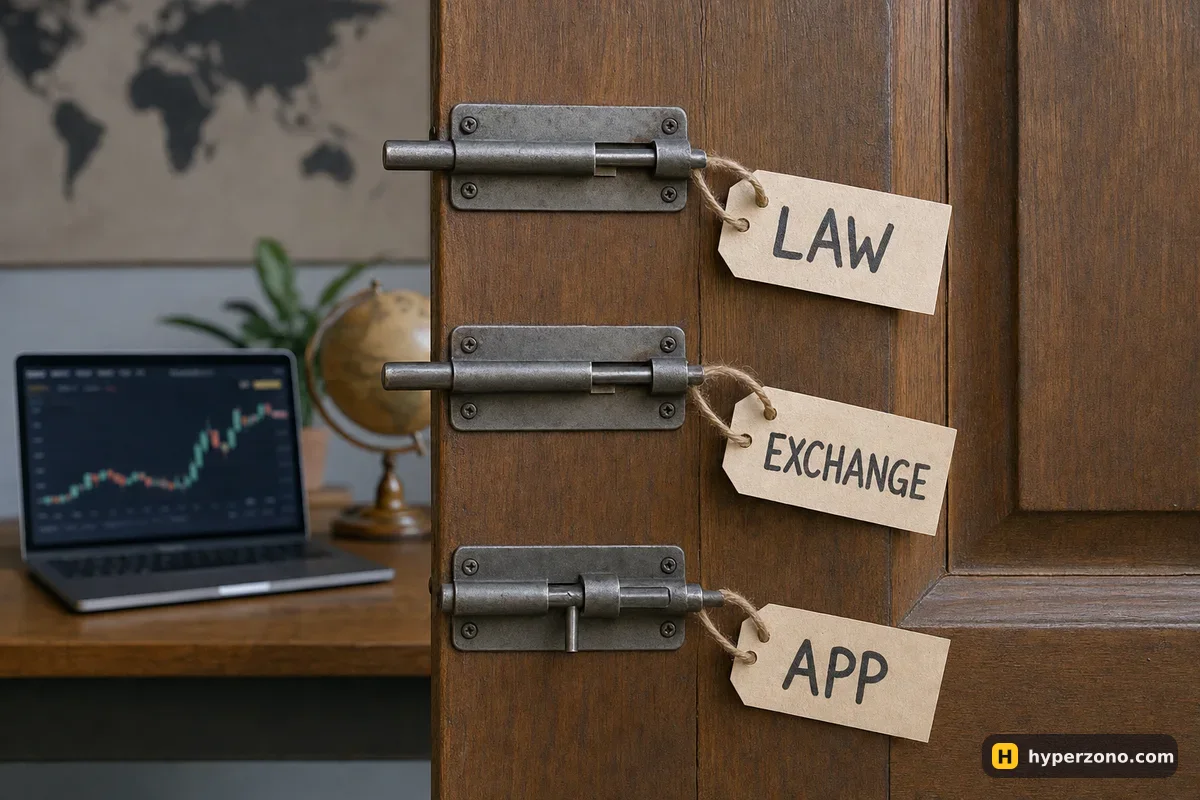
Three things decide whether you can trade
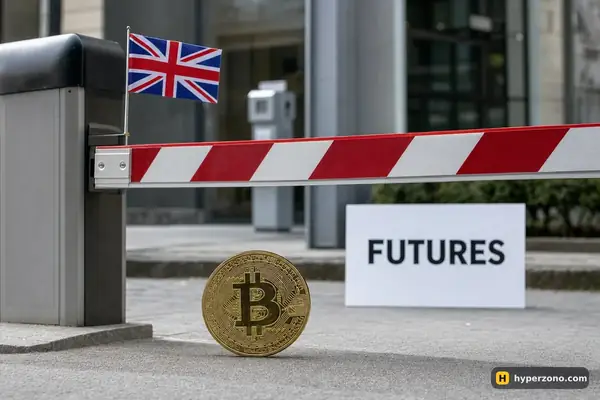
The first is the law where you live, and it often treats ordinary private customers differently from professionals. Take the United Kingdom: in October 2020 the UK regulator, the FCA, banned selling crypto futures and similar products to ordinary private customers, leaving them available only to professional clients. No exchange can hand you a product your own regulator has told it not to sell you, so this layer comes first.
The second is which company actually serves your region. A big exchange is not one single business — in the EEA, Bybit opens accounts through Bybit EU GmbH under an Austrian MiCAR licence, and OKX serves Australian customers through OKX Australia Financial Pty Ltd and customers in the UAE through OKX Middle East Fintech FZE. Different company, different product list, and sometimes very different limits.
Australia shows how big that difference can be. OKX's local company there only lets ordinary customers trade USDT futures at up to 2x — a trade twice the size of your own money — and only after you pass a short knowledge test. The global app shows much bigger numbers; those are not what you would get there.
The third layer is the app itself, and it has the final word. After you verify your identity, the futures section either opens normally, opens with a gate in front of it (that knowledge check in Australia, a suitability test in the UAE), or simply is not there for your account. Our page on which exchanges are available in which countries goes venue by venue; this section goes country by country and explains the method.
Read your country page here
It tells you what the local regulator allows ordinary traders to do, with the date the rules were last checked and a link to the regulator's own page.
Open the exchange's restricted-countries page
Find your country. Note whether it is excluded from all services, or only from futures, and look at the 'last updated' date at the top.
Sign up and verify, then look for the futures tab
Use your real country of residence. If futures are missing, greyed out, or behind a questionnaire, that is your real answer — not what a review site says.
How to read a restricted-countries list without misreading it
There are two different kinds of list and people mix them up constantly. Bybit's Service Restricted Countries page (last updated 16 October 2026) names places where it does not open accounts at all. If your country is on it, that is the whole account, not just futures:
- United States, Canada
- Mainland China, Hong Kong, Singapore
- Uzbekistan, North Korea, Cuba, Iran, Sudan, Syria
- Crimea including Sevastopol, and the non-government-controlled areas of the Donetsk, Luhansk, Kherson and Zaporizhzhia regions of Ukraine
- Dubai, for one of Bybit's companies only
Open that page and search for your own country yourself, because the list changes. OKX's Risk & Compliance Disclosure (last updated 8 July 2026) is built differently again: some countries are restricted for everything, while others are restricted only for derivatives, which is the case for the United Kingdom, Brazil and South Korea. So a country appearing on a page does not automatically mean "no account" — sometimes it means "account yes, futures no".
These lists are also not final. Bybit says plainly that it may end services in any other jurisdictions it decides on from time to time, and other exchanges use the same "including but not limited to" wording. A page you read a year ago may be out of date today, which is why every page in this section carries the date it was last checked.
The app after KYC decides, not the marketing page. Exchange help pages describe the general position; your account is opened by a specific company under a specific licence, and that company may offer less. If the two disagree, believe what your verified account shows you.
Never tell an exchange you live somewhere else
It is tempting to pick a different country at sign-up, and it is the fastest way to lose your money. Bybit states that if it finds a user has made false statements about their location or place of residence, it may close the account immediately and liquidate any open positions — and it asks users to tell it straight away if they become resident in an excluded place. Other venues have similar clauses, and the check usually happens at withdrawal, when the money is already on the platform.
We never suggest a workaround, and a venue that happily invites you in from a country its own terms exclude is telling you something about how it treats customers in general — our notes on checking that an exchange is not a scam cover that. If futures are closed to you, the honest routes are buying coins on spot, demo trading, or simply learning the mechanics first.
Tax is a separate question from access
Being allowed to trade does not make the profit untaxed, and in many countries the two sets of rules come from completely different institutions. In 2023 the OECD published rules for countries to swap crypto tax data automatically, and they cover money held through futures too, not just coins in a wallet. Many countries are adopting them, so assume your exchange history can end up with your tax office — your country page says where yours stands.
The practical move is to keep records from your very first trade, not from the day a letter arrives: dates, deposits and withdrawals, closed profit and loss, fees and funding payments. Then read your local rules — we have plain-language pages for places like crypto futures tax in the UK and India, with more being added.
Where to start in this section
Find your country in the directory below this text and open its page. Each one says, with a checked date, what the regulator allows, which exchanges serve residents and under which company, and whether futures are available, limited or closed to ordinary customers — for example the UK page explains what happens to an account you already have, and the Australia page explains the local company and its leverage cap. If your page says futures are not offered where you live, stop there; nothing in this guide is worth a frozen account.
Is crypto futures trading legal in my country?
Usually the rules are aimed at the platform rather than at you personally, but not everywhere — some countries also limit what residents themselves may do. That is exactly why you check your own country page and your regulator's own statement instead of trusting a general answer. Your country page here gives both, with the date it was last checked.
My country is blocked — is there a way around it?
No, and we will not help with one. Exchanges ask for your real location and place of residence, and Bybit's terms say false statements can lead to the account being closed immediately and open positions liquidated. The problem usually surfaces at withdrawal, when your money is already inside.
I passed KYC and the account opened — does that mean futures are allowed for me?
Not necessarily. In plenty of countries you can open a normal account and buy coins, but the futures section stays closed. Look for the futures tab itself, and for any leverage limit your local company applies.
What if I live in one country and travel to another?
The terms talk about both your location and your place of residence, so a trip does not change your status — and Bybit asks users to tell it if they become resident somewhere it does not serve. Treat a move abroad as a reason to re-read the exchange's restricted-countries page, not as a way around it.
Do I have to pay tax on futures profit?
That depends entirely on your country, and it is a different question from whether you are allowed to trade at all. The OECD published rules in 2023 for countries to exchange crypto tax data automatically, including money held through futures, and many countries are adopting them — whether yours has is a question for your country page. What is true everywhere is that record-keeping gets harder the longer you wait, so save your trade history from the beginning.
My country is not in the directory yet — what do I do?
Run the three steps yourself: search for your financial regulator's own statement about crypto futures for private customers, open the restricted-countries page of each exchange you are considering, and check what the app shows after verification. Our page on exchange availability by region is a useful second stop while your country page is being written.
Sources and fact-check
Exchange terms were checked against official documents on October 20, 2026. Terms change — before you trade, check what matters to you in the exchange app and in your contract’s specs.
Bybit: Service Restricted CountriesFCA: FCA bans the sale of crypto-derivatives to retail consumersOECD: International Standards for Automatic Exchange of Information in Tax Matters (Crypto-Asset Reporting Framework)