Contents
What you are actually trading when you buy gold hereFinding XAUUSDT and XAGUSDT in the appWhat a $10 move in gold is worthHow big a position, and where the stop goesGold perpetual or a gold token like PAXG?Funding and the quiet hours on metal contractsIf the trade does not go through
What you are actually trading when you buy gold here
On a crypto exchange, gold is a perpetual futures contract — most often listed as XAUUSDT, sometimes alongside silver as XAGUSDT. The price you see is USDT per troy ounce, the same unit gold is quoted in everywhere else. You put up USDT as margin, choose long if you think gold rises or short if you think it falls, and your result is the price difference multiplied by how many ounces you took.
What the contract actually follows is not the same at every venue. On OKX, the gold and silver perpetuals track the spot metal price — nothing to roll over — while its copper, oil and gas contracts track designated deliverable futures and roll over in steps. Binance describes its commodity contracts with a rollover mechanism of an underlying futures contract. So before your first trade, open the contract specification for XAUUSDT on the exchange you are using and read what it says the contract follows.
On Binance, gold sits in the same futures section as bitcoin, in a group of 217 contracts on things outside crypto — US stocks and ETFs, gold, silver, oil, gas and copper. They are quoted and settled in USDT, and they trade 24 hours a day, weekends included. The app calls this group TradFi perpetuals, short for traditional finance, and apart from the name they are opened the same way as any coin contract.
Whether any of this is available to you depends on where you live, and no exchange publishes a complete country list for these contracts. Check during sign-up and inside the app rather than assuming; our page on which futures exchanges are available in your country explains what to look for. If you are curious about the rest of that market list, trading stocks on a crypto exchange covers the equity side, and index contracts like the S&P 500 and Nasdaq-100 have their own page.
Finding XAUUSDT and XAGUSDT in the app
Open the futures section, not spot
Metal perpetuals live in the derivatives or futures part of the app. If you search from the spot screen you may find a gold-backed token instead, which is a completely different product.
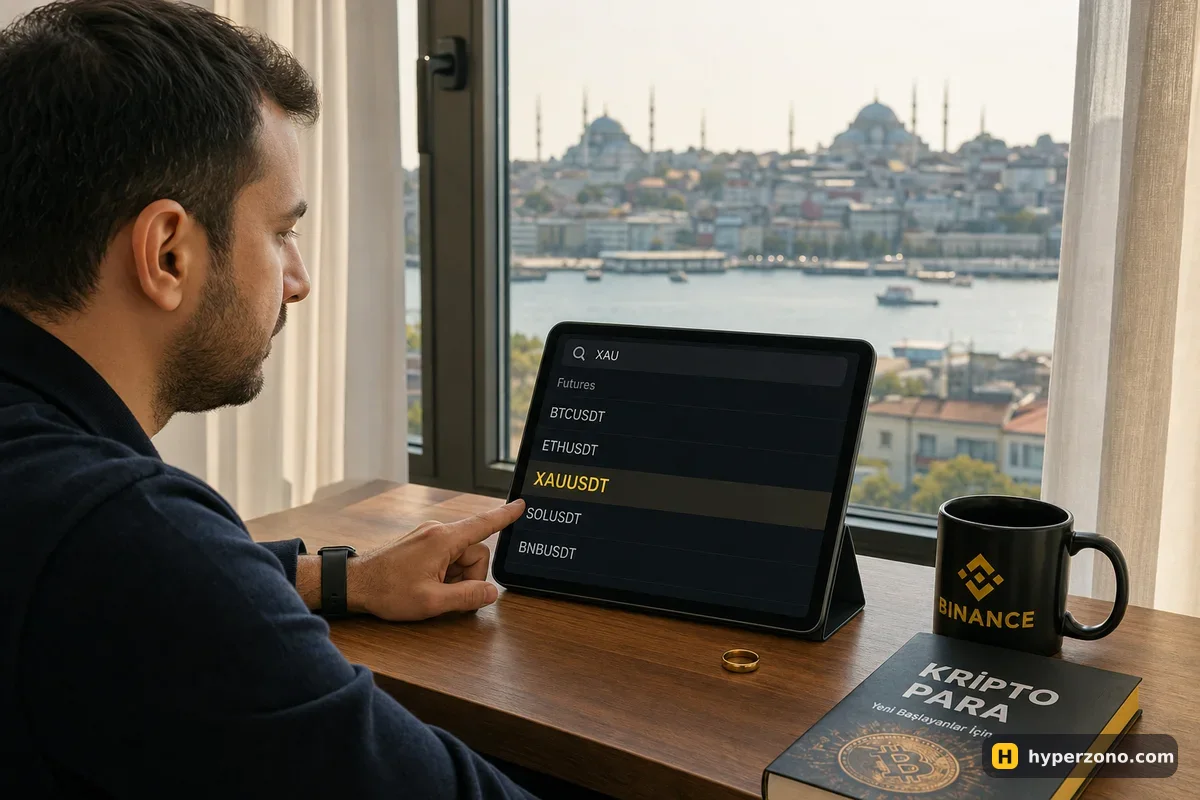
Type XAU into the search box
XAU is the standard code for gold, XAG for silver. The result you want is the USDT-margined perpetual — the ticker normally reads XAUUSDT and the market list shows it with a perpetual label.
Open the contract details page
Before trading, look at the specification: what the contract tracks, the unit the quantity is measured in, the minimum order size, the maximum leverage and the funding interval. These differ between exchanges and change over time, so read the page in front of you rather than trusting a number from an article.
Switch to isolated margin
In the order window, switch to isolated margin, so a gold trade can only cost you the margin you put into it. Leave the leverage slider alone for now — you set it after you know your size, and the next section shows how. Binance lists commodity contracts with up to 100x available, but that is a ceiling, not a suggestion.
Choose quantity, then add a stop
Enter the size in ounces (or the unit the contract uses), check the margin the app shows, and attach a stop-loss in the same order ticket. Our guide on setting a stop loss walks through the fields.
If the search comes back empty, the honest answer is that the contract is either not listed on that exchange or not offered where you are. Don't go looking for a way around it — it is worth checking a second exchange instead. Bybit also runs contracts on things outside crypto, so you can open a Bybit account, search the futures market list and see what is listed for you.
What a $10 move in gold is worth
This is the one calculation worth doing before your first gold trade. Your profit or loss is the number of ounces you hold multiplied by the dollar move in the price, and nothing else is in that formula. Leverage only decides how much of your money the exchange holds as a deposit while the trade is open. It does not change what you make or lose when gold moves $10.
| How much gold | What that costs at 4,000 USDT/oz | If gold moves $10 | If gold moves $50 |
|---|---|---|---|
| 0.05 oz | 200 USDT | 0.50 USDT | 2.50 USDT |
| 0.1 oz | 400 USDT | 1 USDT | 5 USDT |
| 0.5 oz | 2,000 USDT | 5 USDT | 25 USDT |
| 1 oz | 4,000 USDT | 10 USDT | 50 USDT |
Two things follow from that table. First, with a small account the amounts are genuinely small, and that is the nature of a slower market — gold does not do what bitcoin does in an afternoon. Second, fees are charged on the position size, not on your margin: on a 400 USDT position at a 0.05% fee rate you would pay about 0.20 USDT to enter and the same to exit, which matters a lot when your expected gain is a couple of dollars.
How big a position, and where the stop goes
Work backwards from the loss you are willing to take, not from the leverage slider. Say you have 100 USDT and you accept losing 2 USDT on this trade. You look at the gold chart and decide your idea is wrong if price falls $40 below your entry. Divide the risk by the stop distance: 2 ÷ 40 = 0.05 ounces. That is your size, and at 4,000 USDT an ounce it is a 200 USDT position — 40 USDT of margin at 5x, or 20 USDT at 10x, with the same 2 USDT loss either way if the stop fills.
Choose the stop distance from the chart, not from a round number you like. Pull up the daily candles and see how far gold typically swings in a session before you decide; a stop a few dollars from entry will be taken out by ordinary noise.
If the size your risk allows turns out to be below the exchange minimum, you have three choices. The first is to skip the trade — that is a real answer, not a failure. The second is silver: one ounce costs far less, so the smallest order may be a smaller amount of money (check the minimum on its contract page). The third is to practise the same steps on a contract you can size properly. How to work out your position size goes through the same arithmetic for any market.
A quiet market tempts you into a loud position. Because gold rarely moves several percent in a day, 50x feels harmless in a way it never does on bitcoin. But at 50x, a move of around 2% against you wipes out your margin — and that is true whether the chart says BTC or XAU. Gold is calm most days and then jumps on big news, which is exactly when a 50x position disappears. Pick the lowest leverage that still lets you open the size your risk rule allows — what leverage a beginner should use explains why that is the right order of decisions.
Gold perpetual or a gold token like PAXG?
They answer different needs. A tokenized gold coin such as PAXG is a spot purchase: you buy it, you hold it, and the token represents metal held by the issuer. There is no funding, no liquidation and no expiry — if gold drops 20% you still own the same token and can wait. Your costs are the spot trading fee and whatever the issuer charges, which you should read on the token's own page before buying.
A XAUUSDT perpetual is a position you rent while it is open. You can go short, you can use leverage, and you can be closed out by a stop or by liquidation if price goes against your margin. You own nothing at the end — only the result. For a one-week view on the gold price, or to protect something else you hold, the perpetual is the tool; to simply hold gold for a year, the token is far less work. The same split between owning a thing and trading its price applies to stocks, and tokenized stock vs futures contract covers it in more detail.
Funding and the quiet hours on metal contracts
A perpetual has no expiry, so longs and shorts exchange a small payment at fixed moments to keep the contract near the real gold price. When the rate is positive, longs pay shorts; when it is negative, shorts pay longs. The exchange does not take that money, and only someone holding the position at the settlement moment pays or receives it. Intervals differ by contract and venue — Binance uses every 8 hours by default with some contracts on 4, and Bybit has changed the interval on its non-crypto contracts — so read the contract page instead of guessing. How funding works has the full picture.
Fewer people trade these contracts at night and over the weekend. When that happens, the gap between the buy price and the sell price can widen, and a market order may fill a little worse than the price you saw — so check that gap in the order window before you tap, or use a limit order. Crypto exchanges keep these contracts running 24/7, which is convenient but means the price can move while traditional markets are closed; trading hours and gaps covers what to expect.
If the trade does not go through
The most common rejection is a size below the contract minimum: the app refuses the order, you raise the quantity slightly and it goes through. The second is leverage lower than you expected — exchanges reduce the maximum as your position grows, and on Binance anything above 20x is unavailable during the first 30 days of a futures account. Both limits are written on the contract specification page, which is why step three above exists.
If the price in the app differs from the gold price you just looked up online, that is normal. The exchange works out liquidations from its own fair price, built from several big markets — on screen it is called the mark price. That is why your position can survive a sudden spike on one exchange that never reaches the mark price.
If you want to rehearse all of this with no money at stake, demo mode is the place — just check that the gold contract you want actually exists there, since contracts on non-crypto markets are not guaranteed to appear in demo. Opening a demo futures account on Bybit takes a couple of minutes.
Is XAUUSDT the same as gold futures at a traditional broker?
Not quite. A XAUUSDT perpetual has no expiry date and no delivery, and it uses funding payments between longs and shorts to stay near the gold price. OKX says its gold and silver perpetuals track the spot metal price; other venues build their commodity contracts differently, some around an underlying futures contract with a rollover. Read the contract specification on the exchange you use.
Can I trade gold with USDT only, without owning any gold?
Yes, that is the whole point of these contracts. You deposit USDT, use part of it as margin, and settle the difference in USDT when you close. No metal moves anywhere, and you can go short just as easily as long.
What leverage should I use on a gold trade?
The lowest that still lets you open the size your risk rule allows. Work out your size from your stop distance first, then set leverage just high enough to cover the margin. Binance lists commodity contracts with up to 100x available, but that number is a ceiling, not a starting point.
Does gold trade on weekends on a crypto exchange?
On Binance, those contracts on non-crypto markets run 24/7 including weekends. Fewer people are trading at those hours, so check the gap between the buy and sell price in the order window before using a market order, and expect price to move while traditional markets are closed.
Is PAXG better than a gold perpetual?
They do different jobs. PAXG is a token you own, with no liquidation and no funding, which suits simply holding gold for a long time. A perpetual is for a shorter view on the price, in either direction, with a stop and a defined risk.
What is the smallest gold trade I can open?
That depends on the contract's minimum order size, which is printed on its specification page and differs between exchanges. If your order is rejected, it is almost always because the quantity is below that minimum. Silver costs far less per ounce, so its smallest order may be worth less in USDT — read its contract page before you plan around that.