Contents
OKX futures fees in percent, and what that is in USDTMarket or limit: the same trade, two different billsHow to pay less when your size is smallWhat your own rate depends onThe cost the fee table doesn't showHow OKX compares with the other big venues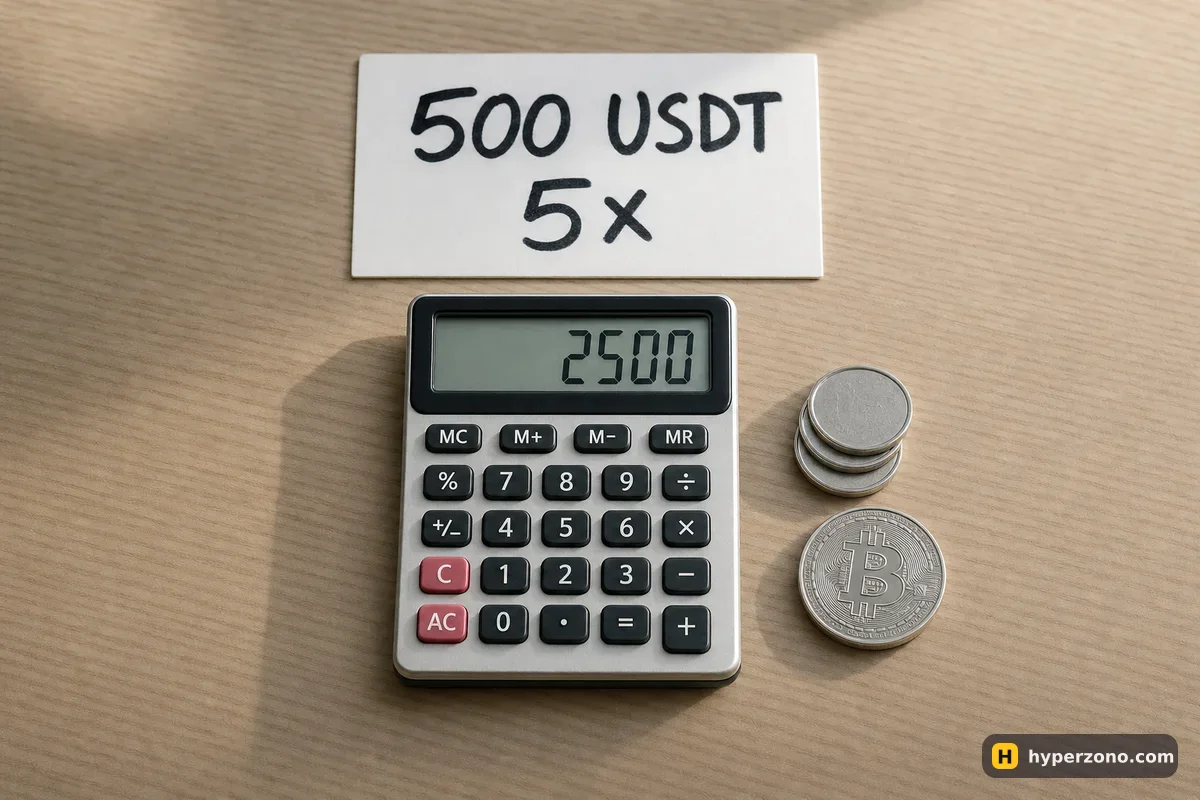
OKX futures fees in percent, and what that is in USDT
OKX has two rates on perpetual futures: a maker fee of 0.02% and a taker fee of 0.05% at the base level. You pay the maker rate when your limit order sits in the order book and waits for someone else to trade against it. You pay the taker rate when you take a price that is already there — a market order, or a limit order that matches the moment you send it. If the general idea of maker and taker is new to you, the fees explainer covers it from scratch.
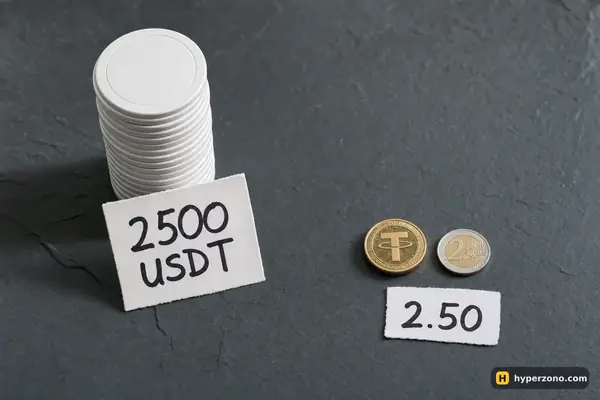
The percentage applies to the size of the position, not to the money you put up. With 500 USDT of margin at 5x your position is 2,500 USDT, so one taker order costs 2,500 × 0.05% = 1.25 USDT. You pay once to open and once to close, which is 2.50 USDT for the round trip. That is half a percent of your 500 USDT deposit, and the price only has to move about 0.1% in your favour for the trade to cover its own fees.
| Level | 30-day volume from | Maker | Taker | A 2,500 USDT trade at market |
|---|---|---|---|---|
| Base | — | 0.02% | 0.05% | 2.50 USDT |
Some newly listed contracts have their own fee schedule; check the contract before trading.
fees checked 24 Oct 2026 on the exchanges’ fee pages, OKX.
Leverage does not raise the fee rate. Going from 5x to 10x with the same 500 USDT doubles the position to 5,000 USDT, so the same 0.05% now costs 2.50 USDT per order instead of 1.25. The rate stayed the same; the thing it is multiplied by got bigger.
Long 2,500.00 USDT, entry 110,000 → exit 111,100, fees 0.05% + 0.05% (example rates).
Market or limit: the same trade, two different bills
Most beginners open and close with market orders, because they are instant and you always get filled. That is the most expensive version of the trade, and on a small size it is still small money. A limit order placed away from the current price costs you less per order, but it only fills if the price comes to you — sometimes it doesn't, and you miss the move. Market or limit goes into when each one makes sense.
| How you trade a 2,500 USDT position | Entry | Exit | Total |
|---|---|---|---|
| Market in, market out (taker both ways) | 1.25 USDT | 1.25 USDT | 2.50 USDT |
| Limit in that waits in the book, market out | 0.50 USDT | 1.25 USDT | 1.75 USDT |
| Limit in and limit out, both waiting (maker both ways) | 0.50 USDT | 0.50 USDT | 1.00 USDT |
A detail that catches people out: a limit order is not automatically a maker order. If you place a buy limit at or above the price people are already selling at, it matches instantly and you pay the taker rate anyway. The maker rate is for orders that genuinely wait.
How to pay less when your size is small
OKX lowers your rates as your 30-day trading volume grows, and also for holding its OKB token. The thresholds for those tiers are on OKX's full fee schedule, but with a few hundred USDT you will stay on the base level for a long time — your own rate is shown on the fee page in your account.
What actually moves the number at a small size is the way you enter and exit, and how often you trade. Using limit orders on at least one side of the trade cuts the bill roughly in half. Trading five times a day instead of five times a week multiplies it by about seven, no matter how good your rates are. Newly listed contracts can also carry their own fee schedule, so check the contract page before you trade something that appeared last week. When you work out whether a trade was really profitable, subtract entry fee, exit fee and funding once each — counting your real result explains how people accidentally count them twice.
What your own rate depends on
The rates above are the base level, and the numbers on your screen can differ depending on your level and the region your account belongs to. The quickest way to see your real figures is to open an OKX account and look at the fee page in your profile, which shows the maker and taker rate your orders will actually be charged.
One more thing to check at sign-up: OKX derivatives are not offered everywhere, and in some places they come from a separate local company with different products and lower leverage caps. The app will tell you during registration. There is more on the exchange itself in the OKX overview, and on country access in which exchanges work where.
The cost the fee table doesn't show
Trading fees are only one of the two charges on a perpetual contract. The other is funding — a payment between traders holding longs and traders holding shorts, settled at fixed times through the day. If you are on the paying side and you hold the position at the settlement moment, your 2,500 USDT position pays 2,500 × the rate. OKX shows the next estimated funding rate right on the order panel, so you can see it before you confirm.
On a trade you open and close within an hour you may never touch funding at all; on a position you hold for a week it can easily add up to more than the trading fees. How funding works has the details, including why the rate flips between positive and negative.
How OKX compares with the other big venues
At the base level the main venues are close enough that the difference on one small trade is cents, not dollars. The same 2,500 USDT trade, opened and closed with market orders, costs 2.50 USDT on OKX, 2.50 on Binance, 2.75 on Bybit, and 2.25 on Hyperliquid — which isn't an exchange account at all, but a venue you trade from your own wallet. Here is the full table — look at the taker column first, since that is the rate most beginners actually pay.
| Where | Maker | Taker | How to pay less | A 2,500 USDT trade: market in and out | Limit in, market out |
|---|---|---|---|---|---|
| Binance Futures | 0.02% | 0.05% | pay fees in BNB: 0.018% / 0.045% | 2.50 USDT | 1.75 USDT |
| Bybit | 0.02% | 0.055% | — | 2.75 USDT | 1.88 USDT |
| OKX | 0.02% | 0.05% | — | 2.50 USDT | 1.75 USDT |
| Hyperliquid | 0.015% | 0.045% | up to 40% off for staking HYPE: 0.009% / 0.027% | 2.25 USDT | 1.50 USDT |
| Binance Wallet / Aster | 0% | 0.04% | — | 2.00 USDT | 1.00 USDT |
Base level for a new account. 2,500 USDT is 500 USDT at 5x leverage; the fee is charged on the position size, not on your 500. Taker is the rate when an order fills at once, maker when a limit order waits in the book.
fees checked 24 Oct 2026 on the exchanges’ fee pages, Binance Futures, Bybit, OKX, Hyperliquid, Binance Wallet / Aster.
Those gaps matter once you trade often or trade big, and almost not at all on your first ten trades, so pick the venue where the app makes sense to you and where futures are actually available for your country. The same 500 USDT at 5x example is worked out venue by venue on the Binance fees and Bybit fees pages, and the lowest-fee comparison lines them all up if cost is your deciding factor. Rates change, so treat these as the numbers as of late October 2026 — the fee page in your own account is the final word.
Is the OKX futures fee taken from my margin or from the position size?
It is calculated on the position size and then deducted from your futures balance. With 500 USDT of margin at 5x, the fee is worked out on 2,500 USDT, not on 500. That is why raising leverage raises the fee in money even though the percentage stays the same.
Do I pay the fee twice on one trade?
Yes — once when the position opens and once when it closes. Each execution is charged separately on its own size. If you close a position in two parts, each part is charged on the amount it closed.
Is there an OKX futures fees calculator?
The fee calculator on this page does the job: enter your position size and pick the maker or taker rate, and it shows the entry fee, the exit fee and the total in USDT. If you are not sure of your size, take your margin and multiply it by your leverage first.
Are OKX futures fees lower than Binance or Bybit?
At the base level OKX and Binance are the same at 0.02% maker and 0.05% taker, and Bybit's taker rate is slightly higher at 0.055%. On a 2,500 USDT round trip that difference is a quarter of a USDT, so it is rarely the thing that decides which exchange suits you.
Does holding a position overnight cost extra on OKX?
There is no separate overnight charge, but perpetual contracts settle funding at fixed times. If you hold the position at one of those moments and you are on the paying side, the payment comes out of your balance; if you are on the receiving side, it comes in. Short trades that open and close between settlements avoid it entirely.
How much does the price need to move just to cover the fees?
With taker fees on both sides at 0.05%, you pay 0.1% of your position size in total, so the price has to move about 0.1% in your favour before you are even. On a 2,500 USDT position that is 2.50 USDT of profit, regardless of the leverage you used to get there.
Sources and fact-check
Exchange terms were checked against official documents on October 24, 2026. Terms change — before you trade, check what matters to you in the exchange app and in your contract’s specs.
OKX: What is OKX Perpetual Futures — Fees, Trading, Features