Contents
Why futures get restricted in some countriesWhat each exchange says about countriesThe same country, different rules on different exchangesHow to check your own country before you depositWhat you tell the exchange about where you live has to be trueIf futures are closed where you live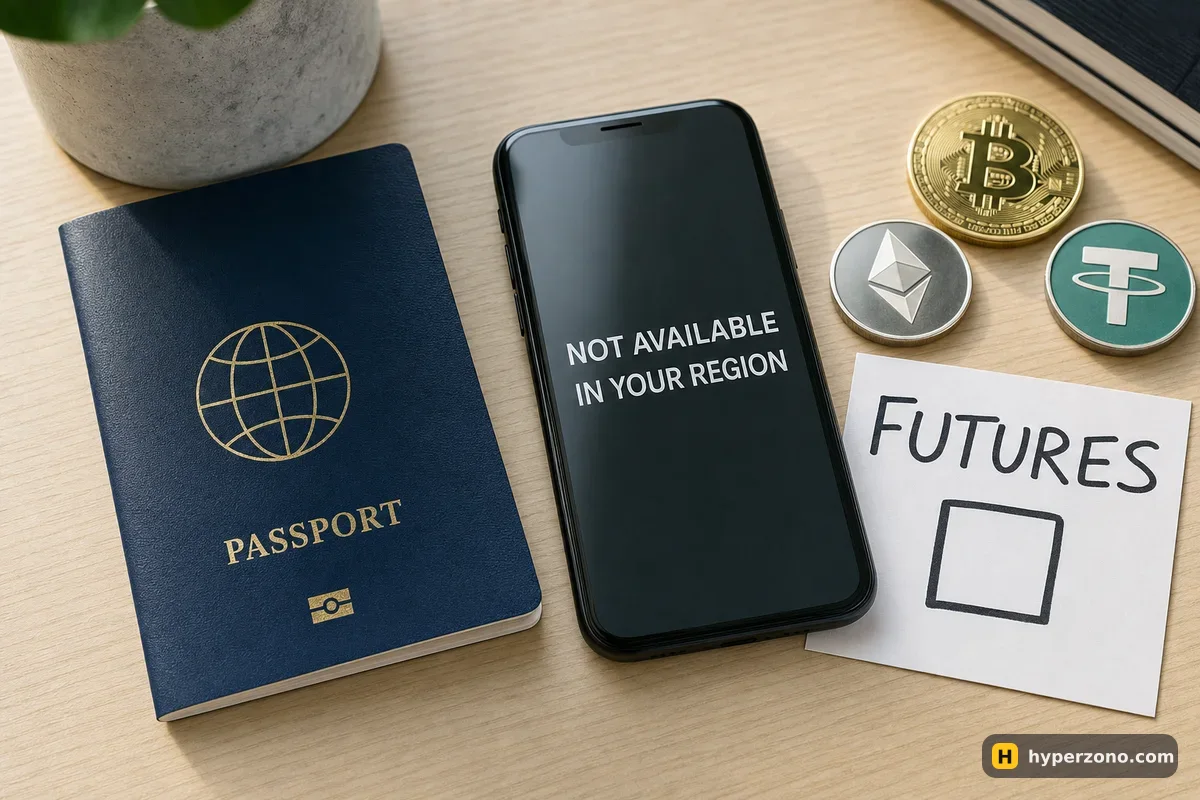
Why futures get restricted in some countries
Futures let you trade with borrowed money, and most countries treat that as a serious financial product, not just buying coins. On exchange pages and in the app this whole group of products is usually called derivatives — that is where futures live. Offering them to local residents normally needs a local licence, and that licence comes with rules about leverage caps, risk warnings and who is allowed to trade at all.
An exchange without that licence has a simple choice: switch the product off for people living there, or argue with a regulator. Almost all of them switch it off. That is why the answer is rarely a flat yes or no — in many places spot trading works normally while perpetual futures are simply hidden. A country appearing on a restriction list often means "some services off", not "the whole exchange blocked".
What each exchange says about countries
Binance never publishes a list of places where futures do work — only where they don't. Its terms mark Cuba, Iran, North Korea, Syria and the Crimea region as high risk, the United States, Canada and the Netherlands are listed as prohibited, and derivatives are not offered in the United Kingdom, Brazil, Australia, South Korea, New Zealand or Hong Kong. A 2021 notice also withdrew futures in Germany, Italy and the Netherlands; that notice has never been updated, so whether it still holds today is simply unclear — the sign-up screen will answer faster than the announcement will.
Bybit keeps one page of service-restricted countries, last updated on 16 October 2026, and says plainly that the list is not exhaustive. On it are the United States, mainland China, Hong Kong, Singapore, Canada, Uzbekistan, Sudan and the sanctioned countries, plus Dubai for one Bybit company. If you live in the European Union or the wider European Economic Area, Bybit signs you up through a separate company, Bybit EU GmbH, on its own site with its own account and its own terms.
OKX puts its restrictions in a compliance disclosure, last updated on 8 July 2026. Some countries lose the service entirely — Canada, India, Japan, Malaysia, Nepal, Afghanistan, Hong Kong, Uzbekistan and the sanctioned places among them — while Brazil, South Korea and the United Kingdom keep spot and lose only derivatives. OKX has more than one version of this page, because more than one OKX company exists. The one that matters is the one shown to you after you register with your country — read that one, not the first page Google gives you.
Gate puts its restrictions in the user agreement, updated on 22 July 2026, and its list is by far the longest — more than thirty places, from the UK, Germany, France and Spain to India, Japan, South Korea, Indonesia, Vietnam, the Philippines and the UAE. Gate also says a restriction may cover only part of the services, so a country on that list is not automatically a full block, and it can change the list without notice.
Hyperliquid names no countries at all. If you connect from a place it does not serve, the app just says you are in a restricted jurisdiction and stops there — which means the only way to find out is to try opening it.
One exchange's "no" is not another's. India is named by OKX and Gate, while Bybit's page does not name it — which is still not a promise that it works there. The only check that counts is the one you run on your own account, and the quickest version is to start a Binance sign-up with the country you really live in and see what the app offers you.
The same country, different rules on different exchanges
Large exchanges are not one company. In Australia, retail clients of OKX's local company can trade USDT-margined perpetuals at up to 2x leverage — twice your own money, no more — after passing a short knowledge test. In the UAE, the local OKX company offers futures and perpetuals after a suitability test, and Bybit does the same thing in the EEA through its Austrian-licensed company, as above.
A 2x cap looks tiny next to the three-digit numbers in the ads, and for a first trade it honestly is not the problem it seems — low leverage is what stops a small account from being wiped out on one bad move, which is the whole point of choosing your leverage carefully. The real catch is different: products, fees and even the list of available coins can differ between the global service and a local one, so read the local terms instead of assuming the global page applies to you.
How to check your own country before you deposit
Open the exchange's own restriction page
Look for "Terms of Use", "Restricted locations" or "Service-restricted countries" in the footer or the help center, and search that page for your country. If it is there, read which services the restriction covers — it is not always all of them.
Start the sign-up with your real country
Register with the country you actually live in. Blocks usually show up right here: either the registration refuses, or it goes through and you are sent to a local company with its own terms.
Look for the derivatives section (that's where futures are)
The fastest answer comes from the app itself. If you sign up on Bybit and the derivatives section opens for your account, that tells you more than any country list you will read online.
Check leverage and contracts, not just access
If a local company signed you up, the leverage cap and the list of contracts may look different from the global version. Some accounts also have to pass a knowledge or suitability test first.
Deposit only after all of the above
Funding an account you cannot trade on, then withdrawing again, costs time and sometimes fees. Payment methods vary by country too — that side of things is covered in funding by card.
Hiding where you live does not make you eligible. Making the sign-up screen believe you are somewhere else may get you an account, but your country is checked again when you verify your identity, and again when you ask to withdraw. If what you declared does not match your documents, the account can be frozen with your money inside it, and the exchange is within its rights under the agreement you accepted. We do not help readers get around country restrictions — there is no version of this that ends well.
What you tell the exchange about where you live has to be true
When you verify your identity, you state where you live, and the exchange uses that answer to decide which company serves you and which products you see. Documents showing one address while your connection keeps pointing somewhere else, or a phone number from a restricted country, can trigger a review later — usually at the worst moment, when you ask to withdraw a profit. If you have genuinely moved, update your details rather than leaving the old country in place. The practical side of all this is in do I need KYC to trade futures.
If futures are closed where you live
You still have honest options. Spot trading is often available on the same exchange, and while it works differently — no leverage, no shorting — it teaches you the same markets; the differences are laid out in futures versus spot. In several countries, locally licensed brokers and exchanges do offer leveraged crypto products under local rules, and those are the ones to look at, because your money then sits inside your own legal system. And if you mainly want to learn the mechanics first, practising without real money does not depend on where you live at all.
Is Binance Futures available in my country?
Binance only publishes where futures don't work, not where they do. If your country isn't on that list, the sign-up screen is your answer — it takes a couple of minutes. Derivatives are switched off in the United Kingdom, Brazil, Australia, South Korea, New Zealand and Hong Kong, and an old 2021 notice also covers Germany, Italy and the Netherlands.
In which countries are crypto futures restricted?
Across the exchange pages, the names that keep coming up are the United States, Canada, mainland China, Hong Kong, Singapore, the United Kingdom, Japan, India, South Korea, Brazil and sanctioned countries such as North Korea, Iran, Cuba and Syria. Several European countries appear too, depending on the venue. Because no two lists match, check the one belonging to the exchange you actually want to use.
Can I trade futures if my country is blocked?
Not honestly, and we will not explain workarounds. The country you declare is matched against your documents at verification and checked again when you withdraw, and a mismatch can leave the account frozen with your balance inside. If your country is restricted, look at spot trading or a locally licensed provider instead.
My country is on the list, but the app still lets me trade. Is that fine?
Access today does not mean access tomorrow. Exchanges often tighten enforcement later and close positions or limit the accounts of residents in restricted places. Trading there means your money depends on a rule the exchange can apply at any moment, which is a risk sitting on top of the market risk you already have.
Do all exchanges restrict the same countries?
No, and the differences are large. Gate's agreement lists more than thirty places, OKX names a different set and blocks derivatives specifically in a few countries while allowing spot, and Bybit's list is shorter but explicitly incomplete. If one venue is closed to you, checking a second is reasonable — choosing by rules and fees rather than guesswork is covered in the best exchange for a beginner.
Why does the leverage cap in my country look so low?
Because a locally licensed company is serving you, and local retail rules often cap leverage — OKX's Australian company, for example, offers retail clients up to 2x leverage, twice your own money and no more, after a short knowledge test. For a first trade that limit is far less of an obstacle than it looks; low leverage is what keeps a small account alive long enough to learn.