
Contents
What is exactly the sameOn demo your order usually fills at the price you sawThe costs demo may quietly skipWhy you win on demo and lose on real moneyHow to make demo much closer to real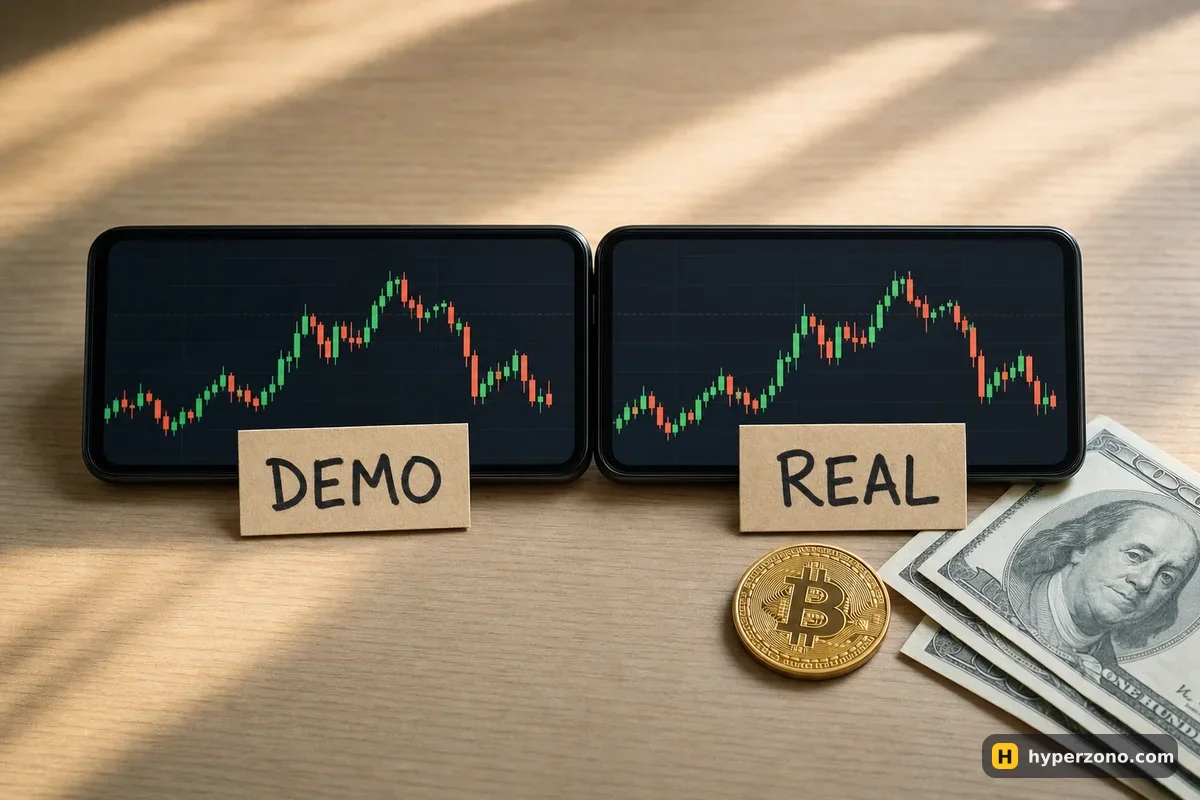
What is exactly the same
The mechanics are not fake. A long still makes money when the price goes up, a short when it goes down, liquidation still happens when your margin runs out, and the order window has the same fields you will use for real. That is why practice is worth doing at all: you learn where to tap, how to set a stop-loss, how leverage changes the size of your position. If you have not picked a place to practise yet, see which exchanges offer demo futures trading.
On demo your order usually fills at the price you saw
In most simulators your market order is filled — that is the word traders use for an order that has been executed — at the price you were looking at, in full and instantly. A live order can land a little worse than the number on the screen, especially when the market is moving fast after news. A stop order shows this most clearly: the trigger price is not the execution price, so a stop-market can close you at a worse price than the one you set — lower if you were long, higher if you were short — and a stop-limit may not fill at all, which is the opposite problem.
The difference is tiny on bitcoin and ethereum, where a lot of people are trading all the time. On a quiet altcoin there may be very few orders sitting right at the price, so a market order can fill a noticeable distance away from the number you tapped. On demo that thinness is easy to miss, because the simulator usually just hands you the price on the screen. One more reason to keep your first real trades on the big, busy pairs.
The costs demo may quietly skip
A real trade pays a fee when you open it and another when you close it, calculated on the whole position — not on your margin. If you hold a perpetual contract through a settlement time, you also pay or receive funding. Some simulators copy all of this, some only copy part of it, so look at the demo trade history and see whether a fee line and a funding line are actually there. If they are missing, your demo results are flattering you by a small amount on every single trade, and a lot over a hundred trades — the full list of what you really pay is on the trading fees page.
| On demo | With real money | |
|---|---|---|
| The price you get | Usually the number you saw, instantly | Can be slightly worse, especially on fast moves |
| Small altcoins | Look as busy as bitcoin | Few orders near the price, so your fill can land further away |
| Fees and funding | May be simplified or absent | Charged on every entry, exit and funding time |
| Your nerves | Calm, you follow the plan | Fear and greed show up immediately |
Why you win on demo and lose on real money
This is the honest answer to the question most people are really asking. When the balance is imaginary, you set a stop and let it do its job, you take a planned profit, and you walk away after a losing trade. When it is your own 100 USDT, the same red number on the screen feels different: you move the stop a bit further away to give the trade "a chance", you close a winner early because you are afraid it will turn, or you open a second trade straight after a loss to get the money back.
None of that shows up in a simulator, because nothing hurts. It is not a character flaw — it is simply a part of trading you cannot practise with fake money. What you can do is build the habits now, so that when real money arrives you already know exactly what you are supposed to do.
How to make demo much closer to real
Trade the size you will actually trade
Your demo account may come with a large virtual balance — ignore it. If your real account will be 100 USDT, open trades the size you would open with 100 USDT, not the size the practice balance allows.
Put a stop-loss on every single trade
Decide the exit before you enter and never touch it afterwards. If you cannot do that on demo, you certainly will not do it live — see what a stop loss is and why you need one.
Subtract the costs by hand
If your simulator ignores fees, write down an estimated entry and exit fee for each trade in your notes. Your results will suddenly look more honest.
Keep a short journal
Date, coin, direction, why you entered, where the stop was, result. Twenty lines will teach you more than two hundred untracked trades.
When you want the simulator and the live terminal to feel identical, use the same app for both — sign up on Bybit, practise in demo mode, and the day you switch, nothing about the layout surprises you. For other ways to learn without risking money, there is a separate page on practising without real funds.
Start real with an amount that does not scare you. The jump from demo to live is mostly emotional, so make the emotion small. A first live position that risks a couple of dollars teaches you the feeling without punishing you for it. When you are ready to make that move is covered in going from demo to real money.
Is demo trading realistic?
The mechanics are realistic — prices, charts, leverage, liquidation. What is less realistic is the execution price you get, possibly the costs, and definitely the way you feel. Treat demo as a check that you know the buttons, not as proof that your strategy makes money.
Why do I win on demo but lose with real money?
Almost always because the rules you followed calmly with fake money get broken with real money: you move the stop, close winners too early, or open a revenge trade after a loss. Fees and a slightly worse execution price take a bite too, but they are usually the smaller part of the gap.
Is paper trading the same as demo trading?
Yes, people use both words for the same thing: simulated trades with no real money at risk. Paper trading sometimes means writing trades down by hand instead of clicking them in an app, which is slower but works fine for practising a plan.
Does demo profit mean I am ready for real trading?
Not by itself. A profitable week on demo can be luck, and demo cannot test your discipline. Look for boring consistency — the same size, the same stop, the same routine over many trades — then start live with a tiny amount.
Should I use high leverage in demo to learn faster?
No. Trade on demo with the leverage you plan to use for real, otherwise you are practising a different game. High leverage on a simulator mostly teaches you that liquidations happen quickly, which you can learn once and then stop repeating.
Can I choose how much virtual money my demo account has?
That depends on the exchange — you'll see how much practice money you get when you switch the app into demo mode. Either way, don't let a big fake balance decide your position size: trade the size that matches the real account you plan to open.
Will the contract I want be there in demo mode?
Not always. Demo accounts usually cover the main coin pairs, but stock, index or commodity contracts may be missing. Check your chosen ticker in the demo list, and if it is not there, practise the mechanics on a contract that is available.