Contents
Binance Wallet vs your Binance exchange accountWhat you can actually do in the walletBinance Wallet perpetuals run through AsterThe one job nobody can do for you: the backupWho it is for, and who should stay on the exchangeBinance Wallet vs your Binance exchange account
When you deposit USDT into your normal Binance account, Binance holds that money for you. You log in with a password and a code, and if you lose the phone you can get back in through support. That is a custodial account, and your futures trades there happen on Binance's own platform.
The wallet works the other way round. The keys are yours, so there is no password reset and no support line that can move your coins back. It is a keyless wallet, which means there is no 12-word seed phrase to write down. Instead you set up a backup, and that backup is the only way back in. Only a verified Binance user can create one, and the operator is Binance Barbados Limited, which is not supervised by a regulator.
What you can actually do in the wallet
Three things, mostly. You can swap one token for another straight from the wallet, without sending it to the exchange first — the swap happens on the blockchain itself. You can hold and look at small or new tokens that never reach the exchange listing. And you can open perpetual futures trades — people usually just say perps.
There is also a mix of extra features — meme coin sections, prediction markets, early-stage tokens — and whether a beginner needs any of that is a fair question, answered in the tour of the wallet's other features. Trading perps from a wallet instead of an exchange account is a broader idea than just Binance; if you want the general picture of how that works anywhere, read can you trade futures from a crypto wallet.
Binance Wallet perpetuals run through Aster
This is the part most people miss. The perpetual contracts you see in the wallet are not Binance Futures contracts. They are provided by a third-party protocol, Aster, on BNB Smart Chain only — available in the web version since 14 January 2026 and in the app since 14 April 2026. Binance is not your counterparty there, and help with a trade goes through Aster's own Discord, not Binance support.
On crypto contracts, Aster charges nothing if your order sits and waits to be filled, and 0.04% if you take the price that is already on the screen. On a 500 USDT trade that 0.04% is 20 cents. Take the price on the screen going in and coming out and you pay it twice — 40 cents for the round trip; wait for your own price and that side costs you nothing. On stock and commodity contracts the taker fee is 0.0125%.
Funding is charged every 8, 4 or 1 hour depending on the contract, so a position held overnight can pay or receive several times; how funding works explains the mechanics, and what futures trading costs adds up everything else. Maximum leverage is not published in Binance's own materials, so check what the slider allows in the app rather than trusting a number you read somewhere.
The full walkthrough is in how perpetuals work in Binance Wallet, and the button-by-button version in how to open a trade there.
There is one limit you cannot get around. Aster's terms forbid use by residents of, and people located in, Russia, Ukraine, the USA, Canada, the United Kingdom, China and other places. If that includes you, perpetual futures in the wallet are not an option, and the honest route is ordinary Binance Futures where it is available to you — check that during sign-up.
The one job nobody can do for you: the backup
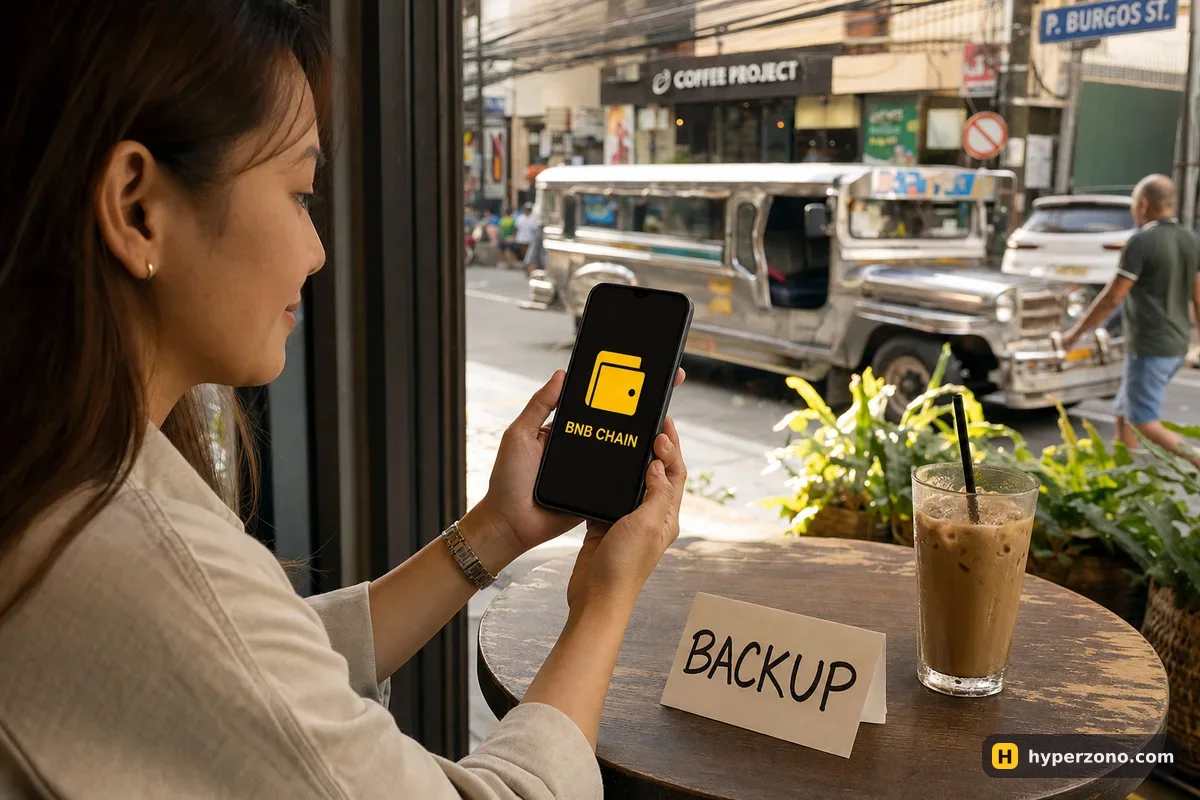
Because the wallet has no seed phrase, the backup replaces it. You can use Quick Backup with your biometrics, where part of the key is held by a third-party provider, or save an encrypted backup to iCloud or Google Drive with a recovery password you choose, or use a QR code. Perpetual contracts in the wallet are simply not available until a backup exists.
Here is the part to take seriously. If you forget that recovery password and then lose the phone or delete the app, Binance cannot restore the wallet and the money in it is gone. Set this up calmly, before you put anything meaningful in — the steps are in creating, backing up and funding a Binance Wallet.
Check the way back the same day. Write the recovery password somewhere off the phone, and in the wallet check that it shows your backup as done. If the app says there is no backup, perpetuals will not open for you anyway. Do this while the wallet is still almost empty: checking the backup now costs you nothing, and finding out it does not work after you lose the phone costs you everything in the wallet.
Who it is for, and who should stay on the exchange
If this would be your first futures trade, the regular exchange side is the gentler place to learn. One balance, a familiar order window, demo mode, support you can write to, and a stop-loss you set in the same screen as the order. You can open a Binance Futures account and follow the step-by-step walkthrough without touching the wallet at all.
The wallet makes sense when you specifically want to hold your own keys, or you are interested in tokens that never appear on the exchange. The honest comparison of the two, side by side, is in Binance Wallet or Binance Futures, and the things that can go wrong — a wrong network, a lost backup, liquidation on a contract you cannot get support for — are collected in the risks page.
Whichever side you trade on, the underlying mechanics are the same, so it is worth reading the basics and what can go wrong first. A perpetual contract behaves the same way whether Binance or Aster is matching it: the same leverage, the same liquidation, the same funding payments.
Is Binance Wallet the same as my Binance account?
No. Your Binance account is held by Binance, and you can recover it through support. The wallet sits in the same app but holds your coins on the blockchain under your own keys, so recovery depends entirely on the backup you set up. Money does not move between the two by itself — you send it across like any other transfer.
Does Binance Wallet have a seed phrase?
It does not. It is a keyless wallet, so there are no 12 words to write down. Instead you protect it with Quick Backup using biometrics, or a backup to iCloud or Google Drive secured by a recovery password, or a QR code. If you lose both the device and the recovery password, Binance cannot bring the wallet back.
Are the perpetuals in the wallet Binance Futures contracts?
No, and this matters. They are executed by Aster, a separate protocol, on BNB Smart Chain, and Binance is not your counterparty. Fees, funding intervals and available contracts come from Aster, and trade support goes through Aster's Discord rather than Binance support.
Can I use Binance Wallet perpetuals in my country?
Aster's terms prohibit use by people in Russia, Ukraine, the USA, Canada, the United Kingdom, China and others, and Binance's own availability varies by country too. Check both in the app while signing up — never try to work around a restriction.
Is it cheaper to trade perpetual futures in the wallet?
On crypto contracts Aster takes nothing when your order waits to be filled and 0.04% when you take the price already on the screen, which looks attractive next to exchange fees. Funding is also charged as often as every hour on some contracts, and moving coins in and out of the wallet may cost you something on top — check what the app shows before you confirm the transfer. Compare the whole cost of a trade, not one line of it — see what futures trading costs.