
Contents
What to decide before you tap anythingWork out the size from the money you can loseSet isolated margin and low leverage firstPlacing the order: your first leveraged tradeAttach the stop loss and take profit right awayClosing it, and writing down what happenedIf the exchange will not let you open the tradeDo the dry run first if you are nervous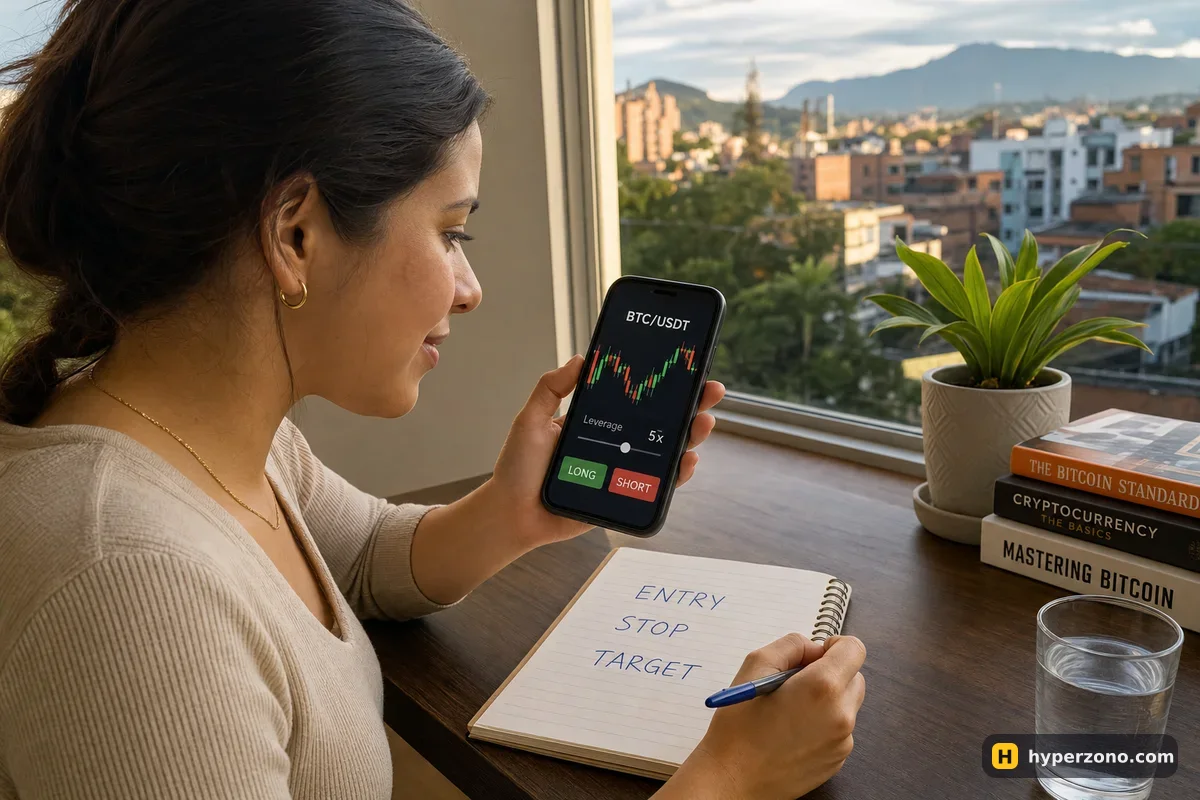
What to decide before you tap anything
A first trade usually goes wrong for one simple reason: the person opens it before deciding how it ends. The price moves, they feel something, and they start making decisions with money already on the line. You can avoid all of that by spending two minutes on a short checklist and writing the answers down somewhere you can see them.
Six lines, and the order matters. You decide the first five; the size then falls out of them, because it is the money you are willing to lose that tells you how big the trade can be.
- The pair — for example BTCUSDT or ETHUSDT, a contract with a lot of trading so your order fills instantly.
- The direction — up (long) or down (short), and one plain sentence saying why.
- The price where you admit you were wrong — your stop loss.
- The worst case in USDT — the money you lose if that stop is hit. For a first trade, something like 1 or 2 USDT.
- The price where you take the money — your take profit.
- The size of the trade in USDT — the value of the position, worked out from the lines above.
If you cannot fill in all six lines, you are not ready to press the button yet — and that is fine, nothing is running away. The order of those lines matters: you decide what you are willing to lose first, and the size of the trade follows from it, never the other way round.
Work out the size from the money you can lose
Say you have 100 USDT in your futures account and you are willing to lose 1 USDT on this first trade. You look at the chart and decide that if the price moves 2% against you, your idea was wrong. A 2% move has to equal 1 USDT, so the position itself should be worth about 50 USDT. That 50 USDT is the size of the trade; it is not the money that leaves your balance.
With 5x leverage, a 50 USDT position asks you to set aside about 10 USDT as a deposit, and the other 90 USDT in your account just sits there. If the price goes your way by 4%, you make about 2 USDT. If it goes against you by 2% and your stop fires, you lose about 1 USDT plus a few cents of fees — on Binance's base level the taker fee is 0.05%, so entering and leaving a 50 USDT position costs around 0.05 USDT in total. Small money, real mechanics, nothing to panic about. If you want the longer version of this arithmetic, there is a whole page on how to work out your position size.
Once you have your number, check it against one practical limit: every contract has a minimum size, and your planned size has to clear it. On Binance, bitcoin starts at 0.001 BTC, which at today's prices is far more position value than our 50 USDT example, while ether starts at 20 USDT of position value and most altcoin contracts start at 5 USDT. So if your risk-based size comes out small, choose a contract whose minimum fits it rather than inflating the trade — you can open a Binance Futures account and read the minimum on the contract details before you commit any money.
Set isolated margin and low leverage first
In the order window there is usually a small button at the top showing something like "Cross" or "Isolated" and a number with an x next to it. Change those two before you do anything else. Isolated margin means only the money you assigned to this position is at risk — if everything goes wrong there, the rest of your balance stays out of it. Cross margin puts your whole free balance behind the position, which is not where a first trade belongs; the difference is explained in cross margin vs isolated margin.
Then the leverage number. Keep it low, because leverage decides how far the price can run against you before the exchange steps in and closes the trade on its own, before the deposit you put behind that position runs out. That price is your liquidation price. At low leverage it sits far away from your entry, so normal market noise cannot reach it, and your stop loss should always be hit long before liquidation becomes a question. There is a separate page on what leverage to pick for a first trade, and it is worth two minutes.
Isolated long of 50.00 USDT, 5× leverage, maintenance margin 0.50% of position size (example). Simplified model without closing fees, risk-limit tiers or other positions — the exchange will show its own price.
Placing the order: your first leveraged trade
Move the money to the futures account
Futures use a separate wallet inside your exchange account. Transfer the USDT across — it is an internal transfer between your own wallets and takes a second.
Open the contract you chose
Search the pair, for example BTCUSDT or ETHUSDT, and make sure you are on the perpetual futures contract and not the spot page. The order window will show Buy/Long and Sell/Short buttons and a leverage setting — spot pages have neither.
Set isolated margin and your leverage
Tap the margin mode and the leverage field at the top of the order window and confirm both before entering any numbers.
Type the size you worked out
Enter the position value from your checklist. Look closely at what the field means: some apps let you switch between the quantity in coins, the value in USDT and the margin you are putting up. If the app refuses the number, you are below the contract minimum — switch to a contract with a smaller one instead of raising your risk.
Choose market or limit
A market order fills right now at whatever the price is. A limit order waits for your price and may never fill. For a first trade on a liquid pair, a market order is the simplest.
Confirm and read the position line
Tap Buy/Long or Sell/Short. Your position now appears below the chart with the entry price, the margin used, the liquidation price and a profit figure that moves every second. That moving number is normal. Do not act on it yet.
Button names differ a little between apps, but the order of actions does not. If you want the exact screens for one exchange, there is a full walkthrough of trading futures on Binance step by step.
Attach the stop loss and take profit right away
This is the part beginners skip, and it is the part that keeps the loss at the size you agreed to. Many apps let you fill in a take profit and a stop loss inside the same order window before you confirm; if yours does not, tap the open position and add them there — it takes about fifteen seconds. Put in the two prices you wrote on your checklist, nothing else.
Once both orders are sitting on the position, the trade can finish without you. You can put the phone down, go to work, go to sleep. That is the real point of a first trade: proving to yourself that you can walk away from an open position. The full setup is covered in how to set a stop loss, and it is worth knowing that a stop is an instruction to close, not a promise about the exact price — in a fast market it can fill a little worse than the level you typed.
The job of your first trade is not profit. It is to see every step work with real money: the order fills, the position shows up, the stop sits where you put it, the money comes back to your balance when it closes. Judge the trade on whether you followed your own plan, not on whether you made two dollars.
Closing it, and writing down what happened
Most of the time one of your two orders will do the closing for you. If you want out early — the reason you entered has disappeared, or you simply want the experience of finishing a trade by hand — tap the position and close it at market, then check that your leftover stop and take profit orders disappeared with it.
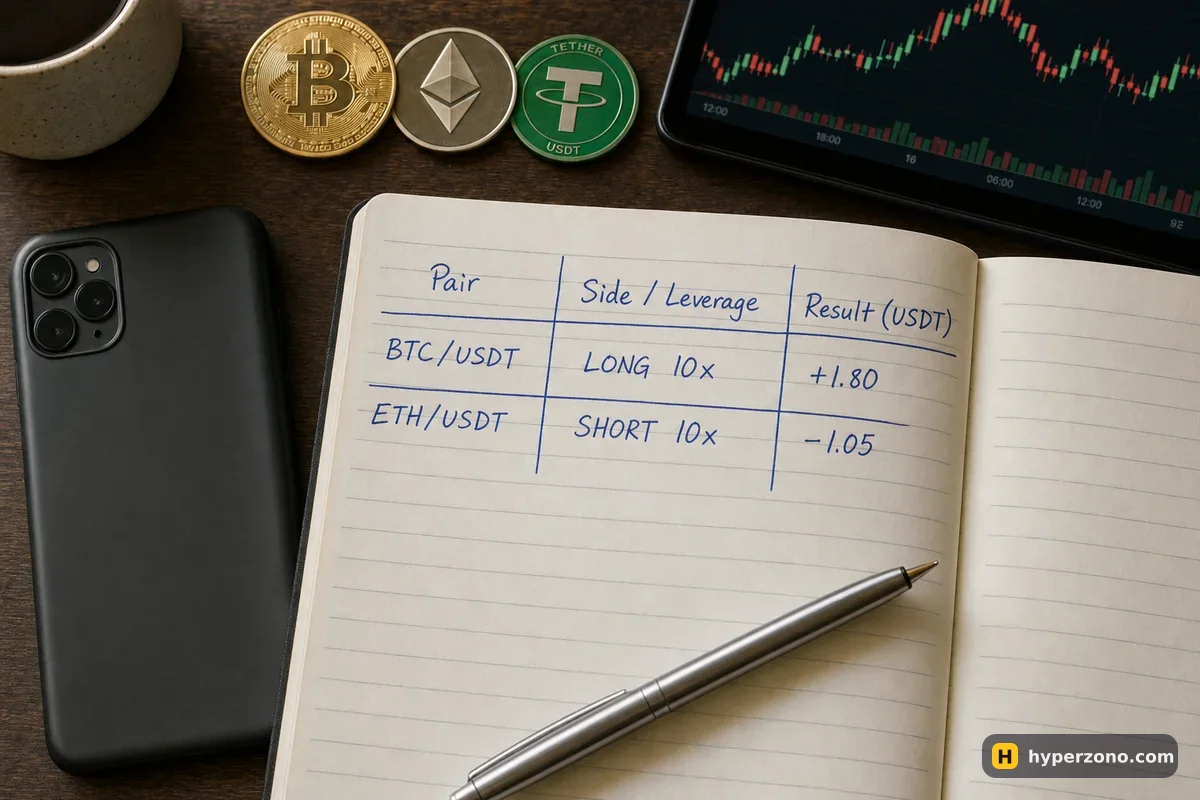
Then open a notebook or a notes app and write five things: the date, the pair and direction, your entry and exit, the result in USDT, and one honest sentence about what you did. "Moved my stop because I did not want to be wrong" is a more valuable line than "+1.80". After ten trades, that notebook tells you more about your trading than any indicator will, and the mistakes it shows are usually the same ones that quietly empty most first deposits.
If the exchange will not let you open the trade
"Order value too small" or "quantity below minimum" means your risk-based size is under that contract's minimum — move to a contract with a smaller minimum rather than pushing your size up. "Insufficient margin" usually means either your money is still sitting in the spot wallet, or the position you typed needs more deposit than you have free; lower the size first, and only then think about leverage.
If the leverage slider will not go where you expect, that can be a platform rule rather than a glitch — on Binance, for example, leverage above 20x is not available during the first 30 days of a futures account. For a first trade this changes nothing, because you were not going anywhere near 20x anyway. And if the futures section is missing from your app entirely, check in the app whether futures are offered where you live before you try anything else; availability really does differ by country. Never try to get around a block.
If your stop was hit within a minute of entry, nothing is broken. It usually means the stop was too close to the entry for that coin's normal movement. Widen the distance on the next attempt and shrink the position so the loss in USDT stays the same.
Do the dry run first if you are nervous
There is no prize for using real money on day one. Demo trading repeats every step above with play balance, so you can learn where the buttons are, misclick a few times and see what a liquidation looks like without paying for the lesson. Bybit has a demo mode with play money — you'll find the switch in the app. Sign up on Bybit, check that futures are available where you live, practise the whole sequence on demo, then repeat it with a small real amount when the steps feel automatic.
What demo cannot teach you is how you behave when the money is yours — that part only shows up live, which is exactly why the first real trade should be sized so small that it cannot hurt you. Keep the possible loss at a level that bores you, and you will make clear decisions.
How much money do I need for my very first futures trade?
Less than people expect. With 50–100 USDT in the account you can risk 1–2 USDT on a trade and still feel every step for real. The thing that can block you is not your balance but the contract minimum: bitcoin contracts need a much larger position than small altcoin contracts do, so pick a contract whose minimum fits the size your risk allows.
Should my first trade be a long or a short?
Whichever matches the simple reason you wrote on your checklist. Mechanically they are mirror images — a long makes money when the price rises, a short when it falls — and the order window works the same way for both. Many people start with a long because it feels more natural, but nothing stops you going short if that is what you actually think.
What leverage should I use the first time?
Low. Leverage does not make you richer at the same position size; it only decides how much of your balance is tied up and how close the liquidation price sits to your entry. For a first trade, pick a number that leaves liquidation far away and let your stop loss do the work instead.
How long should I hold my first trade?
Until one of your two orders fires, which on a small intraday idea is usually minutes to hours. Perpetual contracts have no expiry date, so a position can stay open for days if you let it — just remember that funding payments happen every few hours while it is open.
What if the price moves against me right after I enter?
That is normal and your plan already covers it: either the price comes back, or your stop closes the trade for the small loss you agreed to. The dangerous move is dragging the stop further away to avoid being wrong. If that urge appears, your position was too big for you.
Can I close only part of the position?
Yes, on most exchanges you can close any portion and leave the rest running. On a first trade this small there is little point splitting it, but it is a useful habit later on when you want to take some profit and keep a smaller position open.