
Contents
What actually goes wrongThree controls that do most of the workCan you lose more than you put in?The risk that lives in your headWhere to start in this section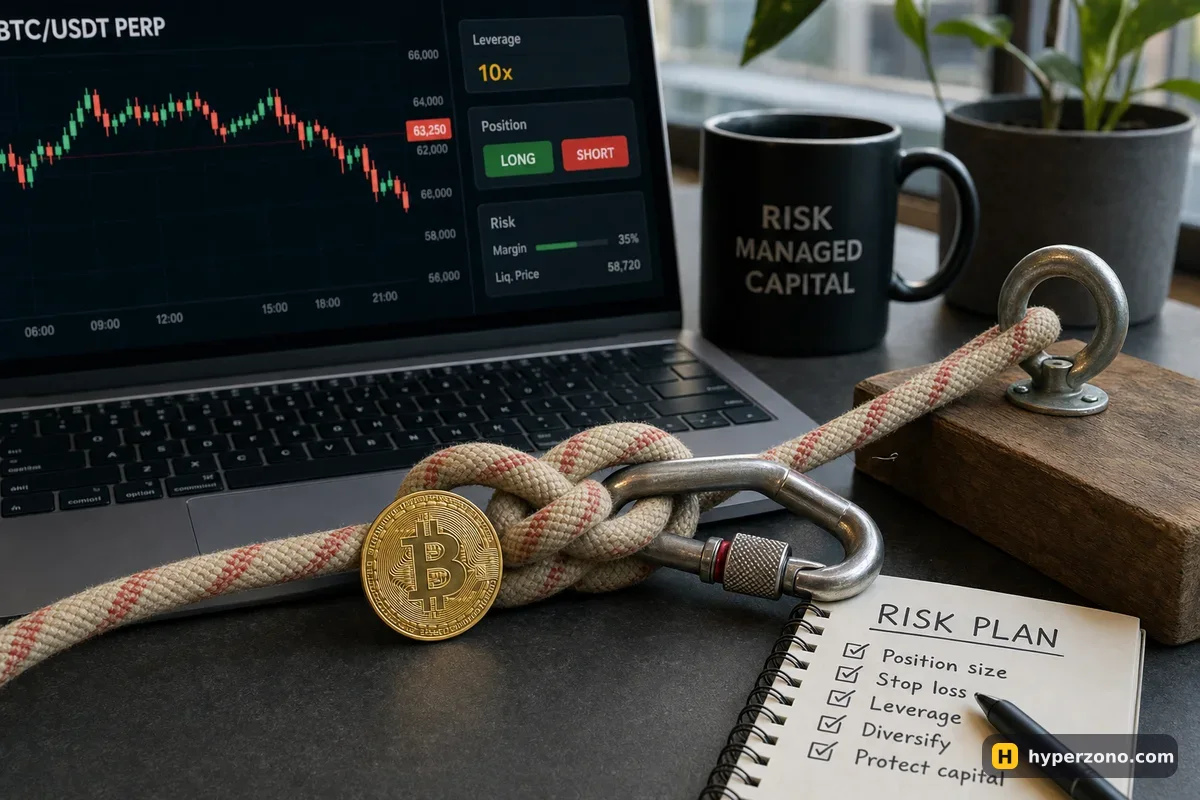
What actually goes wrong
The one most people worry about is liquidation: the price moves against you far enough that the money you set aside for the trade is nearly gone, and the exchange closes the position for you. You don't get a second chance at that price, and the loss is final. How close that point sits to your entry is something you can see in advance — that's what liquidation and the liquidation price are about.
Leverage is what brings that point closer. It doesn't make you richer on its own; it lets you open a bigger trade with the same money, so both the profit and the loss move faster. At 50x, a 2% move against you is roughly the whole margin on that trade. The danger isn't the leverage number itself — it's choosing 50x without ever checking that a 2% move takes everything you put into the trade. Start with what leverage a beginner should use.
Then there is the quiet one: trading without a stop loss. Without it, your exit plan is "I'll watch" — and nobody watches at 3 a.m. Close behind comes oversizing, where one trade carries so much of your balance that a normal, boring move hurts your account badly. And after that loss comes the chain: a bigger trade to win it back, then a bigger one again. Why beginners lose money is the checklist version of all of this.
Three controls that do most of the work
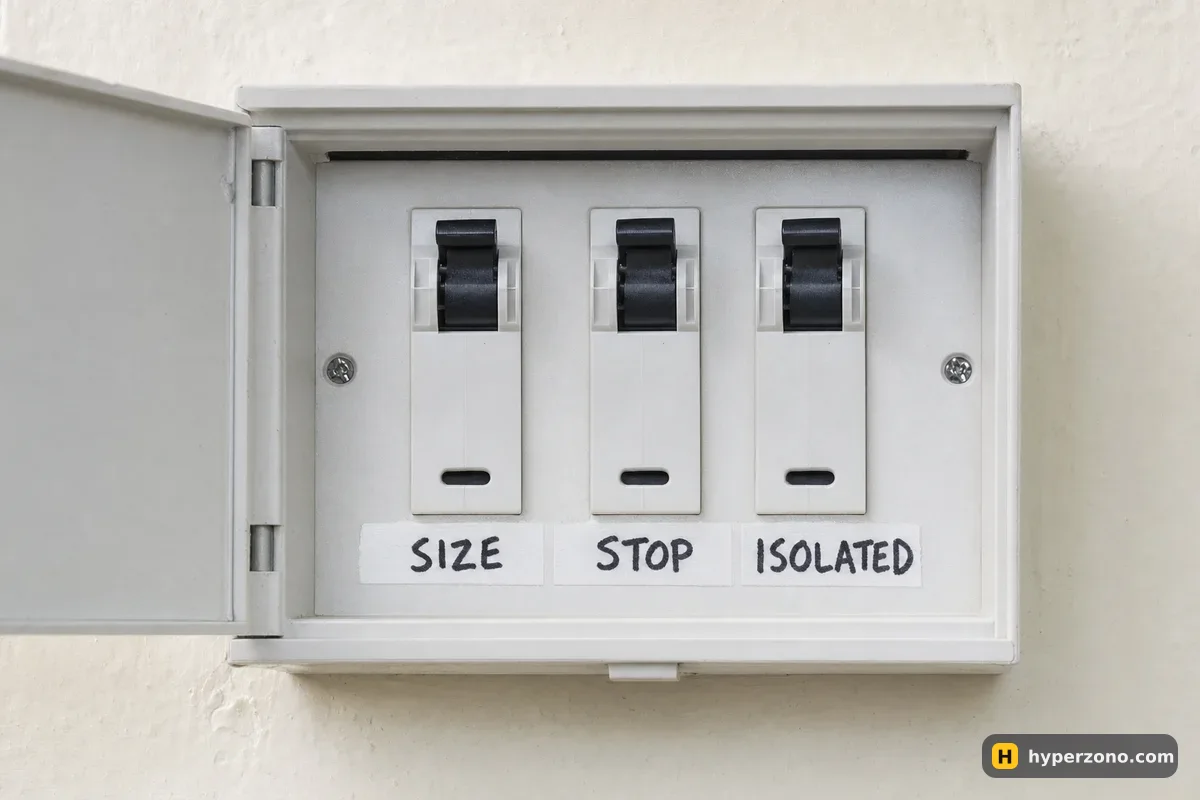
You don't need ten rules. Three settings, chosen before you press the button, cover most of the damage.
The first is position size. Decide what a single trade is allowed to cost you — many people use 1–2% of their balance — and work backwards from your stop to the size that fits. How to work out how much to put into one trade walks through it, and the calculator below does the arithmetic for you.
The second is the stop loss: an order that sits on the exchange and closes the trade at a price you chose while you were calm. Say you have 100 USDT and you open a 500 USDT position on bitcoin — illustrative numbers, but close to what a first trade looks like. With a stop 1% below your entry, a bad trade costs you about 5 USDT and your account barely notices. Without a stop, nothing closes the trade for you — the price keeps going and the loss keeps growing until the exchange closes it for you. Read what a stop loss is and then how to set one.
The third is isolated margin. In isolated mode, the trade can only use the margin you assigned to it, so a disaster on one coin doesn't reach into the rest of your balance. Cross mode uses the whole free balance and links your positions together — handy later, dangerous early. Cross or isolated for a beginner explains the choice; the switch sits in the order window, and the easiest way to see it is to sign up on Bybit and open the order screen before you fund anything.
A stop loss is a request, not a promise. If the price jumps straight past your level — a news gap, a thin weekend market — your trade closes at the next available price, which can be worse than the one you set. It still beats having no stop at all. What a stop loss does and doesn't guarantee covers the gap case honestly.
Can you lose more than you put in?
In normal conditions, no: the exchange closes the position while there is still margin left, and that liquidated trade is where your loss stops. If a liquidation closes worse than planned, exchanges have a fund that can cover part of the shortfall — but no exchange promises it always will. When it doesn't, some exchanges close part of a profitable position on the other side instead; that's called auto-deleveraging, and you may see those letters, ADL, somewhere in the app.
So the honest version is this: losing the margin on a trade is ordinary and expected, losing the whole account is possible if you size badly, and ending up below zero is rare but not something anyone can promise you away. Can you lose your whole deposit and can you end up owing the exchange deal with both ends of that. Isolated margin and small size are what keep the question theoretical.
The risk that lives in your head
The technical risks are the easy half. The expensive half is what happens after a loss, when you feel the urge to get it back right now — bigger size, higher leverage, no stop, a coin you've never traded. That one trade can undo a month of careful ones.
Overtrading works more slowly but gets there too: ten trades a day, each one paying entry and exit fees, each one taken out of boredom rather than a plan. A simple guard is a daily limit you set in advance — two or three trades, or a loss figure that ends your day. Writing the trade down before you open it helps as well; how to write a plan for a single trade shows what to put on the page.
Where to start in this section
If you are completely new, read liquidation first, then stop loss, then position sizing — in that order they build on each other. Before a real trade, run your numbers through the liquidation calculator and the position size calculator so you know, in dollars, what the trade can cost you.
Two costs that quietly eat results — trading fees and funding on perpetual contracts — have their own home in what futures trading costs. The mechanics of placing, moving and closing orders live in managing a position. And if you'd rather meet all of this without money on the line first, learning without real money explains demo mode and what it does and doesn't teach you.
Is futures trading risky for a beginner?
Yes, and pretending otherwise would be dishonest. The difference between risky and reckless is whether you decided in advance how much one trade can cost you. With a 500 USDT position and a stop 1% away, a bad trade costs you about 5 USDT; without a stop, nothing closes that trade for you while the price keeps going.
What is the biggest single risk in crypto futures?
Position size. High leverage gets blamed, but a huge trade is what turns a normal 2% move into a disaster. Work out your size from the loss you are willing to accept, and the leverage number stops being scary.
Can I lose more money than I deposited?
Usually not — the exchange closes the position while margin is still left. In a sudden price jump it can skip past that point, so nobody can promise it never happens; isolated margin and small size keep this from becoming your problem.
How do I manage risk in futures trading day to day?
Decide the loss per trade before you open it, place the stop at the same time as the entry, keep each trade in isolated margin, and set a limit on how many trades you take in a day. Four habits, and they do more than any indicator.
Does a stop loss protect me while I'm asleep?
It sits on the exchange and works whether your phone is on or not, which is exactly why you place it. The one case it can't fix is a price gap straight through your level — then you exit at the next available price, worse than planned but still bounded.
Should I practise on demo before risking real money?
It's a cheap way to learn where the buttons are and how a stop behaves. Just remember that demo doesn't reproduce the feeling of real money moving, which is where most of the real risk sits.