Contents
The XRP funding rate right now on five exchangesWhat funding costs on a 2,500 USDT XRP positionMonth by month: when longs paid and when they got paidWhere to hold the position, and how to check funding before you open itThe XRP funding rate right now on five exchanges
Funding is a small payment that moves between the two sides of a perpetual contract; the exchange does not keep it. A positive rate means longs pay shorts, a negative rate means shorts pay longs, and only a trader holding the position at the settlement moment pays or receives. If you want the mechanism explained from scratch, what funding is and when it is charged covers it in one page.
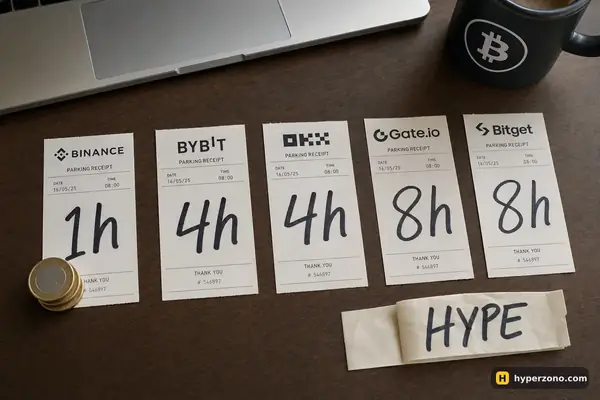
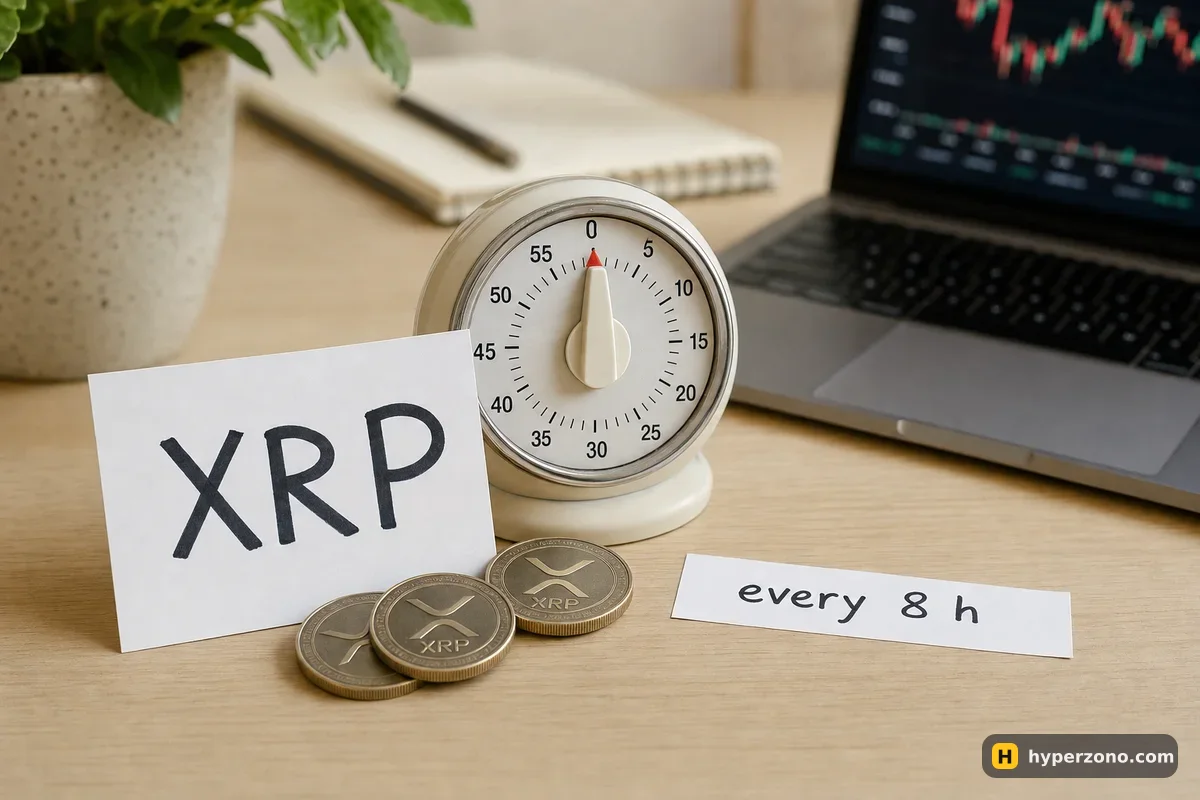
The interval matters before you compare anything. On Binance, Bybit, OKX and the Binance Wallet Perpetuals tab, XRP funding is usually settled every 8 hours, though the interval can differ by contract and can be shortened when rates get extreme — the countdown next to the price always shows the real one. On Hyperliquid it is paid every hour, which is why an hourly rate always looks tiny: to put it next to an 8-hour rate you multiply it by 8, and comparing a 1-hour rate with an 8-hour one walks through that.
The table below shows the current XRP funding rate and the next payment time on all five venues. Look at two things: the size of the rate and its sign. If you open a long now and the rate is positive when the countdown runs out, you pay; if it is negative, you receive. Open after the settlement and you skip that one entirely.
| Where | Paid | Rate now | A 1,000 USDT long: 30 days | 90 days | 12 months | Longs paid (90 days) |
|---|---|---|---|---|---|---|
| Binance Futures | every 8 h | +0.0060% | pays 2.48 USDT | pays 9.54 USDT | pays 0.48 USDT | in 54% of settlements |
| Binance Wallet (Aster book) | every 8 h | +0.0065% | pays 4.48 USDT | pays 14.87 USDT | pays 22.46 USDT | in 66% of settlements |
| Bybit | every 8 h | -0.0027% | pays 2.61 USDT | pays 9.54 USDT | pays 12.80 USDT | in 58% of settlements |
| OKX | every 8 h | -0.0014% | pays 3.54 USDT | pays 12.44 USDT | — | in 80% of settlements |
| Hyperliquid | every hour | +0.0013% | pays 7.42 USDT | pays 23.27 USDT | pays 32.96 USDT | in 69% of settlements |
Rate now is what the venue shows for the next settlement. The totals are what a 1,000 USDT long would have paid holding the whole time (price changes aside); a short would have received the same. "Longs paid" is the share of settlements over 90 days when the rate was above zero. OKX only publishes 3 months of history.
Updated 24 Oct 2026, 20:12 UTC from the exchanges’ public APIs.
What funding costs on a 2,500 USDT XRP position
Back to the example: 500 USDT of your own money at 5x gives a 2,500 USDT position. Funding is calculated on those 2,500 USDT, not on the 500 you put in. That is the detail most beginners miss — the same 500 USDT at 2x would be a 1,000 USDT position and pay less than half as much funding, which is one more thing to weigh when you pick leverage for a trade.
Take an illustrative rate of 0.01% per 8-hour settlement. On a 2,500 USDT position that is 0.25 USDT per payment, three payments a day, so about 0.75 USDT a day and roughly 22 USDT if you held for a full month at that same rate. Against a 500 USDT deposit that is about 4% of your money gone to holding costs alone, before the price has done anything. Real rates move around far more than this, up and down and through zero, which is exactly why the next table is worth two minutes of your time.
Funding is a holding cost, not an entry cost. If you open and close XRP positions within a few hours, you cross one payment or none at all, and funding barely registers next to the trading fee. If you plan to sit in the trade for days or weeks, put your position size and the current rate into the calculator just above and see what one payment and one day of holding cost you.
Month by month: when longs paid and when they got paid
A single rate tells you about the next few hours; the months tell you what holding actually costs. The table below splits XRP funding into months on each venue, so you can see which months took money from longs and which months paid them. These monthly numbers are per 1,000 USDT of position — multiply by 2.5 for our 2,500 USDT example, by 10 for a 10,000 USDT position.
| Month | Binance Futures | Binance Wallet (Aster book) | Bybit | Hyperliquid |
|---|---|---|---|---|
| October 2026 | 1.66 USDT | 3.35 USDT | 1.67 USDT | 5.47 USDT |
| September 2026 | 3.53 USDT | 4.61 USDT | 4.05 USDT | 9.20 USDT |
| August 2026 | 3.91 USDT | 6.10 USDT | 3.74 USDT | 8.21 USDT |
| July 2026 | 1.63 USDT | 5.51 USDT | 0.34 USDT | 4.87 USDT |
| June 2026 | −3.71 USDT | −0.23 USDT | −2.63 USDT | −2.01 USDT |
| May 2026 | 0.43 USDT | 2.57 USDT | 1.21 USDT | 0.48 USDT |
| April 2026 | 0.06 USDT | 2.65 USDT | 2.01 USDT | 0.71 USDT |
| March 2026 | −3.09 USDT | −1.35 USDT | −0.60 USDT | −4.97 USDT |
| February 2026 | −5.44 USDT | −5.24 USDT | −2.51 USDT | −9.68 USDT |
| January 2026 | 0.78 USDT | 2.94 USDT | 2.18 USDT | 4.87 USDT |
| December 2025 | −0.97 USDT | −0.35 USDT | 0.27 USDT | 7.10 USDT |
| November 2025 | 0.54 USDT | 0.66 USDT | 2.16 USDT | 6.98 USDT |
| October 2025 | 1.14 USDT | 1.24 USDT | 0.91 USDT | 1.74 USDT |
What a 1,000 USDT long paid in each month (minus means it received). The current month is not over yet. OKX is left out: its API keeps only 3 months of history.
Updated 24 Oct 2026, 10:56 UTC from the exchanges’ public APIs.
Two things are worth reading out of it. First, the sign flips: there are months when an XRP long paid nothing and was instead credited, because more traders were positioned short on that venue. Second, the same month can look completely different on two exchanges, because funding follows how the crowd is positioned there and nowhere else. A long year total on one venue and a near-zero one on another is normal, not an error.
How often you pay matters as much as how much. A venue where the rate is positive at most settlements is simply a more expensive place to sit in a long, even when each payment looks like small change. Whether longs or shorts paid more often differs by venue and by period — the month-by-month table above shows which months went which way on each exchange. If you want the same kind of picture for other coins, the funding history tool covers BTC, ETH and SOL, and the year-long funding cost study goes through the method behind it.
Where to hold the position, and how to check funding before you open it
History is a hint about where to look first, not a rule. Positioning changes, and a venue that paid longs one month can charge them the most the next. The habit that actually saves you money is small: look at the rate and the countdown on the screen before you size the trade, every time.
Find the funding line on the trading screen
Open the XRP perpetual on the exchange. Near the price at the top of the screen, usually beside the mark price — the fair price the exchange uses for liquidations — you will see the current funding rate and a countdown to the next payment.
Turn the rate into money
Multiply your position size by the rate. On our 2,500 USDT position, a rate of 0.01% is 0.25 USDT per payment — about 0.75 USDT a day if the countdown is running on 8-hour intervals.
Check it against your holding plan
Planning to hold a week? Multiply the daily figure by seven and compare it with the profit you are aiming for. If funding eats a large slice of your target, shorten the trade, cut the size, or pick a venue where the rate currently favours your side.
Watch the sign, not just the number
If the rate is negative while you are long, you are being paid to hold. Nice, but it is never a reason to keep a losing trade open.
If the several prices on that screen confuse you, which price decides your trade sorts out last, index and mark price in a couple of minutes. And do not assume the interval from memory: in the Binance Wallet Perpetuals tab funding can run every 8, 4 or 1 hour depending on the contract, so read the countdown on the pair you are actually trading. If it is about to run out and you are not sure which side pays, there is nothing wrong with waiting a minute and opening after the settlement.
The simplest way to make all of this concrete is to open a Binance Futures account, pull up the XRPUSDT contract and look at the funding rate and the countdown next to the price before you size anything. Check that futures are available where you live while you sign up — availability differs by country and by exchange. Then come back and compare the same pair in the live table above.
What is the XRP funding rate today?
It depends on the exchange and on the time of day, because it is recalculated for every settlement. The live table on this page shows the current rate on Binance, Bybit, OKX, Hyperliquid and the Binance Wallet Perpetuals tab, with the time of the next payment. Any page quoting one fixed XRP funding number is out of date the moment it is published.
Where can I see XRP funding rate history?
Each exchange publishes the funding history for its own contract, and the month-by-month table above pulls it together for all five venues. Not every venue keeps the same depth of public history, so some columns go back further than others.
Do I get paid funding if I short XRP?
When the rate is positive, yes — the money comes from the traders holding longs, not from the exchange. Whether longs or shorts paid more often differs by venue and by period, and the month-by-month table above shows which months went which way on each exchange. That is still not a reason to short, because funding is small next to what the price itself can do to your position.
Does higher leverage mean higher funding?
Yes, in the way that matters to you. Funding is charged on the position size, so 500 USDT at 5x pays funding on 2,500 USDT, while the same 500 USDT at 2x pays on 1,000 USDT. Your deposit is identical; the holding cost is two and a half times bigger.
Why can XRP funding look more expensive on Hyperliquid than on Binance?
Not because it pays every hour — an hourly rate is about one eighth the size of an 8-hour one, so the interval alone does not make it dearer. If the month-by-month table shows a bigger total there for a given month, it means the rate on that venue was positive more often, so longs paid on more settlements. That can flip when positioning changes, which is why you check the live rate instead of assuming one exchange is always cheaper.
Can funding alone make my trade lose money?
If you are in and out within a day, almost never — you cross one payment or none, and on a 2,500 USDT position that is usually well under a dollar. Over months it adds up and can quietly eat a chunk of a 500 USDT deposit, as the monthly table shows. Add funding to your plan the same way you add trading fees.
Sources and fact-check
Exchange terms were checked against official documents on October 24, 2026. Terms change — before you trade, check what matters to you in the exchange app and in your contract’s specs.
Hyperliquid Docs: FundingAster Docs: Funding RateBinance: Introduction to Binance Futures Funding Rates