
Contents
What happens when you get liquidatedA 100 USDT exampleWhy it fires on the mark price, not the price you see tickingWhy you almost never get anything backHow to keep liquidation far away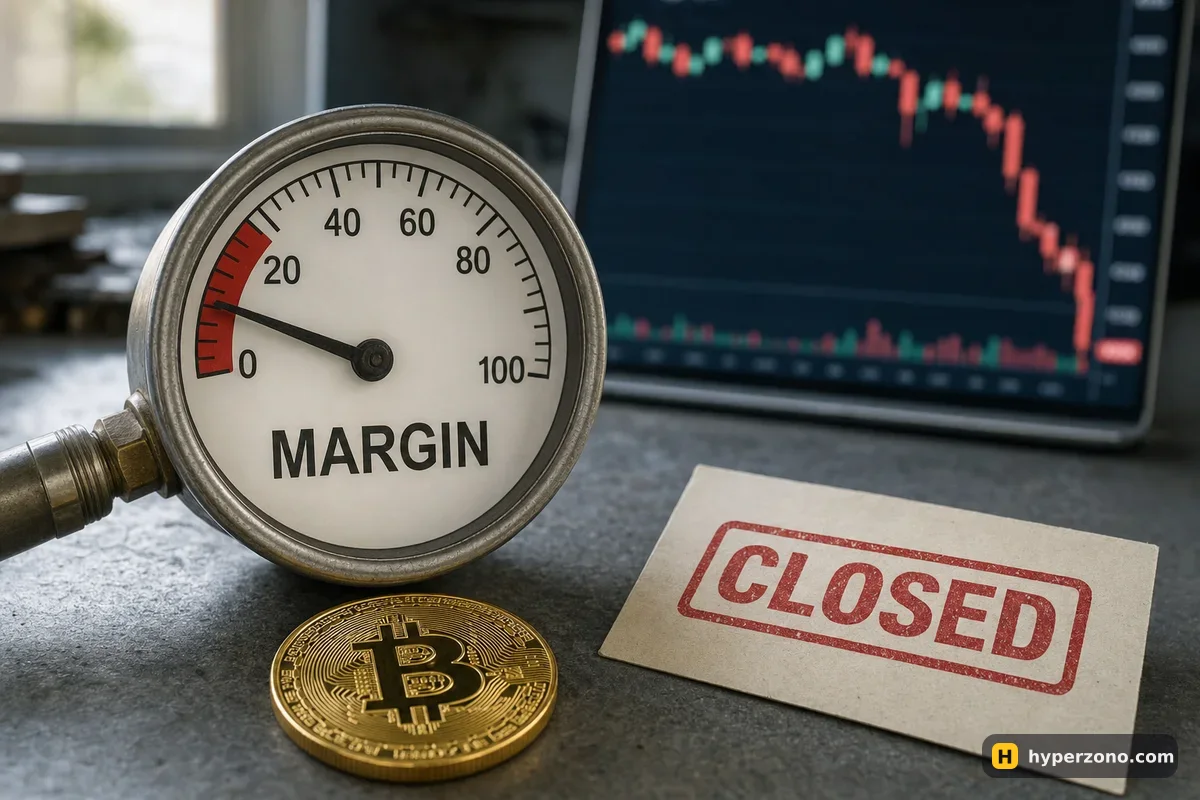
What happens when you get liquidated
While your trade is open, part of your money sits as a deposit behind it. That deposit is your margin, and every move of the price against you eats into it. The exchange does not wait until it is fully gone: it keeps a small safety level, called the maintenance margin, and the moment your remaining margin drops to that level, its risk system takes the position off your hands and sells it (or buys it back, if you were short) on the market.
The decision is made by software, not by a human, and you get no warning call. You may see a notification afterwards, and in the app the position simply disappears with a note that it was liquidated. The system watches every open position without a break, which is why liquidation can happen while you sleep or while your phone is in your pocket.
A 100 USDT example
Say you put 100 USDT of margin into a long on bitcoin with 10x leverage, so your position is worth 1,000 USDT. Bitcoin is at 100,000 and you hold 0.01 BTC. Every 1% the price falls costs you 10 USDT — one tenth of your margin. By the time bitcoin has dropped roughly 9%, almost nothing is left to cover further losses, and the exchange closes you out somewhere around there rather than waiting for a clean 10%.
Isolated long of 1,000.00 USDT, 10× leverage, maintenance margin 0.50% of position size (example). Simplified model without closing fees, risk-limit tiers or other positions — the exchange will show its own price.
The exact level depends on your leverage, your margin mode, the fees and the size of the position, and the exchange shows it to you as a liquidation price in the order window. If you want to know where yours sits before you tap buy, that is covered separately in how to find your liquidation price.
Why it fires on the mark price, not the price you see ticking
Liquidations are triggered by the mark price — a fair price the exchange calculates from several large markets — and not by the last trade printed on your screen. That protects you from one sudden price spike or crash on a single exchange wiping out thousands of positions that were otherwise fine. It also surprises people: your chart may briefly show a lower price than the one that closed you, or the other way round. When you look at an open position, the mark price is the number worth watching, because that is the one your liquidation level is compared against.
Why you almost never get anything back
By the time the system steps in, the loss has already swallowed nearly all of your margin — that is exactly why it stepped in. On top of that, the forced close is executed on the market at whatever price is available at that second, which in a fast move can be worse than the level you expected. Each exchange also applies its own charges for a forced close — you can see them in the contract details in the app.
Whatever tiny remainder survives all of that is returned to your balance, which is why most beginners see zero. In a very sharp move the loss can even run past your margin, and exchanges keep an insurance fund to absorb that gap, though no exchange promises it always covers everything.
The simplest way to never meet the risk system. Set your own exit before the exchange sets one for you — a stop-loss a few percent away takes you out near the price you picked, for a small loss instead of the whole margin. Placing it is free; when it fires you pay the usual fee on the exit.
How to keep liquidation far away
Three habits do most of the work: use isolated margin so one bad trade cannot reach the rest of your balance, keep leverage modest so the price has room to breathe, and place a stop-loss the moment you open the trade. It helps to know what the numbers on the slider really do to that distance — that is the whole point of what 5x, 10x and 20x actually mean. With low leverage and a position size that matches your balance, the liquidation price sits so far from the market that it stops being part of your day.
If you want to see where that line falls for a real contract, sign up on Bybit and open the order window — the liquidation price updates live as you move the leverage slider, before you commit any money. Trying it in demo first costs nothing and shows you the whole sequence, including what the screen looks like when a position is force-closed. It is worth getting liquidated once on play money, so it never happens to you by surprise on real money.
What does liquidated mean in crypto?
It means your leveraged position was closed by the exchange, not by you, because your margin could no longer cover the loss. Your coins in the spot wallet are untouched — only the futures position and the margin behind it are affected.
What happens when you get liquidated on Bybit or Binance?
The risk system closes your position on the market, and whatever is left of your margin after the loss and the exchange's own charges comes back to your futures balance. Usually that remainder is close to nothing, and the position simply vanishes from your open trades. The exact charges for a forced close are in the contract details in the app.
Can I stop a liquidation once it starts?
Not once it fires — it takes a fraction of a second. Before that you can either add margin to the position or close part of it yourself, which pushes the liquidation price further away. Adding more money to a losing trade is a habit worth avoiding, though: it is how a small loss turns into a big one.
Does a stop-loss prevent liquidation?
In normal conditions yes, because your stop sits much closer than the liquidation level and takes you out first. If the price jumps straight past your stop in a fast move, it can still fill at a worse price than you planned, so keep the position small enough that even a bad fill is survivable.
Can you get liquidated with low leverage?
Yes, but the price has to move much further against you. At 2x a long needs roughly a 50% fall before the margin is gone, at 20x only about 5%. That is the real reason leverage feels dangerous — it shortens the distance to the exit.
Do I lose money from my spot wallet too?
No, liquidation only touches your futures account. With isolated margin it reaches just the margin you assigned to that one trade; with cross margin it can use the free balance in your futures wallet, which is why beginners are usually better off isolated.