Contents
Bybit vs OKX at a glanceFees on the same trade: what 2,500 USDT really costsFunding on the same coin matters more than the fee gapAccount, deposits and who can actually sign upChoose Bybit if…, choose OKX if…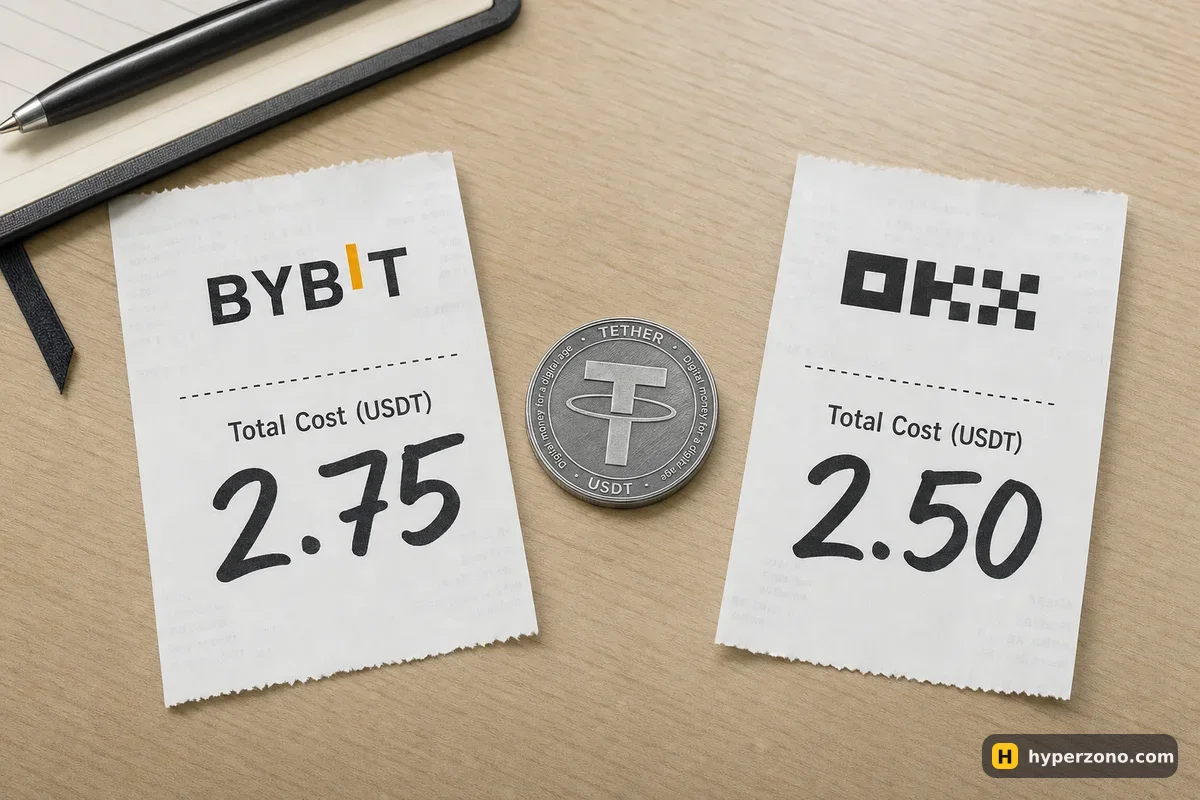
Bybit vs OKX at a glance
Both are ordinary centralized exchanges: you register, verify your identity, deposit USDT and trade perpetual contracts from an app or a browser. Neither asks you to connect a crypto wallet, and neither needs a broker. The table below is the short version of everything the rest of this page explains, using the same example trade throughout: 500 USDT of your own money at 5x leverage, which makes a position of 2,500 USDT.
| Bybit | OKX | |
|---|---|---|
| Base fee (maker / taker) | 0.02% / 0.055% | 0.02% / 0.05% |
| Market in and out, 2,500 USDT | 2.75 USDT | 2.50 USDT |
| Both orders resting as limit | 1.00 USDT | 1.00 USDT |
| Funding interval | set per contract — the countdown is on the contract page in the app | set per contract; OKX describes three payments a day on its perpetual swaps |
| Practice mode | Demo Trading | demo trading on web and app |
Fees on the same trade: what 2,500 USDT really costs
The exchange charges a fee on the size of your position, separately when you open and when you close. If you press buy or sell at the current market price, you pay the taker rate; if you place a limit order that waits in the book and someone trades into it, you pay the smaller maker rate. At the base level on 24.10.2026 that is 0.055% taker and 0.02% maker on Bybit, and 0.05% taker and 0.02% maker on OKX.
On a 2,500 USDT position, entering and exiting at market costs 2 × 2,500 × 0.055% = 2.75 USDT on Bybit and 2 × 2,500 × 0.05% = 2.50 USDT on OKX. If both your entry and your exit are limit orders that sit in the book, each venue charges 0.02% twice, the trade costs 1.00 USDT on either one, and the difference disappears completely.
Two groups of contracts cost more on Bybit: brand-new coins and coins whose token has not launched yet, where the base rate is 0.04% maker and 0.10–0.11% taker. They are marked in the app, so look at the fee shown in the order window before you trade a coin you have never heard of. OKX says the same kind of thing in its own words — some newly listed contracts have their own fee schedule.
| Where | Maker | Taker | How to pay less | A 2,500 USDT trade: market in and out | Limit in, market out |
|---|---|---|---|---|---|
| Binance Futures | 0.02% | 0.05% | pay fees in BNB: 0.018% / 0.045% | 2.50 USDT | 1.75 USDT |
| Bybit | 0.02% | 0.055% | — | 2.75 USDT | 1.88 USDT |
| OKX | 0.02% | 0.05% | — | 2.50 USDT | 1.75 USDT |
| Hyperliquid | 0.015% | 0.045% | up to 40% off for staking HYPE: 0.009% / 0.027% | 2.25 USDT | 1.50 USDT |
| Binance Wallet / Aster | 0% | 0.04% | — | 2.00 USDT | 1.00 USDT |
Base level for a new account. 2,500 USDT is 500 USDT at 5x leverage; the fee is charged on the position size, not on your 500. Taker is the rate when an order fills at once, maker when a limit order waits in the book.
fees checked 24 Oct 2026 on the exchanges’ fee pages, Binance Futures, Bybit, OKX, Hyperliquid, Binance Wallet / Aster.
Bybit also says your actual rate can depend on your region, and the exact one appears on the My Fee Rate page once your identity is verified — so if the quarter of a dollar matters to you, sign up on Bybit and read your own number rather than a general table. Lower rates come from trading volume on both venues; Bybit can also drop your fee for a large account balance, but that route starts around 100,000 USD, so it will not apply in your first year. The base rate is the one you will actually pay. More on how these charges stack up in what fees you pay on crypto futures and in the lowest-fee comparison.
Funding on the same coin matters more than the fee gap
While a perpetual position stays open, longs and shorts pay each other a small amount at fixed times — that is funding, and the exchange does not keep it. The interval is set per contract on both venues; OKX describes three payments a day on its perpetual swaps, and the contract page in the app shows the exact interval with a countdown to the next payment. You only pay or receive if you are holding the position at that moment.
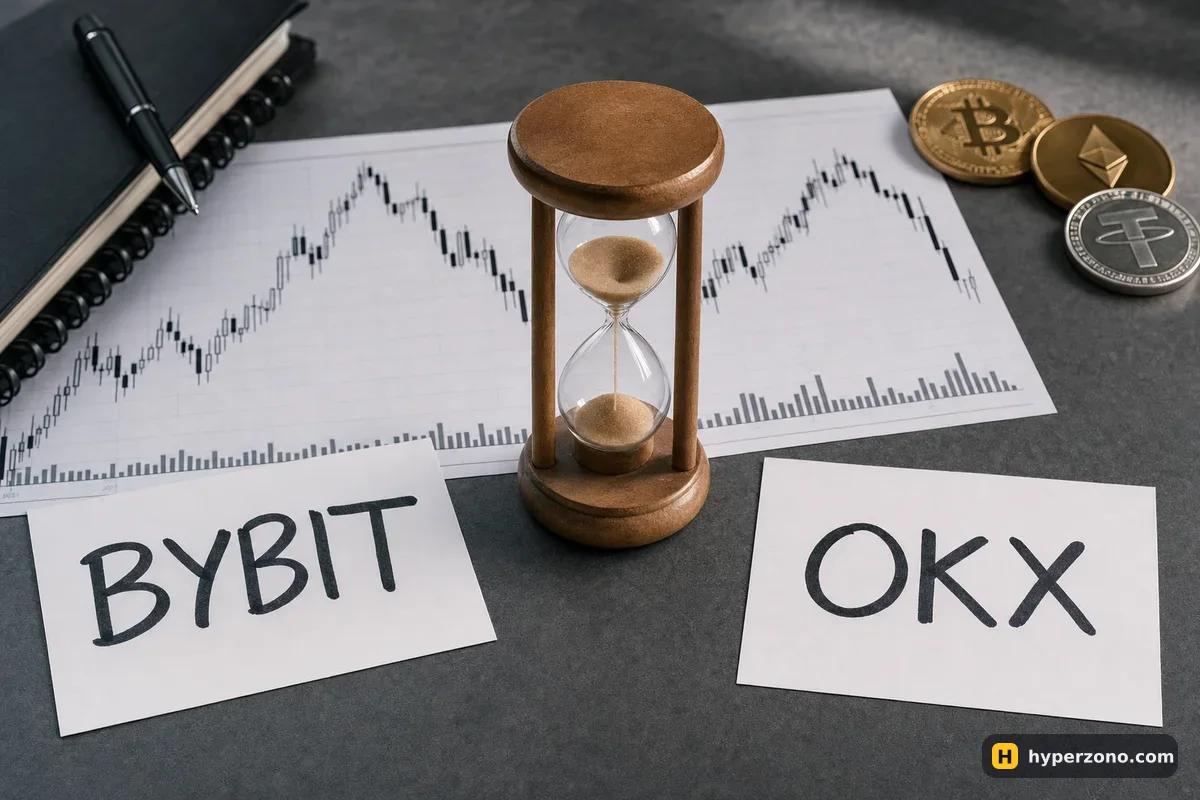
Bybit and OKX are separate markets, so the same coin can carry a different funding rate on each, and the side that pays can even be reversed. Here is an illustrative sense of scale. A common baseline rate on a calm perpetual is 0.01% every 8 hours — about 0.03% a day. On your 2,500 USDT position that is roughly 0.75 USDT a day, so a month on the paying side comes to around 22 USDT, while the whole fee difference between the two exchanges on that trade was 25 cents.
That 22 USDT is only an example to give you a feel for the size of the number. Real rates change at every settlement: they can run several times above the baseline when a lot of people are long, and they can go negative, which means you are paid instead of charged. Neither venue is permanently the cheaper one, so the only sensible comparison is the current rate on the coin you actually want.
| Coin | Binance Futures | Binance Wallet | Bybit | OKX | Hyperliquid |
|---|---|---|---|---|---|
| BTC | 2.91 USDT | 4.23 USDT | 2.91 USDT | 3.48 USDT | 6.85 USDT |
| ETH | 3.17 USDT | 5.11 USDT | 2.85 USDT | 3.13 USDT | 6.73 USDT |
| XRP | 2.48 USDT | 4.48 USDT | 2.61 USDT | 3.54 USDT | 7.42 USDT |
| BNB | 1.59 USDT | 1.26 USDT | −0.06 USDT | 4.53 USDT | 5.96 USDT |
| SOL | 2.63 USDT | 3.21 USDT | 1.94 USDT | 2.93 USDT | 5.70 USDT |
| HYPE | 3.54 USDT | 3.92 USDT | 1.14 USDT | 3.74 USDT | 6.88 USDT |
| DOGE | 4.10 USDT | 4.26 USDT | 2.84 USDT | 5.58 USDT | 8.64 USDT |
| ENA | 6.42 USDT | 8.01 USDT | 4.71 USDT | 5.11 USDT | 9.18 USDT |
What a 1,000 USDT long paid over the last 30 days on each venue (minus means it received). The coin name opens its page with month-by-month history.
Updated 25 Oct 2026, 01:20 UTC from the exchanges’ public APIs.
Check the live table for your coin, and keep an eye on the interval: a contract that settles every 4 hours bills you twice as often as one that settles every 8. If this whole idea is new, read how funding works first, then open the live BTC funding page before you hold anything overnight.
Account, deposits and who can actually sign up
The sign-up path is similar on both. On OKX you verify the account, deposit USDT on the Assets page, then open Trade → Perpetual Futures, pick a contract such as BTC-USDT-SWAP, choose cross or isolated margin, set your leverage and place a limit, market or stop order. Bybit works the same way in practice, and both offer a demo mode where you can press every button with play money first — see which exchanges offer demo futures trading. Deposit methods, minimums and timings change by country, so check those in the app rather than trusting any article.
Availability is where the two genuinely differ, and this is the part worth reading slowly. OKX does not serve people in several large countries: India, Japan, Malaysia, Nepal, Hong Kong, Canada and Uzbekistan are all on its restricted list, along with Afghanistan, Cuba, Iran, North Korea, Syria and occupied regions of Ukraine. In the UK, Brazil and South Korea you can use OKX, but futures are not offered — so this comparison does not apply to you there. Australia and the UAE are handled by separate local OKX companies, where you pass a knowledge or suitability test first, and Australian retail leverage is capped at 2:1.
Bybit's list is a different one: the United States, mainland China, Hong Kong, Singapore, Canada, Uzbekistan and sanctioned regions, plus Dubai for one of its entities. In the EEA you are onboarded instead to a separate Bybit EU company with its own account. Both exchanges say plainly that their lists are not complete and can change without notice, so the only reliable check is the sign-up screen itself — confirm that your country is accepted, and that futures are part of what you get there, before you send any money. There is more on doing that check in which exchanges are available in my country.
Choose Bybit if…, choose OKX if…
Choose OKX if you mostly enter and exit at market, where its 0.05% taker rate shaves a little off every trade. Choose Bybit if its app and demo feel more comfortable in your hands, if the deposit methods offered where you live work better there, or if OKX does not accept people from your country — Bybit's restricted list is a different one, though it is also incomplete, so confirm it during sign-up before you deposit. Both venues let you set leverage far higher than a beginner should use; your first trades are safer at 2x or 3x whatever the slider allows, as choosing leverage for a first trade explains.
If you cannot decide, no rule says you must pick one forever: many people open both, keep a small amount on each, and compare their own fills and their own funding bills. Full pictures of each venue live on the Bybit page and the OKX page, and if Binance is also on your shortlist, that head-to-head is covered in Binance or Bybit. To look at OKX yourself, you can open an OKX account and run its demo mode before depositing anything.
The cost that surprises beginners is not the fee. On a 2,500 USDT position the entry-plus-exit fee is under 3 USDT on both venues. Hold that same position for a month on the paying side at a baseline 0.01% per 8 hours and you have paid roughly 22 USDT, with the price going nowhere. Check the current funding rate before you open, not after.
Is Bybit cheaper than OKX for futures?
For market orders, no — OKX's base taker rate is 0.05% against Bybit's 0.055%, which is 2.50 USDT versus 2.75 USDT to open and close a 2,500 USDT trade. For limit orders that rest in the book both charge 0.02%, so the cost is identical. On a trade you hold for days, funding usually matters more than either number, and there neither venue is permanently cheaper — you have to look at the current rate on the coin.
Which is better for a beginner, Bybit or OKX?
Both are workable first accounts: an app, a demo mode, USDT deposits, cross and isolated margin, stop-loss orders. What actually decides it is simpler: which one accepts people from your country and offers futures there. Whichever one clearly does that, and lets you deposit easily, is the better choice for you, regardless of a quarter of a dollar in fees.
Do Bybit and OKX pay the same funding rate?
No. They are separate markets, so the same coin can have a different rate on each, and sometimes the paying side is reversed. To picture the size of it: at a baseline 0.01% every 8 hours, a 2,500 USDT position costs around 0.75 USDT a day, near 22 USDT over a month — far more than the 25 cents of fee difference. Check the live funding table for your coin before you hold overnight.
Can I use both Bybit and OKX at the same time?
Yes, nothing stops you having an account on each, and it is a reasonable way to compare them on your own trades. Just keep your total risk in mind — two accounts can quietly turn into twice the position size you planned.
Do I need to verify my identity on both?
Expect to, yes. On OKX you verify the account before you can trade perpetuals, and on Bybit your exact fee rate only appears on the My Fee Rate page after verification. Plan on uploading a document either way; the exact requirements depend on your country.
Sources and fact-check
Exchange terms were checked against official documents on October 24, 2026. Terms change — before you trade, check what matters to you in the exchange app and in your contract’s specs.
Bybit: Bybit Trading Fee Structure — Help CenterOKX: What is OKX Perpetual Futures: Fees, Trading, Features