Contents
What you can actually trade thereWhat "perpetual swap" means in plain wordsWhat OKX futures cost youBots, and practising before you risk real moneyIs the app too busy for a first trade?Can you even use OKX where you live?So who is OKX right for?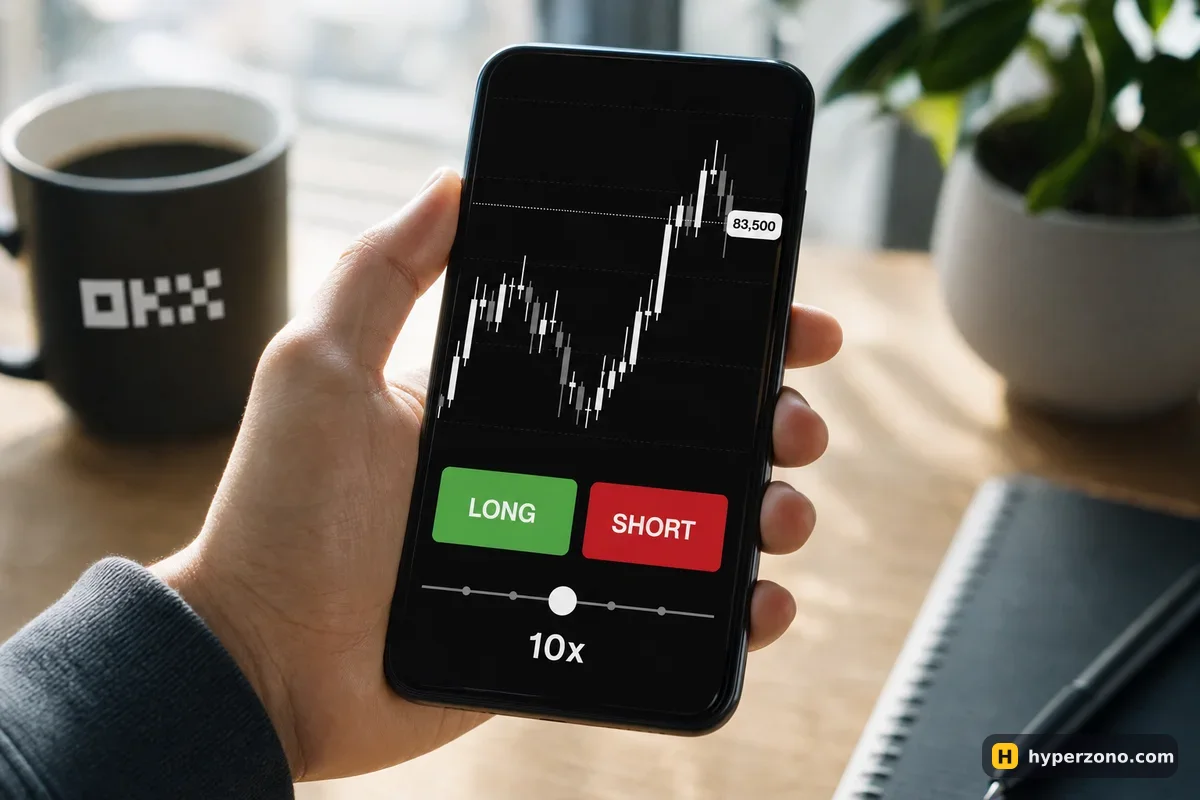
What you can actually trade there
The contracts you'll actually use on OKX are perpetual swaps on coins — bitcoin, ether and a long list of altcoins, priced in USDT. Alongside them OKX lists futures with a fixed expiry date, which settle on a set day instead of running forever, and options for people who want them. For a first trade you will almost certainly use a USDT perpetual swap on bitcoin or ether, and you can ignore the rest of the menu.
Beyond coins, OKX has index perpetuals called US100, US500 and JP225, whose price OKX calculates itself from stock market data instead of copying a contract traded on a stock exchange. There are also perpetuals on individual stocks and on commodities: gold and silver follow the ordinary metal price, while oil, gas and copper follow a specific delivery month and get switched to the next one from time to time — the details sit in each contract's specification. None of these make you an owner of a share, an ounce of gold or a barrel of oil — you are trading the price difference, nothing more.
What "perpetual swap" means in plain words
A perpetual swap is a futures contract with no end date. You open it when you want and close it when you want, and nobody forces a settlement on a particular day. That is why people hold these positions for hours, days or weeks, depending on their plan.
To keep the contract price close to the real coin price, traders on the two sides pay each other a small amount at set times. If the rate is positive, people holding longs pay people holding shorts; if it is negative, the other way around. The exchange does not take that money, and you only pay or receive if your position is open at the exact settlement moment — the mechanics are the same everywhere, and we unpack them in what funding is and perpetual versus dated contracts.
Keep your first trades walled off. When several positions share one balance, a bad trade can pull on money you were saving for something else. In the order window, set the position to isolated margin: then the most that trade can cost you is the margin you put behind it. The two modes are compared in cross margin vs isolated margin.
What OKX futures cost you
You pay a fee twice on every trade — once when you open and once when you close — and it is charged on the full size of the position, not on the margin you put up. On most exchanges a limit order that sits and waits costs you less than grabbing the price that's already there, and heavy traders pay less than new ones. OKX shows its own rates in the app — open the fee page and read the perpetual swap row before your first trade.
To give you a feel for the scale, take an illustrative rate of 0.05%: on a 500 USDT position that is about 0.25 USDT to open and roughly the same to close. Small — until you open twenty trades a day on a 100 USDT account. The way fees quietly eat a small deposit is explained in what fees you pay on futures.
Bots, and practising before you risk real money
The bot section is one reason people like OKX. There are bots that buy in portions as the price moves against your entry, and a signal bot that acts on TradingView alerts. Whatever else you find in that section, read the description inside the app before you start anything — a bot that keeps adding to a losing position can empty an account faster than a human would, and none of this is needed in week one. If you do get curious later, how to launch your first futures bot walks through the setup.
Many exchanges also let you practise with virtual money before you risk real USDT. Open the account menu in the OKX app and look for a practice or demo mode — that is the fastest way to know. If you can't find one, practise elsewhere: Bybit's demo futures account is open to everyone and teaches the same buttons, and other options are listed in exchanges that offer demo futures.
Is the app too busy for a first trade?
Honestly, OKX feels denser than Bybit or Binance the first time you open it — more products on the home screen, more tabs, more things competing for your attention. It only looks harder. Once you are in the order window, it is the same few decisions as anywhere else: pick the contract, pick long or short, set the size, set a stop-loss.
The fastest way to find out whether the screen suits you is to sign up on OKX, put in 20–30 USDT and open one small position on BTC with a stop-loss already set. Twenty minutes of tapping teaches you more than any review. If you would rather compare the main candidates side by side first, start with which exchange suits a beginner.
Can you even use OKX where you live?
This is the part that decides the question for a lot of readers. OKX publishes a risk and compliance disclosure naming countries where its services are restricted, and it names a second group of countries where you can open an account but futures are simply not offered. In some places a local OKX company serves you instead, with its own product list and much lower leverage.
| Where you are | What OKX's own pages say |
|---|---|
| India, Japan, Malaysia, Nepal, Canada, Hong Kong, Afghanistan, Uzbekistan, Cuba, Iran, North Korea, Syria, sanctioned regions of Ukraine, the US and its territories | OKX says its services are restricted there — expect sign-up or futures to be blocked |
| United Kingdom | Retail customers are served from Seychelles, with perpetual swaps, futures, spot margin, options and trading bots marked unavailable |
| Australia | A local OKX entity offers derivatives; retail clients get USDT-margined perpetuals at up to 2:1 leverage after a knowledge assessment |
| United Arab Emirates | A local OKX entity offers futures, options and perpetuals after a suitability test |
| Brazil, South Korea | Derivatives-related services restricted |
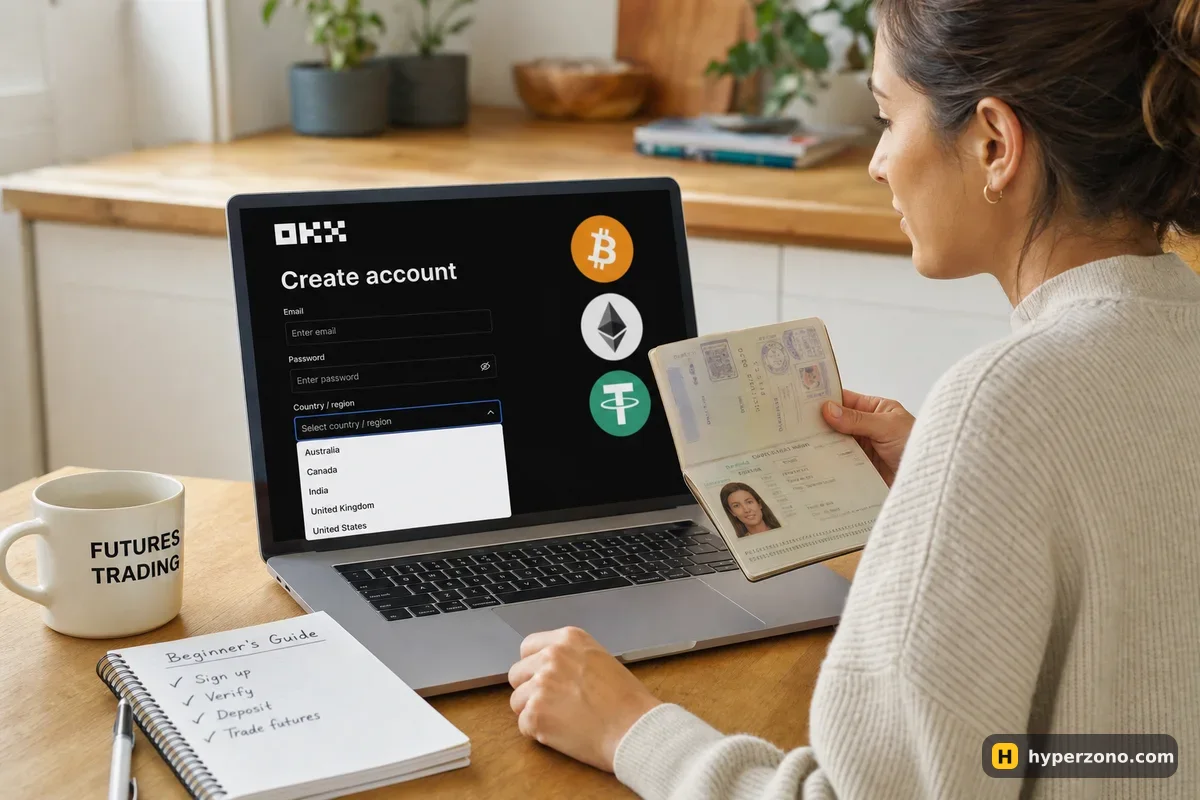
Different regional versions of the same OKX page name extra countries — Nigeria, France, Bangladesh, El Salvador and Algeria have appeared on them — so your sign-up screen is the only honest test. Choose your country honestly during registration, finish identity verification with a real document, and then look for the futures tab: if the products are not there, no setting will bring them back, and looking for a way around a country block is how people lose their account and their balance. A wider view of this is in which exchanges are available in my country.
So who is OKX right for?
It suits you if futures are available where you live, you are comfortable spending a little time learning a busier screen, and you can imagine using a bot later on. It is a weaker fit if you want the simplest possible first screen, or if you live somewhere OKX routes you to a local entity with a 2:1 cap and a questionnaire — not bad rules, just a different experience from what this page describes.
Whatever you decide, the first trade should be small and protected. One contract, isolated margin, modest leverage, and a stop-loss set before you tap buy. That habit matters far more than which of the big exchanges you picked.
Is OKX good for beginners?
Yes, with two conditions. The app is busier than some rivals, so give yourself half an hour to find your way around, and check that futures are offered in your country before you plan anything. Once you are past that, the trading itself is as straightforward as anywhere else.
Does OKX have demo futures trading?
OKX doesn't publish this clearly enough for us to promise it, so check the account menu in the app. If there's no practice mode, Bybit's demo futures account is open to everyone and teaches the same buttons.
What are OKX futures fees?
OKX doesn't publish a rate we can quote here. Open the fee page in the app and read the perpetual swap row — it's two taps, and the number is the one that will actually apply to you.
Can I use OKX futures in India or the UK?
India is on OKX's restricted list, so the services are not offered there at all. In the UK, retail customers are served by an offshore OKX entity and perpetual swaps, futures, spot margin and bots are marked unavailable. Both lists can change, so check the official OKX pages and what the app shows during sign-up.
What is a perpetual swap on OKX?
It is a futures contract with no expiry date, priced in USDT, that you can hold as long as you keep enough margin. Instead of settling on a fixed day, the two sides exchange a small funding payment at set times to keep the contract price near the real coin price.
Is OKX better than Binance or Bybit for a first trade?
They are close enough that availability in your country, the language of the app and how comfortable the screen feels matter more than the brand. Compare the main options in our beginner exchange guide, then open an account on the one that reads most easily for you.