
Contents
Is it true that 90% of traders lose money?Mistake 1: leverage far bigger than the move you expectMistake 2: no stop loss, or moving it when price comes closeMistake 3: adding money to a losing tradeMistake 4: trading again right after a lossMistake 5: ignoring what the trade costs youMistake 6: no record of what you didThe checklist, in one place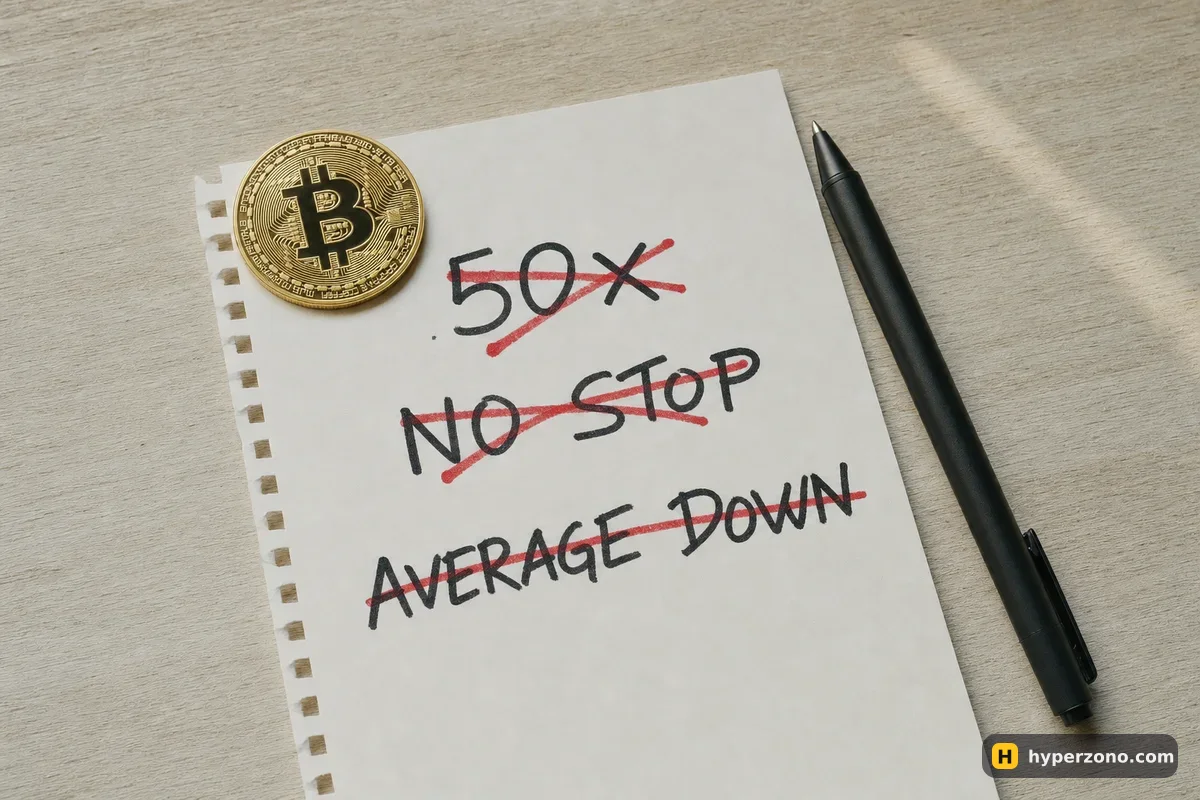
Is it true that 90% of traders lose money?
You will see that number on every second page about futures, and nobody can show you where it comes from — exchanges don't publish the profit and loss of their users. What is fair to say is that losing is the normal starting experience, and the reasons are boring and repeatable rather than mysterious. If you are wondering whether this is trading at all or just a dressed-up bet, that is a separate question with its own page: trading or casino. Here we stay with the practical part — what beginners actually do wrong with their money.
Mistake 1: leverage far bigger than the move you expect
Say you have 100 USDT and you open a bitcoin long at 20x, so your position is worth 2,000 USDT (illustrative numbers). A 2% move against you costs 40 USDT — almost half your account — and bitcoin can do 2% while you are having lunch. Somewhere around a 5% move the exchange closes the trade for you, which is called liquidation, and your 100 USDT is gone on a move that most traders would call a normal day.
Isolated long of 2,000.00 USDT, 20× leverage, maintenance margin 0.50% of position size (example). Simplified model without closing fees, risk-limit tiers or other positions — the exchange will show its own price.
The fix is to turn the thinking around. First decide where the price would prove you wrong and where your stop goes, then choose a position size where hitting that stop costs you a small part of the account — the arithmetic is on the position size page. Leverage becomes whatever is left over, not the first thing you drag to the right; what leverage to choose for a first trade goes into it in more detail. The 5% is only a rough guide — the exchange also counts fees and a small amount it keeps in reserve, so look at the liquidation price your app shows next to the position and use that one.
Mistake 2: no stop loss, or moving it when price comes close
A trade without a stop has no maximum loss — it has a hope. The second version is sneakier: you set the stop, price walks toward it, and you drag it a bit further away because "it will come back". That turns a planned 5 USDT loss into a 60 USDT one, and it is probably the single most common way beginners hand over an account. A stop loss only works if you treat it as already spent money; here is how to set one, and why you need it at all.
Move a stop in one direction only. Once the trade is open, you are allowed to move the stop closer to lock in a better outcome, never further away to give the trade more room. Decide that rule now, while no money is on the line, because in the moment it will feel very reasonable to break it.
Mistake 3: adding money to a losing trade
Averaging down feels clever: the price is cheaper now, so you buy more and your average entry improves. On futures it usually makes things worse, because the position you now hold is bigger, so every further dollar of movement costs you more, and the margin you just added was the money that would have let you survive. You started with 100 USDT and a 10 USDT risk. After you doubled, the same further drop costs you twice as much, and the price where the exchange closes you out is now much closer. You didn't improve the trade, you just gave it a bigger bill.
If a level looks good enough to add, it was good enough to plan in advance as part of one entry with one stop. Adding because you are losing is not a plan, it is a reaction. You can watch this play out without risking anything by trying the same scenario twice on a demo account on Bybit — once with the extra entry, once without.
Mistake 4: trading again right after a loss
A loss stings, and the fastest way to stop the sting is to open another trade and win it back. That next trade is usually bigger, faster and taken without a reason, and the one after that is bigger still. Two useful limits: a maximum number of trades per day, and a daily loss amount after which you close the app no matter what the chart is doing. Three trades and 10 USDT is a perfectly sensible ceiling on a 100 USDT account.
Mistake 5: ignoring what the trade costs you
Fees are charged on the whole position, not on your margin, and separately on the way in and the way out. On that 2,000 USDT position, at Binance's base taker fee of 0.05% that is about 1 USDT each way — 2 USDT round trip, or 2% of a 100 USDT account for one trade that hasn't even made a decision yet. Ten trades in a week quietly take a fifth of the money.
There is a second cost if you hold a perpetual contract through one of the payment times — every 8 hours by default on Binance, and every 4 hours on some contracts. At that moment you either pay a small amount to the traders on the other side or get paid by them. The rate sits next to the contract name in the app, so check it before you hold a position overnight, because on a busy coin it is bigger than people expect. Both costs are laid out on the fees page.
Mistake 6: no record of what you did
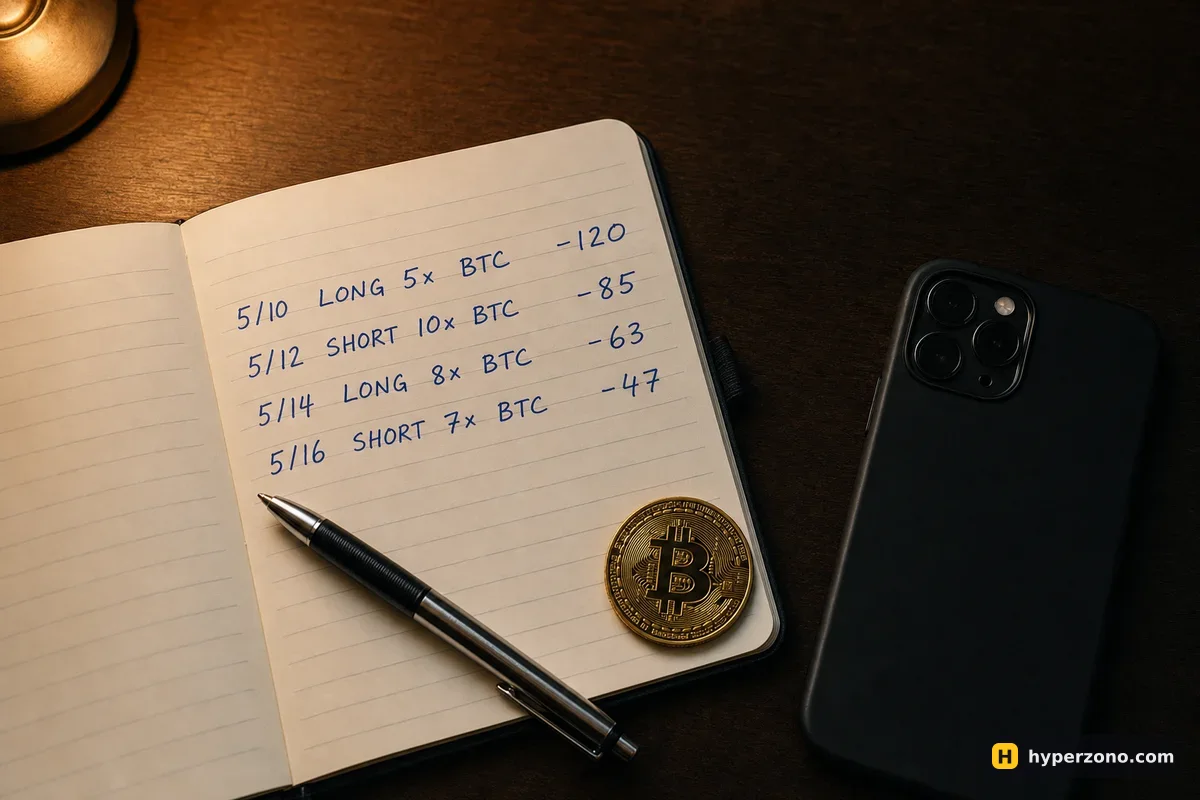
Without notes, every month looks like random noise and you repeat the same error twenty times without noticing it. A journal can be four columns in a notebook or a phone note: the coin, why you entered, where your stop was, and what happened. After thirty trades you will see something specific — for example that almost all your losses came after 11 at night, or that you never lose on planned entries, only on ones you took because you were bored.
The checklist, in one place
- Choose the stop first, the position size second, and let leverage be whatever is left.
- Every trade gets a stop loss, set at the moment you open it.
- The stop moves closer to lock in a result, never further away.
- No adding to a trade just because it is losing.
- A daily limit on trades and on losses — then you close the app.
- Count fees and funding as part of the result, especially on a small account.
- Write down four lines after every trade.
None of this makes losses disappear. Good trading still means plenty of small losses, with the wins large enough to cover them — the aim is to make the bad days survivable, not to avoid them. A beginner who keeps every loss small gets to stay in the game long enough to actually learn something, and that is the whole difference between the people still trading after a year and the people telling you futures are a scam.
Why do 90% of traders lose money in futures trading?
Nobody can verify that exact percentage, because exchanges don't publish their users' results. What is true is that most people who start do lose, and almost always for the same few reasons: leverage far too high for the move they were expecting, no stop loss, and trading again in anger after a loss. Those are habits, not bad luck, so they can be changed.
What is the most common crypto futures mistake?
Choosing leverage before choosing the stop. If you pick 25x first and then look for a place to put your stop, there is no room left — a normal 1% wobble already costs a quarter of your money. Decide where you would admit the trade is wrong, then size the position so that point costs you only a small part of the account.
Can I trade futures without ever losing?
No, and anyone telling you otherwise is selling something. Losing trades are a normal part of the job; the skill is keeping each one small and predictable so a handful of winners can cover them. Think of it as keeping your losses the size you chose in advance.
Does funding really matter on a small account?
It can, and it is the cost beginners forget first. The payment is worked out on the whole position value, not on your margin, so a position you hold for a day or two through several payment times can quietly eat into a small balance. Look at the rate shown next to the contract name before you leave a trade open overnight — on a coin everyone is crowded into, it is far from cents.
Does demo trading stop me making these mistakes?
It helps with the mechanical ones — where the stop field is, how a position closes, what a funding payment looks like. It does not teach you how your hands behave when real money is dropping, because the fear simply isn't there. Use demo to learn the buttons, then move to real money in very small size to learn yourself.
Is it the fees that kill small accounts, or the trades?
The trades do most of the damage, but fees finish the job quietly. Each entry and exit is charged on the full position value, so an account of 100 USDT that opens twenty leveraged trades a week can hand over a serious slice of itself before the market has decided anything. Fewer, better-planned trades fix both problems at once.