Contents
Start with what a futures contract actually isThe order that saves you moneyLong and short: the first real decisionMargin and leverage, in one sittingLiquidation, and the stop-loss that comes before itSix more words you will meet on every screenHow long this takes and where to practiceStart with what a futures contract actually is
When you trade futures you are not buying coins. You are taking a position on where a price goes, and the exchange settles the difference in your account in USDT. That single idea makes everything else in this section easy, so give it one honest read in what crypto futures are in simple words before you touch anything else.
Once the idea clicks, watch the money move through one trade from entry to exit — how a futures trade actually works does exactly that with small round numbers. Read those two pages and you already understand more than most people who open their first position.
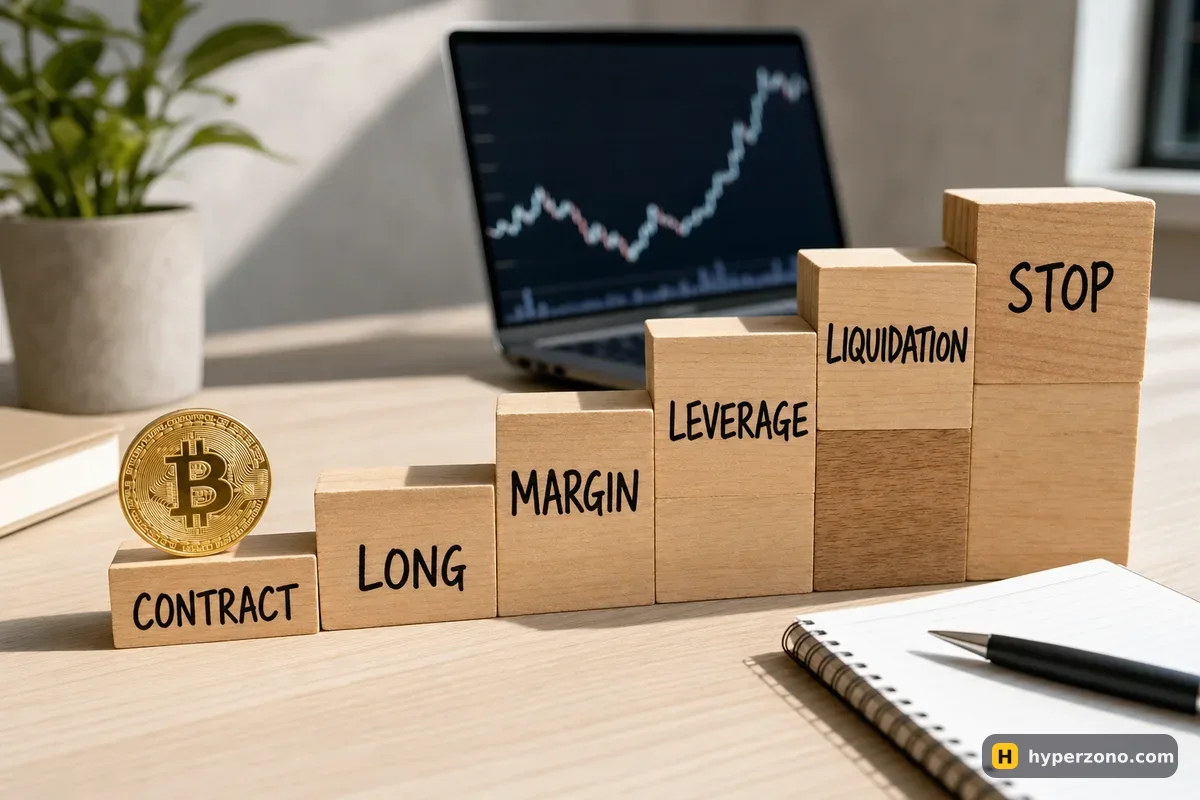
The order that saves you money
1. What the contract is
You agree on a price and settle the difference later. No coins change hands, no wallet full of bitcoin needed.
2. Long and short
Two buttons, two directions. Long if you think the price goes up, short if you think it goes down.
3. Margin and leverage
The money the exchange holds while your trade is open, and the multiplier that decides how much it holds. These two only make sense side by side.
4. Liquidation
What happens when that held money runs out and the exchange closes the trade for you. Know where that point sits before you enter.
5. The prices on the screen
Why one contract shows several prices, and which of them the exchange uses to decide your liquidation.
6. What a trade costs
The small amounts the exchange takes on the way in and out, plus funding if you hold a perpetual contract for a while.
7. The stop-loss
The order that closes the trade at a loss you picked yourself, long before liquidation ever gets involved. Learn it last, use it first.
Long and short: the first real decision
Direction comes early because it is the simplest real choice you make in the order window, and long and short in plain words takes about five minutes. Nothing about these two depends on leverage, which is exactly why they come before it.
The part that surprises people coming from buying coins is that you can also make money while the price is falling — you open a short, and the exchange pays you the difference if the price drops. You do not need to own any bitcoin for either direction; the contract is settled in USDT.
Margin and leverage, in one sitting
While your trade is open, the exchange holds part of your money aside as a deposit. That deposit is your margin, and it decides how far the price can move against you before things get uncomfortable. Leverage is simply the setting that changes how big a position that deposit can carry.
Say you put 100 USDT on the exchange and open a 500 USDT position on bitcoin. The 100 is your margin, the 5x is the leverage, and a 2% move in bitcoin is 10 dollars either way. Start with what margin is and read what leverage is straight after, the same evening. The detail about which number to pick can wait until you are actually standing in front of the slider.
One setting is worth deciding before your first trade: the margin mode, isolated or cross. For a first position, isolated keeps any damage inside that single trade instead of reaching the rest of your balance, and it is one tap in the order window.
Leverage and margin belong in the same evening. Reading about leverage without margin is how people end up at 50x and find out that barely a 2% move against them is enough to wipe out the margin in that trade — in practice the exchange closes it a little before that, once fees and the maintenance requirement are counted. Open the two pages one after the other, and the liquidation page right after them.
Liquidation, and the stop-loss that comes before it
Liquidation is what happens when the margin on a position is used up: the exchange closes the trade for you. In normal conditions you lose the margin on that position and no more, but on a very fast move it can end up slightly worse. What liquidation means explains it calmly and shows you how to find that price before you enter, not after.
Then comes the order that keeps all of this theoretical. A stop-loss closes the trade at a loss you picked yourself, far in front of the liquidation level — what a stop loss is and how to place one is the single most useful page in this section. It is not a guarantee on a fast market, but it turns most bad trades into a small, survivable loss.

Six more words you will meet on every screen
The seven ideas above cover the thinking. These six words are the ones you will see in the app without anyone explaining them to you.
- Perpetual — a futures contract with no expiry date, the one most beginners trade.
- Mark price — the fair price the exchange uses to decide liquidation, instead of the last trade on the screen.
- Take-profit — an order that closes the trade in profit at a level you set in advance.
- Funding — a payment passed between long and short traders on perpetual contracts, explained in what funding is.
- Trading fee — the small amount the exchange charges on the size of each entry and exit; see what futures fees look like.
- PnL — your profit or loss on a position, whether it is still open or already closed.
How long this takes and where to practice
Most people get through the whole path in two or three unhurried evenings, and that is enough to open a small position without guessing. What takes longer is the habit side — placing stops without arguing with yourself, sizing a trade so a bad day costs you a few dollars rather than your balance. That part grows with practice, not with more reading, and how much to put into one trade turns it into a number you can use.
The cheapest practice costs nothing: demo mode lets you press every button with simulated funds, and trying Binance futures in demo shows how it is set up, though demo is not offered in every country and the feelings are different when real money is involved. When you are ready, you can open a Binance Futures account and check during sign-up whether futures are available where you live — availability differs by country and changes.
After that, the natural next step is your very first practice trade, taken small and slowly, with a stop-loss already in place.
What should I learn first about crypto futures?
Start with what a futures contract is — you are trading a price, not buying coins. Everything after that (direction, margin, leverage) only makes sense once this part is clear, and it takes about ten minutes to understand.
Should I learn leverage or margin first?
Margin first, then leverage, and ideally in the same sitting. Margin is the money the exchange holds while your trade is open; leverage is the setting that decides how big a position that money can carry. Learned the other way round, leverage looks like free money, which it is not.
Cross or isolated margin for a first trade?
Isolated, in most cases. It keeps the risk inside that one position instead of letting it reach your whole balance, which is exactly what you want while you are still learning — cross versus isolated compares both in detail.
How long does it take to learn crypto futures basics?
Two or three evenings of reading covers the concepts on this page. Getting comfortable in the app — placing stops, sizing trades, closing calmly — usually takes a few weeks of small trades, and there is no way to rush that part.
Do I need to read charts before my first trade?
Not to understand how futures work, which is what this section is for. Charts become useful when you start choosing entries, and the strategies section covers reading candles and timeframes from scratch.
Which terms do I really need before opening a trade?
Long, short, margin, leverage, liquidation and stop-loss. If you can explain those six to a friend, you know enough to open a small position and watch what happens with your own money.