
Contents
Why this payment exists at allWho pays funding, long or short?When is funding charged?What it costs in real moneyWhere to see the current and predicted rateWhat to watch out for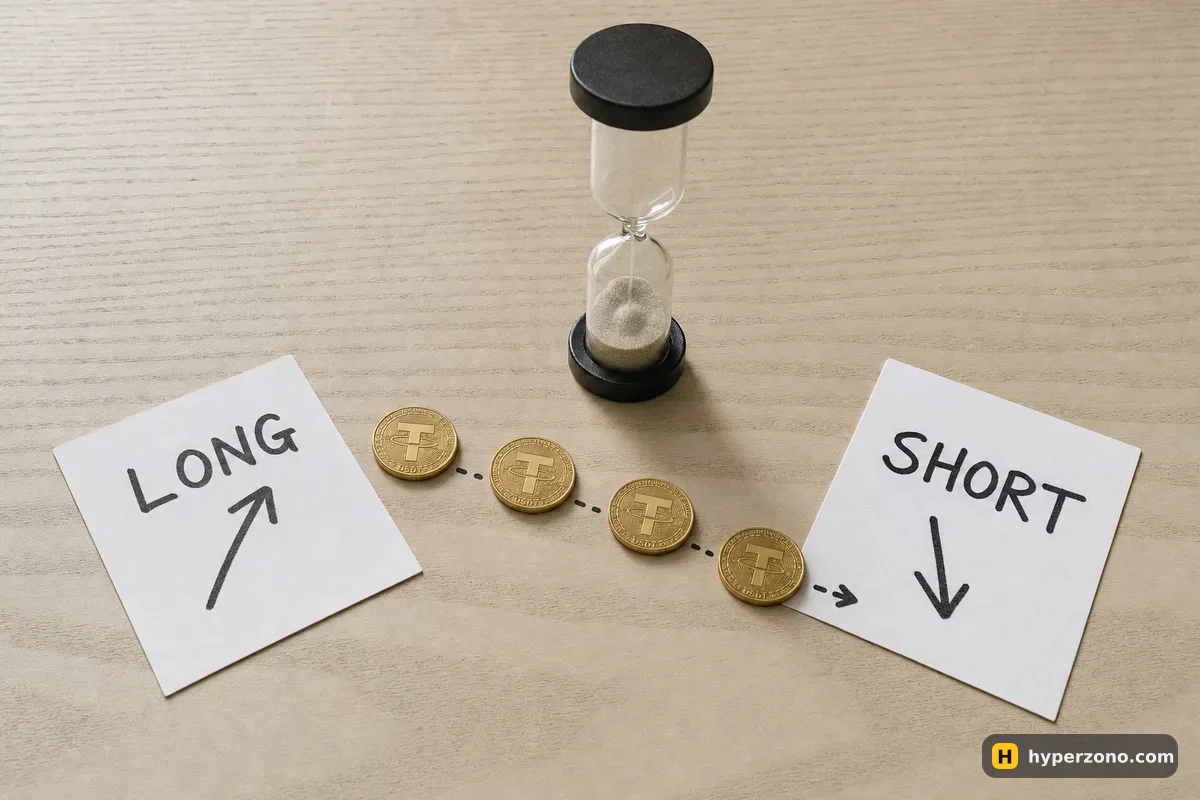
Why this payment exists at all
A perpetual futures contract never expires, so nothing forces its price back to the real price of bitcoin. Funding is the rubber band that does that job. When lots of people are buying the contract and it drifts above the spot price, the rate turns positive and buyers start paying sellers a little every few hours — which makes holding a long slightly expensive and makes shorting slightly attractive, until the two prices come back together.
That is also why contracts with a fixed expiry date have no funding at all: they are pulled back to spot by the expiry itself. You can see the difference between the two kinds of contract on the page about perpetual and dated futures.
Who pays funding, long or short?
It depends only on the sign of the rate at the moment of settlement. A positive rate means longs pay shorts. A negative rate means shorts pay longs. The rate is recalculated for every settlement and can flip from one to the other, so being short is not a way to collect money forever.
The money goes straight to the traders on the other side. This is not a fee the exchange charges you — the trading fee you pay on entry and exit is a separate thing, explained on the page about futures trading fees.
When is funding charged?
On Binance, most USDⓈ-M contracts settle funding every 8 hours — at 00:00, 08:00 and 16:00 UTC. Some contracts use a 4-hour interval, and if the rate reaches its cap the interval can shorten to 1 hour, so always look at the timer on the contract you are trading rather than assuming. Other venues differ: on Hyperliquid, for example, funding is paid every hour.
Here's the part that surprises beginners: you pay only if the position is open at that timestamp. Open a trade at 08:30 UTC and close it at 15:00 — no funding at all. Hold the same trade through 16:00 by one minute, and the full payment is taken.
Funding is counted on the size of your trade, not on your deposit. If you put up 100 USDT of margin with 10x leverage, your position is worth 1,000 USDT, and funding is calculated on that 1,000. Higher leverage doesn't change the rate, but it does make the payment bigger relative to the money you actually put in.
What it costs in real money
The formula is simple: payment = position size × rate. Take an illustrative position of 1,000 USDT and two illustrative rates. At 0.01%, each settlement costs 0.10 USDT — about 0.30 USDT a day if you hold through all three payments and the rate stays there. At 0.1%, each settlement costs 1 USDT, or around 3 USDT a day.
One funding payment on a 1,000.00 USDT position. Traders pay each other, not the exchange. Each contract has its own rate and interval.
For a trade you hold for an hour or two, funding is so small you will barely see it next to what the price does to you. Over a week it is a different story. Hold that same 1,000 USDT trade for a week at 0.1%, and you pay about 21 USDT — on 100 USDT of margin that is a fifth of your money gone before the price even moves. If you want to put in your own numbers, use the funding calculator; to see how funding fits together with fees and leverage in your final result, see how to calculate your real profit.
Where to see the current and predicted rate
Every exchange shows the funding rate right next to the contract's price, together with a countdown to the next payment. The number you see is the rate expected for the upcoming settlement — it is still being updated, so it can change slightly before the clock hits zero. Most apps also keep a funding history for each contract, which is useful if you want to know what holding the same trade cost people over the past days.
The easiest way to get a feel for it is to open a Binance Futures account, pick a bitcoin perpetual and simply watch the rate and the timer for a day before you trade anything. Check in the exchange app that futures are available where you live — the list of countries differs from one venue to another and changes over time.
What to watch out for
Funding comes out of your margin, not out of some separate pot. On a small account with high leverage, several payments against you reduce the cushion holding your trade open and nudge your liquidation price closer. It won't liquidate you on its own in a quiet market, but it is one more reason not to hold a big leveraged position for days just because you hope the price turns around.
And don't build a plan around collecting funding. The rate is small, it changes, and it can flip to the other side while your position stays exposed to the price move — which is far bigger than any payment you collect.
Who pays the funding fee, long or short?
Whoever is on the side the rate points at. A positive funding rate means longs pay shorts; a negative rate means shorts pay longs. The money moves between traders, and the exchange does not take it.
How often is funding charged in crypto futures?
On Binance, most USDⓈ-M perpetuals settle every 8 hours, at 00:00, 08:00 and 16:00 UTC. Some contracts use 4 hours, and in extreme conditions the interval can drop to 1 hour. Other exchanges use their own schedules — Hyperliquid pays every hour — so check the timer on the contract you are trading.
Can I avoid paying funding?
Yes, in two ways. Close your position before the settlement time and reopen it afterwards, or trade a contract with a fixed expiry date, which has no funding at all. Just remember that closing and reopening costs you two trading fees, which may be more than the funding you avoided.
Does funding come out of my profit or my margin?
It is taken from your futures balance, which is the same money backing your position. On a winning trade it simply reduces the profit; on a losing one it adds to the loss and brings your liquidation price a little closer.
How much does funding cost if I hold a trade for a week?
Multiply your position size by the rate, then by the number of settlements. A 1,000 USDT position at an illustrative 0.1% every 8 hours costs about 21 USDT over seven days. At a calmer 0.01% the same week costs around 2 USDT, so the rate on your contract matters a lot.
Do I really get paid for holding a short?
Only while the rate is positive and only at the settlement moments you hold through. It is a small amount on a normal position, and the price can move against you by much more than you collect, so it is not a standalone way to earn.