Contents
The one difference that really mattersWhat keeps a perpetual price close to the real bitcoin priceWhat happens on expiry day with a quarterly contractHow to tell them apart in the appWhere the trading activity actually isWhich one should you trade first?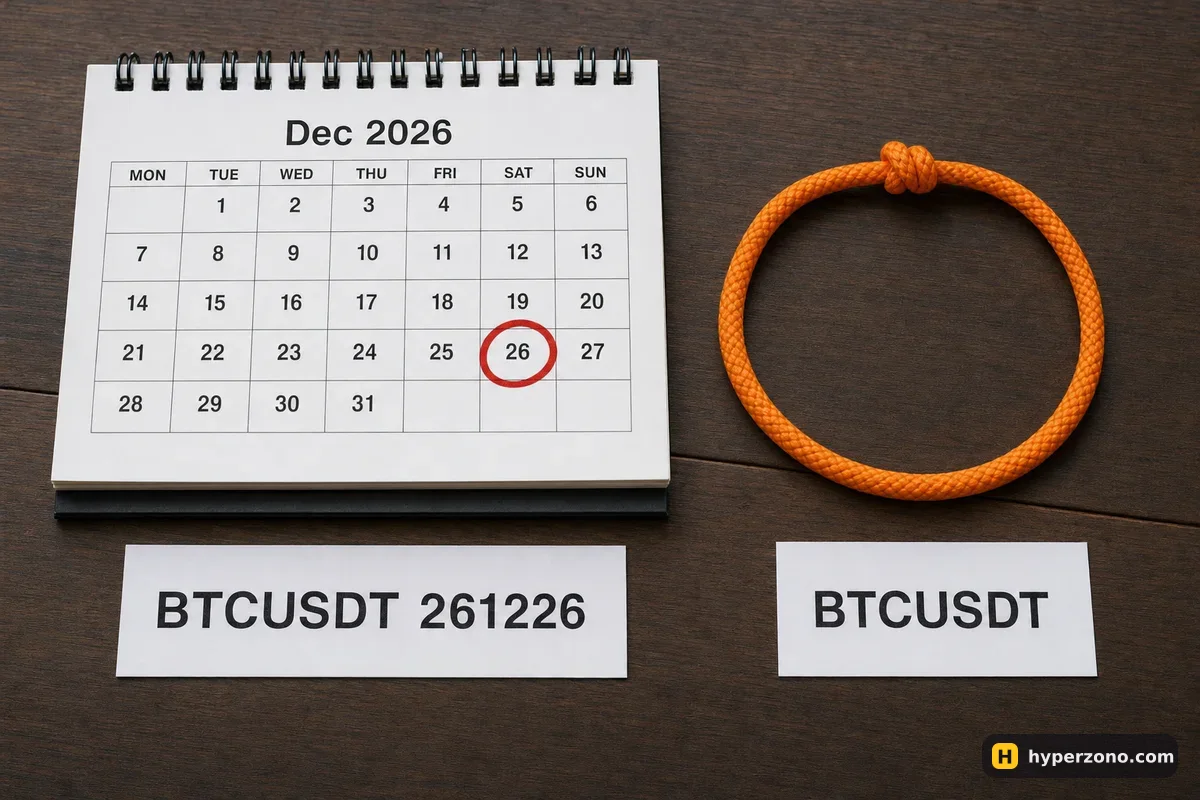
The one difference that really matters
With both, you make money when the price of bitcoin moves your way, and you never have to own any bitcoin to do it. While your trade is open they behave the same: you profit on the price difference, and your loss grows the same way. If that part is still fuzzy, read what crypto futures are in simple words first, then come back here.
The difference starts with time. A perpetual contract has no finish line — nobody closes it for you except you, the stop-loss you set, or the exchange itself if your deposit runs out; that last one is called liquidation. A dated contract carries a specific settlement date, and on that date your position is closed whether you wanted it closed or not. Everything else you will read about these two types grows out of that single fact.
What keeps a perpetual price close to the real bitcoin price
Here's the problem a contract without an end date has: nothing forces it to match the actual market. So exchanges added a small payment between traders. Every few hours, if the contract is trading above the normal price of bitcoin, the people holding longs pay a little to the people holding shorts, and if it is trading below, the payment goes the other way. That payment is called funding, and it pulls the contract back toward the price you would pay if you simply bought a coin and owned it — on an exchange that ordinary buy-and-own price is called the spot price, and how futures differ from buying on spot covers that side properly.
Here is what that looks like in money, with illustrative numbers. Say you have 100 USDT and open a 200 USDT long on the perpetual with 2x leverage. Funding is charged three times that day at 0.01%, so you pay about 6 cents — you barely notice it. Hold that same trade for a month with the rate staying positive and it adds up to roughly 1.80 USDT. That is almost 2% of your 100 USDT, gone before the price has done anything.
For a trade you open and close within a day it is usually a tiny number, but it is real money leaving or entering your account while the position is open. The full mechanics — how often it is charged, how to read the rate on screen, when it actually pays you — live on the page about funding on perpetual contracts.
What happens on expiry day with a quarterly contract
A dated contract does not need funding at all, because time does the job instead. As the settlement date gets closer, the contract price and the spot price squeeze together, and on the final day they meet. So a dated contract can sit a bit above or below the spot price of bitcoin for weeks, and nothing is broken — the two prices just come together as the date gets closer.
On settlement day the exchange takes an average of bitcoin prices from several big marketplaces, closes every open position at that averaged price and settles the profit or loss into your account. On screen that averaged price is called the index, and exchanges use it instead of the last trade on their own order book so that one strange spike cannot decide your money — the same idea is explained on why a contract shows several prices. How each venue works out that final number is written in the contract specification, so check it in the exchange app before you trade a dated contract.
You do not receive bitcoin on settlement day and nobody delivers anything to your door. If you still believe in the trade, you have to open a new position on the next contract, which means paying entry fees again.
How to tell them apart in the app
The ticker gives it away. A perpetual looks plain — BTCUSDT, ETHUSDT. A dated contract has the settlement date stuck onto the end of its name, something like BTCUSDT with 261226 after it — that one closes on 26 December 2026. The exact way the date is written differs a little between exchanges, but the numbers at the end are always the giveaway. Exchanges also split the two types into separate tabs in the contract list, usually under names like perpetual and delivery or quarterly.
The easiest way to see it with your own eyes is to open a Binance Futures account, tap the contract name at the top of the trading screen and scroll the list — the dated ones stand out immediately because of the numbers in their names. Before you sign up anywhere, check that the exchange and its futures are actually available where you live: in some countries futures are not offered at all, and in others the exchange serves you through a separate local company with fewer contracts and lower leverage. You will see it in the app during sign-up, and which exchanges are available in my country goes through what to look for.
| Perpetual (BTCUSDT) | Dated / quarterly (BTCUSDT with a date on the end) | |
|---|---|---|
| Ends when | Only when you close it, or on a stop-loss or liquidation | On the written settlement date |
| Cost of holding | Funding, paid or received every few hours | No funding |
| Price vs the spot price | Pulled back toward spot by funding | Drifts a little, then meets spot on settlement day |
| People trading it | Usually the busiest contracts in the list | Usually quieter — compare them yourself in the app |
Where the trading activity actually is
This is the part beginners underestimate. On a busy contract there are always buyers and sellers sitting close together, so your market order fills at roughly the price you saw on screen. On a quiet one, the nearest buyer may be noticeably below the nearest seller, and you lose a bit on the way in and again on the way out.
On the big exchanges the plain bitcoin and ethereum perpetuals are usually the contracts with the most people trading them, and the dated ones are quieter. You can see this yourself — open both and compare how tightly the buy and sell prices sit together. With 50 or 100 USDT that gap matters more than it sounds, because a few tenths of a percent lost on entry and exit is a real slice of a small trade.
Pick the boring contract first. For your first trades, take the plain perpetual on bitcoin or ethereum, keep leverage low, switch the trade to isolated margin so that only the money you put into this one trade is at risk, and set a stop-loss right away, in the same order window. One decision at a time is enough — you do not need an expiry date to think about as well.
Which one should you trade first?
The perpetual, in almost every case. The price tracks the market you are actually watching, you can close whenever you want instead of planning around a date, and the order fills cleanly because other people are trading the same contract. The one cost you accept in exchange is funding, and on short trades it is usually small change compared with the move you are trying to catch.
Dated contracts become interesting later, when someone wants to hold a view for months without funding payments, or is trading the gap between the dated contract's price and the spot price. That is a different kind of trading, and it needs more money and more patience than you will have on your first account. If you are wondering how long you can sit in a perpetual trade, that question has its own answer on how long you can hold an open position.
Whichever you choose, the money part works the same: you decide direction, size and where you get out. Write those three things down before you tap the button, and the choice between contract types stops feeling like a big decision.
Do crypto futures expire?
Some do, most of the ones people trade do not. Dated contracts carry a settlement date in their name and close automatically on that day. Perpetual contracts have no expiry at all — your position stays open until you close it, your stop-loss triggers or the money behind the trade runs out.
What are perpetual futures in simple words?
A contract that follows the price of a coin and never ends. You put up a deposit, open a long or a short, and take the profit or loss on the price difference. A small payment called funding passes between longs and shorts every few hours to keep the contract price near the ordinary market price of the coin.
Is a quarterly contract cheaper to hold than a perpetual?
It can be, because there is no funding to pay. But you pay for that in other ways: fewer people trading it, a price that sits away from the spot price for a while, and fees again when you open a new position after settlement. On short trades the saving rarely shows up.
Can I hold a perpetual position forever?
In theory yes, in practice only as long as your deposit survives the swings and the funding payments. A position left alone for weeks at high leverage usually gets closed by the exchange before it turns into a profit. Set a stop-loss and decide in advance how long you plan to stay in.
What do the numbers at the end of a futures ticker mean?
They are the settlement date. A contract called BTCUSDT with 261226 on the end is a bitcoin futures contract priced in USDT that settles on 26 December 2026. Plain BTCUSDT with nothing after it is the perpetual, and each exchange writes the date slightly differently.