Contents
What changed in February 2026, in plain wordsWhat those rules change for your 100 USDTWhy "MiCA-licensed" does not mean futures are allowedWhat the big exchanges say about EuropeI already have an account on a platform that is pulling backTax: there is no single EU ruleWhat changed in February 2026, in plain words
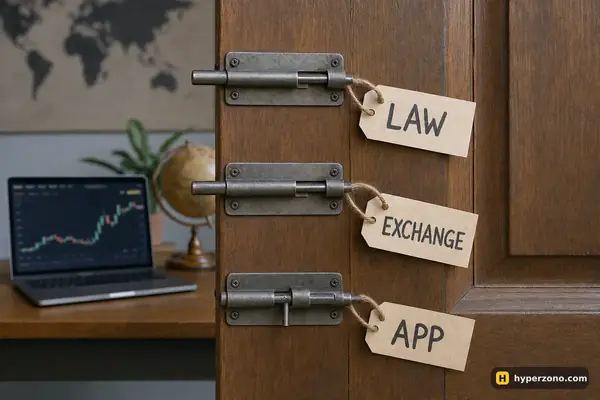
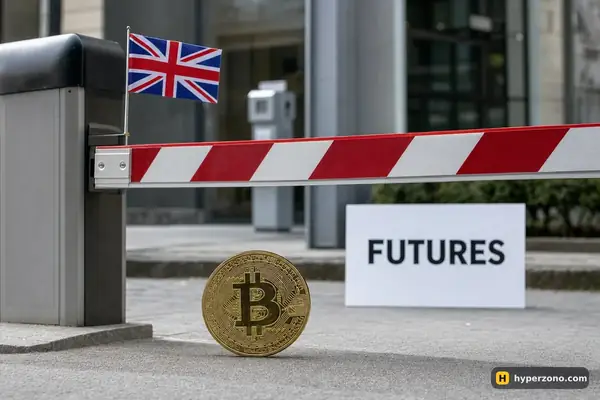
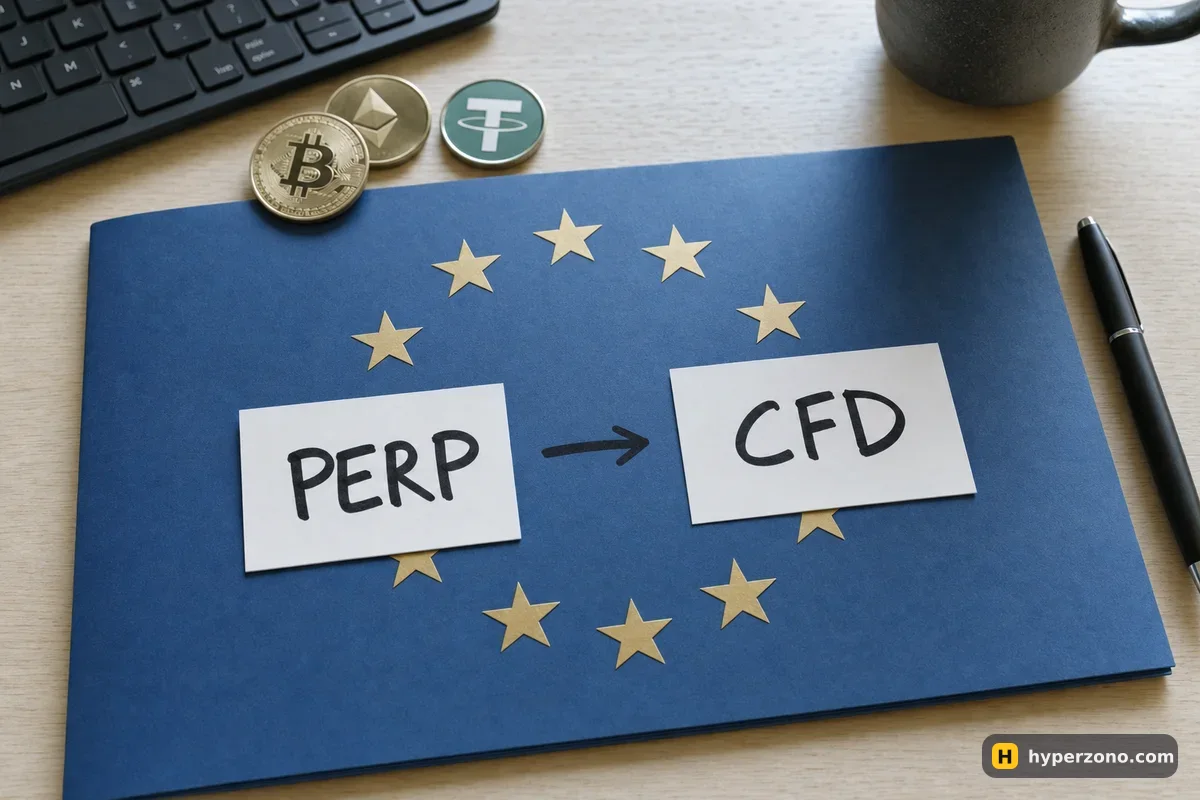
On 24 February 2026 the EU's markets regulator, ESMA, told firms and national regulators how to decide whether a leveraged product falls under the existing CFD rules. The main idea is short: the name on the product does not decide anything, the way it works does. ESMA says it keeps seeing contracts marketed as "perpetual futures" on Bitcoin and Ethereum that work like a CFD — you never hold the coin, you simply settle the price difference in cash with the platform — and that such contracts are likely to fall under the same restrictions, while the firm offering each product still has to analyse that product itself. If the two words still blur together, futures and CFDs side by side is the page for that.
These rules are not new — they were written for CFDs back in 2018, and every EU country has since put its own version in place. Platforms can't get out of them with product design either. It makes no difference that the contract pays a small fee between buyers and sellers every few hours (the funding rate), that it is traded on an official market, or that the platform has its own safety fund — if the product works like a CFD, the same restrictions follow it.
What those rules change for your 100 USDT
The first change is leverage. On a global site you might be offered 20x and open a 2,000 USDT position with 100 USDT of your own money; under the EU caps the same 100 USDT buys a much smaller position, so your profit and your loss from a 1% move both shrink by the same amount. The exact cap is published by your own national regulator and shown in the order window — check it there, not in an advert. If the difference between 5x, 10x and 20x is still new to you, read that first.
The second change is a floor under your loss: the platform has to close your position before the loss goes past the money in your account. You can still lose the 100 USDT you put in, but you cannot be left owing the platform more than you deposited. The third is that nobody is allowed to tempt you in with a welcome bonus or trading credit — if a European platform waves one at you, something is off.
On screen all of this shows up as two extra steps before your first trade. The platform has to ask you questions about your experience, and it has to hand you a short standard document spelling out the risks and the costs. A European platform that lets you straight into leveraged trading with no questions at all is a reason to look twice.
Why "MiCA-licensed" does not mean futures are allowed
This is where most readers get caught. A MiCA licence is for crypto services — buying, selling and holding coins. Leveraged contracts sit in a different part of the rulebook, the one ESMA's February statement is written about. So a "licensed under MiCA" badge on an exchange's European site tells you it may serve you crypto services in Europe; it tells you nothing about whether perpetuals or futures are part of that offer. You will also notice these pages usually say "EEA" rather than "EU", because the European entities are set up for that wider area.
What the big exchanges say about Europe
If you are in the EU and already have a Binance account, the one thing that matters is the message inside your own account. In its notice of 24 June 2026, Binance said it had withdrawn its MiCA licence application in Greece because there was no formal decision before the transition period ended, and that it will apply in another member state and announce which one when it is ready.
The same notice says funds stay safe and accessible, that some users may be affected depending on their country and account status, and that Binance is contacting every EU user by email and in-app message with the details and timelines. It does not list which services change, so only your own notification answers the question for your account. Binance also warns that it will never phone you or ask for your password, 2FA codes or private keys — anyone who does is not Binance.
Bybit serves Europe through Bybit EU GmbH on its separate European site, a separate account under an Austrian MiCA licence, so the product list a European client sees is not the global one. OKX runs its European business through its own EEA entities, and the same applies there. In both cases the honest answer only appears when a European resident goes through the sign-up and the platform routes them to the local entity — that product list, for your country, is what counts. For the picture outside Europe, see which futures exchanges are available in my country; country-by-country pages for Europe will be linked here as they go live.
I already have an account on a platform that is pulling back
Do nothing dramatic, and read the notice inside your account, because only that notice tells you what applies to you — new sign-ups, deposits, open positions and withdrawals can all be treated differently. Take it step by step: close or reduce what you are holding at a price you choose rather than a forced one, move funds to your own wallet or to a provider allowed to serve you, and export your trade history, fee and funding reports while you still have access.
No workarounds, ever. Do not change the country on your account and do not try to reach a product that is not being offered to you. ESMA's statement says taking part in getting around these restrictions is prohibited, and on the exchange side it breaks the terms you agreed to. The usual ending is a frozen account at the worst possible moment.
Tax: there is no single EU rule
Each member state taxes trading gains its own way, and leveraged contracts are often treated differently from simply buying and holding coins. Check your national tax authority's own guidance rather than a forum post, and keep your records from the very first trade: trade history, fees and funding payments. Exporting those reports takes a minute while your account is open and can be impossible later.
Are perpetual futures banned in the EU?
No. ESMA's statement of 24 February 2026 says they are likely to fall under the rules written for CFDs, and that each firm has to assess its own product. So this is a set of limits, not a ban — but the limits are real, and far fewer platforms can offer you these contracts than you see advertised globally.
What is a CFD, in simple words?
It is a contract where you never own the coin. You agree with the platform that when you close the trade, whoever was right about the price direction gets paid the difference in cash. That is also how a crypto perpetual works, which is why EU rules keep pulling the two together.
Is Binance futures blocked in Europe now?
The June 2026 Binance notice does not say that. It says the Greek licence application was withdrawn, that Binance will apply in another member state, that funds stay safe and accessible, and that affected users are being contacted directly with timelines. Go by the message in your own account and the official support channel, and ignore anyone who phones you.
The exchange has a MiCA licence — can I trade futures there?
Not automatically. MiCA covers crypto services, while leveraged contracts sit under a different set of rules. Open the European entity's own terms and product pages and look for what is actually offered to ordinary clients in your country; the sign-up flow is where you find out.
Why is the leverage so low compared with global sites?
Because in the EU the cap comes from your national regulator, not from the platform's marketing. With 100 USDT you will simply open a smaller position than a global site would offer you, which also makes the loss from a bad move smaller. The exact number is published by your own regulator and shown in the order window.
What can I do while I sort out access?
Learn. Position sizing, stop-losses and how a liquidation actually happens are the same everywhere, and you can go through all of it on paper or in demo — see learning futures without real money. If a licensed route opens up for you, you will not be starting from zero.
Sources and fact-check
Exchange terms were checked against official documents on October 20, 2026. Terms change — before you trade, check what matters to you in the exchange app and in your contract’s specs.
ESMA: Public statement on identifying derivatives within the scope of the national product intervention measures on CFDs (24 February 2026)Binance Blog: Important Update for Our European Users (24 June 2026)Decrypt: Binance Withdraws MiCA License Application in Greece (June 2026)