
Contents
What the base fee actually looks likeSpread and slippage cost more than the feeFunding: the cost people forgetWhat discounts a new account really getsWhy 0.01% does not matter on a 200 USDT accountHow to work out your real round-trip cost
What the base fee actually looks like
Every exchange charges you twice on one trade: once when you open it and once when you close it. The fee is taken from the size of the position, not from the money you set aside as margin, so 100 USDT used at 5x is charged as a 500 USDT trade. There are two rates — a lower one if your order waits for someone else to trade with you (maker), and a higher one if you take a price that is already sitting there (taker). Most beginners tap the market button, so plan around the taker rate, and read what fees you pay on futures if you want the mechanics in full.
Binance publishes 0.02% maker and 0.05% taker at the starting level, and 0.018% / 0.045% if you pay your fees in BNB. Those rates are for its USDT-margined contracts — the section the app calls USDⓈ-M, where your margin and your profit are both counted in USDT. Bybit, OKX, Gate and Hyperliquid each publish their own pair of rates, and those pages change over time.
Spread and slippage cost more than the fee
Look at any contract and you will see two prices: the best price someone will buy from you at, and the best price someone will sell to you at. The gap between them is the spread, and you pay it the moment you enter with a market order. On bitcoin that gap is tiny. On a small altcoin with few orders it can be several times your fee, and if your order is bigger than what sits at the best price, the rest fills worse — that part is slippage.
This is why hunting for the lowest maker and taker rates usually misses the point. A 0.05% taker fee on a liquid bitcoin contract works out cheaper in real money than a lower fee on a thin market where your entry and your exit each slip a little. If you want to see it with your own eyes, you can open a Binance Futures account and compare the buy and sell prices on BTCUSDT with those on some tiny coin before you place a single order.
A thin market charges you a fee the exchange never shows. Before you trade a coin you have not traded before, check how close the buy and sell prices are. If they are far apart, your round trip starts in a hole that no fee discount will fill.
Funding: the cost people forget
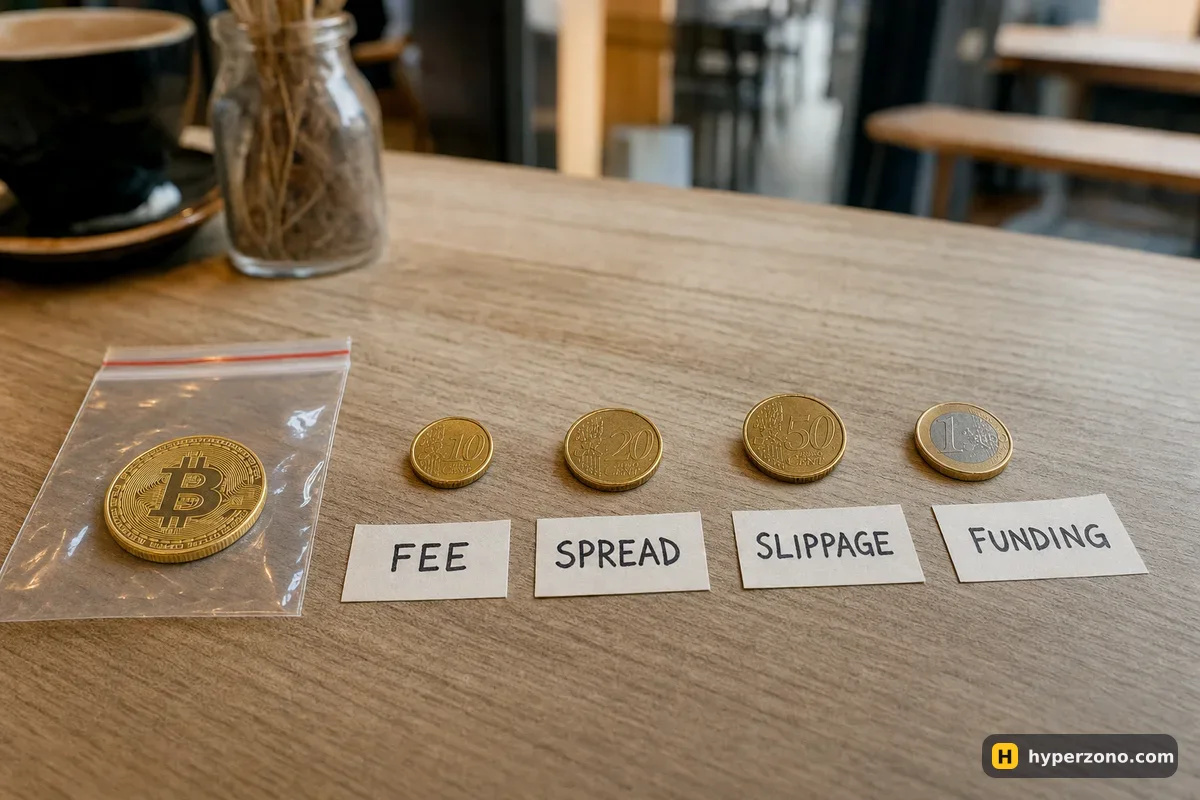
Perpetual contracts have no expiry date, so at set moments longs and shorts pay each other a small amount to keep the contract price near the real market price. The exchange does not take this money, but it leaves your balance all the same if you are on the paying side. On Binance that settlement happens every 8 hours by default, with some contracts on 4 hours and an hour-by-hour schedule when the rate hits its cap; on Hyperliquid it is settled every hour.
For a trade you hold for twenty minutes, funding is usually nothing. For a position you keep open for three days, it can easily outweigh both your entry and your exit fee. How funding works goes through the numbers, and the practical habit is simple: look at the next funding time and the current rate on the contract screen before you decide to hold overnight.
What discounts a new account really gets
Paying fees in the exchange's own token is the clearest saving you can switch on from day one: on Binance, paying fees in BNB brings the futures rates down to 0.018% maker and 0.045% taker. Some exchanges also run a referral programme where a code entered during sign-up affects the fee you pay — whether there is one, and what it is worth, is shown on the registration screen itself. What a referral link gives you explains how to read that screen.
The third route is the VIP ladder, where your rate drops as your monthly trading volume grows. Those levels are built for people who trade very large amounts every month, so treat them as something you may reach later, not as a reason to pick one exchange today. The thresholds are listed on each exchange's fee page.
Why 0.01% does not matter on a 200 USDT account
Say you have 200 USDT and you trade at 5x, so your position is worth 1,000 USDT. A difference of 0.01% in the fee is 0.10 USDT per side, or 0.20 USDT for a full round trip. Trade ten times a month and the whole saving is 2 USDT — less than one careless entry on a wide spread, and far less than one trade held without a stop-loss.
On an account that size, the things that actually change your result are whether the exchange works in your country, whether the app makes sense to you, and whether you can get your money out without trouble. Which exchange suits a beginner and which exchanges are available where you live are worth more of your attention than a hundredth of a percent.
How to work out your real round-trip cost
Start from the position size, not your deposit
Multiply your margin by the leverage. 100 USDT at 5x means a 500 USDT position, and that 500 is what the fee is calculated on.
Count the fee twice
Entry and exit are charged separately. At a 0.05% taker rate, a 500 USDT position costs 0.25 USDT in and 0.25 USDT out — half a dollar for the round trip.
Add the spread you can see
Look at the gap between the buy and the sell price on the contract screen and treat roughly that gap as an extra cost on entry.
Add funding if you plan to hold
Position size multiplied by the funding rate, for each settlement you sit through.
Compare the total with your target
If the move you are aiming for barely covers these costs, the trade is not worth taking.
The figures above are illustrative — put your own numbers in and see what comes out.
One more cost sits outside trading itself: taking money off the exchange. Each venue sets its own withdrawal fee per coin and per network, and a cheap network can cost a fraction of an expensive one for the same transfer. Look at that number in the withdrawal window before you move funds, not after.
Which crypto exchange has the lowest futures fees?
There is no winner that holds for everyone, and for a beginner it hardly matters. Binance starts at 0.02% maker and 0.05% taker; the other large venues publish their own starting rates, and your personal rate then shifts with fee tokens, referral programmes and volume tiers. On a few hundred dollars those differences come to cents a month, so pick the exchange that works in your country and that you can actually use.
Is a maker fee really cheaper than a taker fee?
Usually yes, often by about half. You get the maker rate when your limit order waits in the order book instead of taking a price that is already there. The catch is that a waiting order may never fill, and chasing the maker rate on a fast-moving market can cost you more in missed entries than it saves in fees.
Are decentralized venues like Hyperliquid cheaper?
They set their own fee schedule, but the comparison is not only about the percentage. You trade from your own wallet, funding there is settled every hour, and moving money in and out works differently from a normal exchange account. How trading from a wallet works covers that side of it.
Does a referral link actually lower my fees?
Some exchanges run a referral programme where a code entered during sign-up affects the rate you pay. Whether one applies to you, and how much it is worth, is shown on the registration screen itself. More on it in what a referral link gives you.
Can I trade futures with no fees at all?
Only in demo mode, where nothing is real anyway. On a live account the exchange charges you when you open and again when you close. What you can control is how often you trade: ten small trades a day cost ten times what one considered trade costs, and that is the saving most beginners actually have within reach.