
Contents
Decide the loss before you decide the sizeThe position size formulaThree accounts, the same ruleWhere leverage comes inRounding to what the exchange will actually acceptWhen the number comes out too small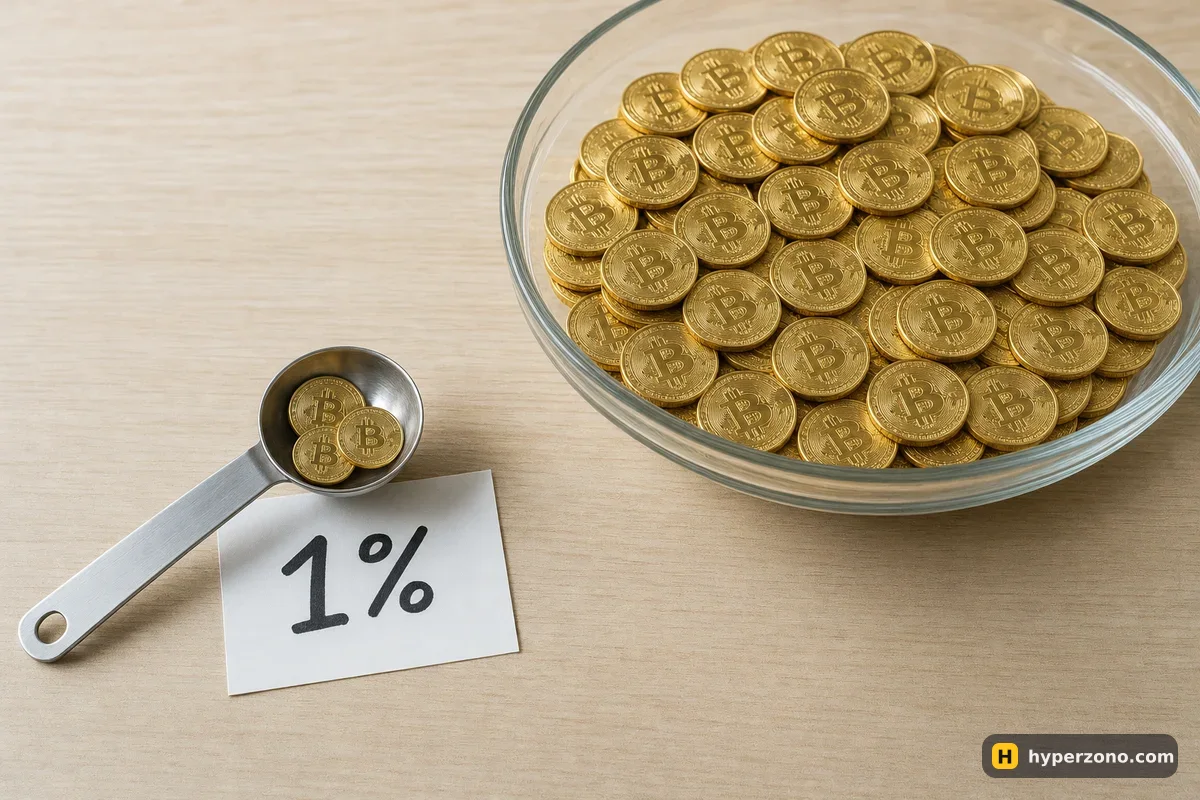
Decide the loss before you decide the size
Most beginners do it the other way round. They think "I'll put 50 dollars into this one", open the trade, and only afterwards wonder where the stop should go. Flip the order. First say how many dollars you are ready to hand over if this particular idea turns out to be wrong, and let that number produce the position size for you.
The usual starting point is 1% of your account per trade, and 2% if you are feeling confident about the setup. On a 1,000 USDT account that's 10 to 20 USDT. It sounds small, and that's the point: you can be wrong five times in a row and still have more than 90% of your money and a calm head. People rarely lose their account because one trade went badly. They lose it because one trade was far too big.
The position size formula
Here is the whole thing, the way you would say it out loud: position size = the dollars you accept losing ÷ the stop distance as a decimal. Two dollars of risk and a 2% stop give 2 ÷ 0.02 = 100 USDT. To turn a percentage into a decimal you divide it by 100, so 2% becomes 0.02 and 2.5% becomes 0.025 — that is the number you type into a calculator.
The stop distance is simply how far your stop loss sits from your entry price, measured as a percentage of the entry. If you plan to buy bitcoin at 83,500 and put your stop at 81,830, that's 1,670 below your entry, which is 2% of 83,500 (illustrative numbers). That's where the 100 USDT from the opening came from: a 200 USDT account, 1% of it (2 USDT) as the loss budget, a 2% stop.
The 100 USDT is the full value of the bitcoin you control, not the money the exchange holds from your balance. If the price reaches your stop, you lose about 2 USDT, which is exactly what you agreed to. Where to put that stop on the chart is a separate skill, covered on the stop loss page, and you can run the arithmetic for your own numbers in the position size calculator.
Three accounts, the same rule
| Account | Risk 1% | Stop distance | Position size | Margin at 10x |
|---|---|---|---|---|
| 200 USDT | 2 USDT | 2% (0.02) | 100 USDT | 10 USDT |
| 1,000 USDT | 10 USDT | 2.5% (0.025) | 400 USDT | 40 USDT |
| 5,000 USDT | 50 USDT | 2% (0.02) | 2,500 USDT | 250 USDT |
Notice what moves the position size around. A bigger account gives a bigger budget, so the size grows in step. A wider stop makes the size smaller, because the same 10 USDT of risk has to cover a longer distance. The middle row shows it: with a 2.5% stop instead of 2%, a 1,000 USDT account gets a 400 USDT position rather than 500. Your loss budget stays fixed, and the market decides how much of a position that budget buys today.
Where leverage comes in
Leverage is nowhere in the formula, and that confuses people. Once you know the position size, leverage only answers a second, smaller question: how much of your balance the exchange sets aside as margin. A 400 USDT position at 5x holds 80 USDT of your money; the same 400 USDT position at 10x holds 40 USDT. The trade is identical, your loss at the stop is identical. The easiest way to feel this is to open a Binance Futures account and watch the margin figure change as you move the leverage slider while the quantity stays put.
The position is 400.00 USDT in every row. A 2% price move gives the same money result — 8.00 USDT. Only the share of your margin changes: from 6% to 20%.
Leverage still has one job you must check. It has to be low enough that the price where the exchange would close your trade by itself sits further away than your stop. At 10x with isolated margin, that forced close sits very roughly 10% away from your entry, so a 2% stop fires long before it. At 50x it would be only around 2% away, and a normal wiggle could wipe out the whole margin before your stop ever triggers. If this part is new, read what leverage to choose for your first trade and how margin works.
Rounding to what the exchange will actually accept
The order window asks for a quantity in coins, not dollars, and the quantity field moves in fixed steps. Take that 100 USDT position on bitcoin at 83,500: 100 ÷ 83,500 is 0.0011976 BTC. On Binance the smallest BTCUSDT position is 0.001 BTC and the steps go in thousandths, so 0.0011976 becomes 0.001 BTC — about 83.5 USDT of position, and a loss of roughly 1.67 USDT if the 2% stop is hit. Always round down to the nearest step the field accepts, never up: rounding down keeps you inside your loss budget, rounding up quietly breaks it.
Minimums differ by contract and by venue. On Binance, ether futures start from about 20 USDT of position value and most altcoin contracts from about 5 USDT, while bitcoin's 0.001 BTC minimum is the biggest of the three — at a price near 83,500 that's about 83.5 USDT of position before you can even start. Other exchanges set their own — the fastest way to find out is to open the order window on Bybit, pick a contract and type a tiny quantity; the field will tell you the smallest size it accepts. Leave a few cents of slack too, since the fee on entry and exit comes out of the same pocket as your loss.
When the number comes out too small
This happens constantly on small accounts. With 200 USDT, a 1% risk and a wide 4% stop, the formula gives 2 ÷ 0.04 = 50 USDT — under bitcoin's minimum. You have a few honest options, and one tempting bad one.
- Choose a contract with a smaller minimum, so the size the formula asked for is actually possible.
- Take the smallest allowed size and check what it really risks. The minimum 0.001 BTC with a 4% stop loses about 3.34 USDT — that's 1.7% of a 200 USDT account, still within reason.
- Wait for a setup where your stop is naturally closer, which makes the calculated size bigger.
- Keep adding to the account, or practise the same arithmetic in demo mode until the numbers get comfortable.
The bad option is dragging the stop closer to the entry just to make the size fit. A stop belongs where the chart says your idea was wrong, not where your calculator wants it. If almost every trade comes out below the minimum, your account is simply small for that market — see trading with 10 dollars for what is and isn't realistic at that level.
Write the three numbers down before you click. Account, risk in dollars, stop distance in percent. If you can't fill all three in, the trade isn't ready — and no position size can be calculated from a plan that has no exit.
How much should I risk per trade as a beginner?
One percent of your account is the usual answer, two percent at most when you really like the setup. On 500 USDT that's 5 to 10 USDT per trade. It feels too careful at first, and that feeling is exactly why it works — a run of five losses costs you a tenth of your money instead of half.
Does the 1% risk rule work on a small account?
The idea works, the arithmetic gets tight. On 100 USDT, 1% is one dollar, and one dollar of risk with a 2% stop means 1 ÷ 0.02 = 50 USDT of position, which is below the minimum on some bitcoin contracts. Pick contracts with small minimums, or accept a slightly higher percentage and know exactly what it is.
Is position size the same as the margin I put in?
No, and mixing them up is the most common sizing mistake. Position size is the full value of what you control — 400 USDT of bitcoin, for example. Margin is the slice of your balance the exchange holds for it: 40 USDT at 10x, 80 USDT at 5x. Your profit and loss are calculated on the position, not on the margin.
How do I size a trade if I don't use a stop loss?
You can't, honestly. Without a stop there's no distance to divide by, so your possible loss runs all the way down to the price where the exchange closes you out. If you want a number you can control, the stop has to exist first — the size is just a consequence of it.
Should I increase the size when I'm very confident?
Confidence is not information, and it tends to peak right before the market does something surprising. If you want to allow for it, decide in advance that strong setups get 2% instead of 1% and leave it there. Jumping to 10% on a feeling is how a good month turns into a bad week.