Contents
Coins are the main market, and the place to startStocks: Tesla, Apple and Nvidia without a broker accountIndices: the S&P 500 and Nasdaq-100 in one contractGold, silver and energyOpening hours, thin markets and where they are allowedWhere to start in this section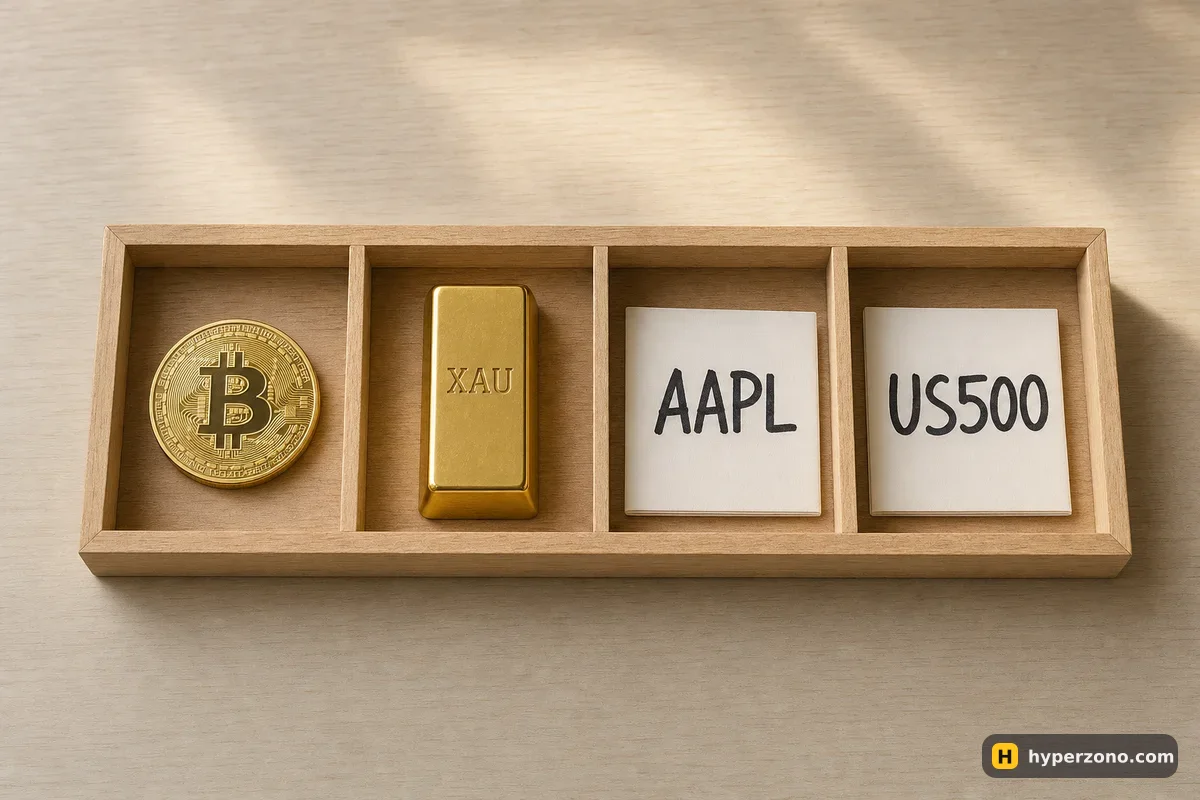
Coins are the main market, and the place to start
Almost everything traded on crypto futures exchanges is still coins: bitcoin, ether and hundreds of smaller tokens, usually as contracts named like BTCUSDT or ETHUSDT. You never hold the coin itself. You open a position on the price, and when you close it the difference is paid into your account in USDT. On the same contract you can bet on the price rising (a long) or falling (a short) — the money you put down is the same either way.
Say you have 100 USDT in your futures account. The same 100 USDT can back a bitcoin position today and a gold position tomorrow — you move nothing between accounts, and the profit or loss lands in USDT either way. As an illustration: you take a 500 USDT position with 100 USDT of your own money set aside as margin, which is 5x leverage. A 2% move in your favour is about 10 USDT of profit, and the same move against you is about 10 USDT of loss, whether the contract is on bitcoin, on Tesla or on gold.
Most of these contracts are perpetual, meaning they have no end date: you hold as long as your margin holds, and every few hours longs and shorts pay each other a small amount called funding. Some exchanges also list contracts with a fixed expiry date, which behave a little differently as that date gets closer. Which coins to pick for your first trades is a question of its own: which coins to trade first.
Stocks: Tesla, Apple and Nvidia without a broker account
Since 6 October 2026 you can also trade contracts on shares on Binance — they sit in the same futures list as bitcoin, priced and settled in USDT. They are part of a wider group of non-crypto contracts, 217 in total, covering US stocks and funds, some Hong Kong and Korean names, plus metals and energy. You trade them exactly like a coin contract: USDT margin, long or short, same order window.
You are not buying shares, so you are not a shareholder — there is no voting and no share certificate. When the company pays a dividend, the exchange adjusts the contract to account for it, but no dividend lands in your account, because you own no shares.
Tokenized shares are a different thing. They are not futures at all — on Bybit, for example, xStocks are bought on the spot side, and you hold a token that follows the share price, under its own rules that you should read in the app. If you want to open a trade on one company, the step-by-step is in how to trade Tesla, Apple or Nvidia. The quickest way to see what is actually listed for your account is to open a Binance Futures account and type the ticker into the contract search.
Indices: the S&P 500 and Nasdaq-100 in one contract
Instead of picking one company, you can trade a contract that follows a whole market. On Binance these are QQQUSDT and SPYUSDT — the announcement calls them index perpetuals, but the price follows two US funds, QQQ and SPY, which hold the Nasdaq-100 and S&P 500 shares themselves, so it is not the index future a stock broker would sell you. OKX takes another route with US100, US500 and JP225 perpetuals priced from OKX's own settlement indices. What that means in practice is covered in S&P 500 and Nasdaq-100 on a crypto exchange.
Gold, silver and energy
Gold, silver, copper, WTI and Brent crude and natural gas are all there too — and the mechanics differ from contract to contract more than people expect. On OKX, gold (XAUUSDT) and silver (XAGUSDT) simply track the spot price. Copper, oil and gas follow dated futures contracts instead, and every so often the exchange moves the contract from the expiring one to the next, in five steps of 20% — so the price you see can shift a little for reasons that have nothing to do with the market mood.
On Binance, check each commodity contract's own specification before you open anything, because the mechanism is not the same everywhere. Gold is the one most beginners ask about, so it has its own walkthrough: how to trade gold with futures.
| Market | Example contracts | Worth knowing |
|---|---|---|
| Coins | BTCUSDT, ETHUSDT, altcoins | The deepest market; perpetuals with funding every few hours |
| US stocks | Tesla, Apple, Nvidia perpetuals | No shareholder rights; on Binance maximums run from 20x to 75x by contract (Tesla 25x), new listings 20x |
| Index-linked | QQQUSDT, SPYUSDT (Binance); US100, US500, JP225 (OKX) | Binance's follow the QQQ and SPY funds; OKX uses its own settlement indices |
| Metals and energy | Gold, silver, copper, WTI, Brent, natural gas | On OKX gold and silver follow spot; oil, gas and copper follow dated futures with rollover. Binance commodities up to 100x |
Opening hours, thin markets and where they are allowed
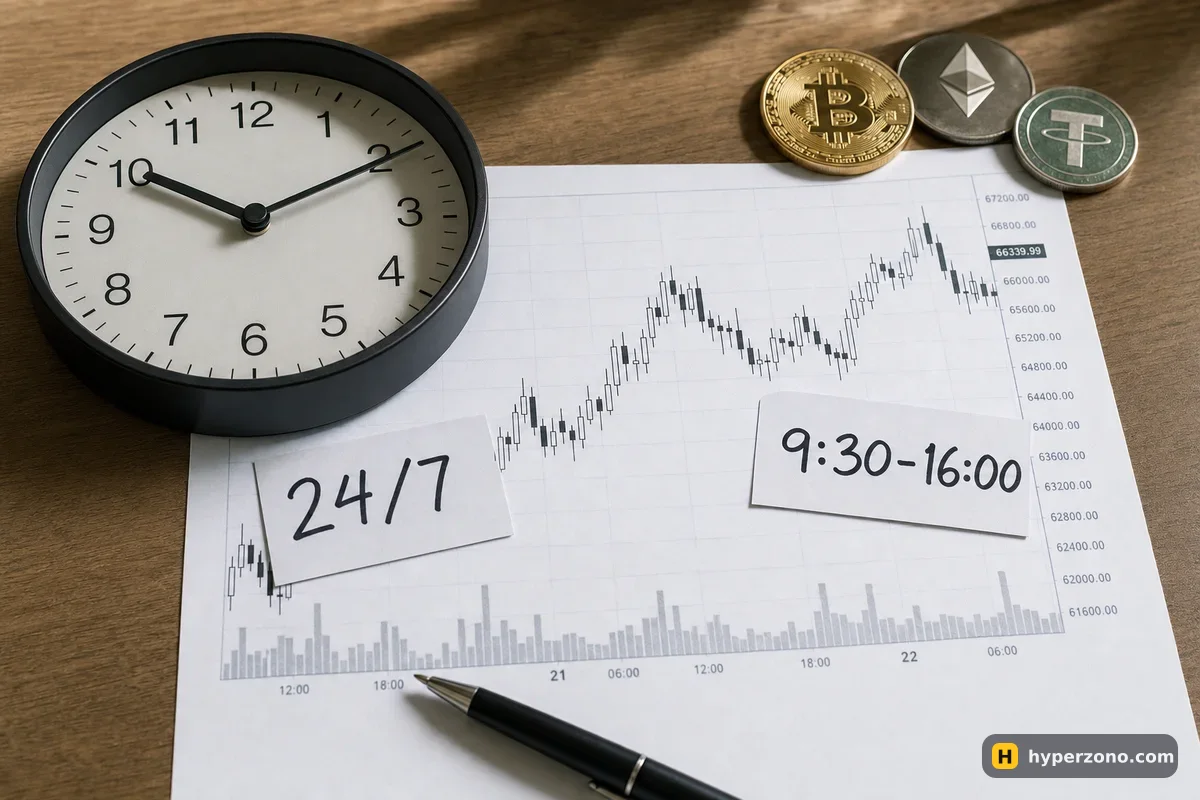
Binance's non-crypto perpetuals trade 24/7, weekends included, while the companies behind them only change hands on the real stock exchange between 9:30 and 16:00 New York time, with holidays and short days of their own. Outside that window the contract price still moves, driven by the exchange's own index rather than by share trading, and a quiet market can jump further on a single order than you expect.
That is a real reason to keep positions smaller on these contracts and to put a stop-loss in from the start. It is also a reason not to reach for the big numbers on the leverage slider — what leverage to pick for a first trade is worth reading before you do.
Check availability before you plan anything. Stock, index and commodity contracts are not offered everywhere, and some exchanges serve parts of the world through separate local entities with different products and lower leverage caps. Open the app, start sign-up, and see what your account is actually allowed to trade — never try to get around a restriction. More on this in which exchanges are available in my country.
Where to start in this section
If you are new, learn the mechanics on a coin contract first — bitcoin or ether, small size — because the order window, margin and liquidation work identically across every market here, and coins are the market you can always find. Once that feels routine, read the page for the market you are curious about and look up its contract specification before your first trade. Demo mode is a fine place to rehearse, though a specific stock or index ticker may simply not be there, so check the one you want before you plan around it.
What can you trade with crypto futures?
Coins first of all — bitcoin, ether and hundreds of altcoins. On top of that, the larger exchanges list perpetual contracts on US stocks and funds, on stock indices, and on gold, silver, copper, oil and natural gas. All of them use the same USDT margin and the same order window, so 100 USDT in your futures account can back a trade on any of them.
Can I really trade Nasdaq or S&P 500 on a crypto exchange?
You can trade contracts that follow them. Binance lists QQQUSDT and SPYUSDT, whose price follows the US funds QQQ and SPY, and OKX lists US100, US500 and JP225 built on OKX's own settlement indices. They are not the exchange-traded index futures a stock broker would offer, so treat them as their own product and read the specification.
Is gold on a crypto exchange the same as owning gold?
No. You are trading a contract on the gold price, settled in USDT — nothing is delivered and nothing is stored for you. On OKX the gold perpetual tracks the spot price, while oil, gas and copper follow dated futures that the exchange moves forward step by step, so always check which mechanism your contract uses.
Do I own the shares if I trade a Tesla perpetual?
No. You hold a position on the price, not shares, so there is no stock in your name, no voting and no share certificate. When the company pays a dividend, the exchange adjusts the contract to account for it, but nothing is paid into your account as a dividend.
How much leverage can I use on stock or gold contracts?
It varies by contract, and the published maximums look big — on Binance stock perpetuals run from 20x to 75x depending on the contract, with Tesla at 25x and new listings at 20x. A new futures account is limited to 20x for its first 30 days anyway, and for a first trade even that is far too much. Start low and size the position so one bad move costs you a small part of your account.
Are all these markets available in my country?
Not necessarily. Futures as a whole are restricted or limited in a number of places, and stock, index and commodity contracts can be narrower still, sometimes served through a separate local company with lower leverage limits. Check during sign-up in the app and on the exchange's own restriction pages, and if a product is not offered where you live, leave it alone.