Contents
The ENA funding rate right now on five venuesWhat ENA funding has cost in money: 30 days, 90 days, 12 monthsMonth by month: when longs paid most and when shorts paidWhere to hold the position, and how to check funding before you open itThe ENA funding rate right now on five venues
Funding is the small payment that passes between longs and shorts on a perpetual contract at fixed times; the exchange does not keep it. If you want the mechanism itself, how funding works covers it in full — here we stay on one question: what the Ethena funding rate is doing right now and what it has cost in money.
The rate changes at every settlement, so there is no point quoting a figure that will be stale by the time you read it. The table below pulls the current ENA funding rate from each venue's public data and refreshes every hour. Read it like this: a positive rate means longs pay shorts, a negative rate means shorts pay longs, and the interval tells you how often that payment happens.
| Where | Paid | Rate now | A 1,000 USDT long: 30 days | 90 days | 12 months | Longs paid (90 days) |
|---|---|---|---|---|---|---|
| Binance Futures | every 4 h | +0.0026% | pays 6.42 USDT | pays 15.39 USDT | receives 3.42 USDT | in 65% of settlements |
| Binance Wallet (Aster book) | every 4 h | +0.0050% | pays 8.01 USDT | pays 23.75 USDT | pays 58.33 USDT | in 87% of settlements |
| Bybit | every 4 h | +0.0050% | pays 4.71 USDT | pays 12.93 USDT | receives 2.49 USDT | in 68% of settlements |
| OKX | every 8 h | +0.0069% | pays 5.11 USDT | pays 15.10 USDT | — | in 84% of settlements |
| Hyperliquid | every hour | +0.0013% | pays 9.18 USDT | pays 32.35 USDT | pays 39.99 USDT | in 78% of settlements |
Rate now is what the venue shows for the next settlement. The totals are what a 1,000 USDT long would have paid holding the whole time (price changes aside); a short would have received the same. "Longs paid" is the share of settlements over 90 days when the rate was above zero. OKX only publishes 3 months of history.
Updated 24 Oct 2026, 20:12 UTC from the exchanges’ public APIs.
The interval sits next to the rate in the table above. Today ENA settles hourly on Hyperliquid, and on the other venues in blocks of several hours — read the exact figure in the table, because an exchange can change it on a given contract. That is also why Hyperliquid's number looks tiny next to the others: before you compare two venues, put the rates on the same clock — multiply the hourly figure by 8 to line it up with an 8-hour rate, not by 24. If that still feels confusing, comparing a 1-hour rate with an 8-hour one walks through it slowly.
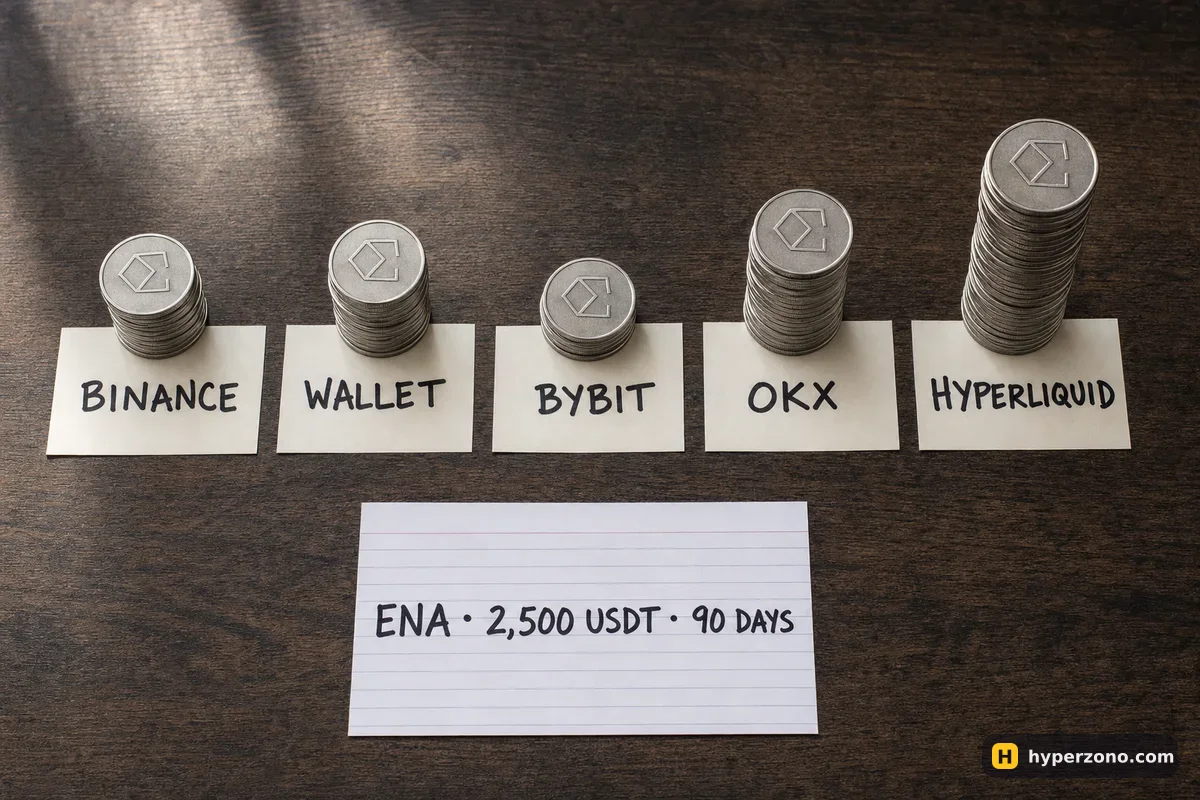
One funding payment on a 2,500.00 USDT position. Traders pay each other, not the exchange. Each contract has its own rate and interval.
What ENA funding has cost in money: 30 days, 90 days, 12 months
Here is the same question in USDT, on the one example we use everywhere on this page: 500 USDT at 5x leverage, which is a 2,500 USDT position. Funding is always charged on the position size, not on your margin. These totals count funding only — the price of ENA moving up or down is a separate story and is not in these numbers.
| Venue | 30 days | 90 days | 12 months |
|---|---|---|---|
| Binance Futures | −16.05 | −38.48 | +8.55 |
| Binance Wallet Perpetuals (Aster) | −20.03 | −59.38 | −145.83 |
| Bybit | −11.78 | −32.33 | +6.23 |
| OKX | −12.78 | −37.75 | no data |
| Hyperliquid | −22.95 | −80.88 | −99.98 |
Look at the 90-day column. On Bybit that ENA long gave up about 32 USDT in funding, on Hyperliquid about 81 USDT — a difference of roughly 49 USDT on the same idea, the same size and the same three months. On a 500 USDT account that is around 10% of your money, decided by nothing except where you clicked buy. Funding is not big per payment; it is big because it repeats.
The 12-month column tells the other half of the story, with two caveats. On Binance and Bybit a long that sat there for a year came out slightly ahead on funding — it received 8.55 and 6.23 USDT on our example — because for part of that year the rate was negative and shorts were paying longs. For OKX we only have about three months of funding history, so there is no 12-month figure; that empty cell does not mean zero. And the Binance Wallet Perpetuals tab only opened on web in January 2026 and in the app in April 2026, so most of that −145.83 is Aster's own funding history on the same contract, from before you could reach it from the wallet.
Month by month: when longs paid most and when shorts paid
An average over a year hides the months that actually hurt. The table below breaks ENA funding into calendar months on each venue, and it is quoted per 1,000 USDT of position size — for our 2,500 USDT example, multiply each figure by 2.5. Scan down a column and you will see the pattern: long stretches of small payments, then one month that does most of the damage.
| Month | Binance Futures | Binance Wallet (Aster book) | Bybit | Hyperliquid |
|---|---|---|---|---|
| October 2026 | 4.47 USDT | 6.03 USDT | 2.76 USDT | 6.42 USDT |
| September 2026 | 6.22 USDT | 10.40 USDT | 5.27 USDT | 12.82 USDT |
| August 2026 | 5.04 USDT | 6.74 USDT | 4.59 USDT | 12.17 USDT |
| July 2026 | 2.03 USDT | 6.19 USDT | 2.06 USDT | 8.19 USDT |
| June 2026 | −0.62 USDT | 7.07 USDT | −0.19 USDT | 5.31 USDT |
| May 2026 | 3.14 USDT | 9.34 USDT | 2.45 USDT | 7.67 USDT |
| April 2026 | −0.37 USDT | 6.62 USDT | 0.05 USDT | 0.57 USDT |
| March 2026 | 0.04 USDT | 6.39 USDT | −3.95 USDT | −1.58 USDT |
| February 2026 | 1.07 USDT | 4.18 USDT | 1.50 USDT | 2.48 USDT |
| January 2026 | 2.99 USDT | 8.05 USDT | 3.07 USDT | 4.51 USDT |
| December 2025 | −4.50 USDT | −2.44 USDT | −4.84 USDT | −3.32 USDT |
| November 2025 | −14.58 USDT | −1.29 USDT | −8.72 USDT | −10.52 USDT |
| October 2025 | −8.35 USDT | −8.96 USDT | −6.55 USDT | −4.74 USDT |
What a 1,000 USDT long paid in each month (minus means it received). The current month is not over yet. OKX is left out: its API keeps only 3 months of history.
Updated 24 Oct 2026, 10:56 UTC from the exchanges’ public APIs.
September 2026 was the expensive month for ENA longs everywhere: per 1,000 USDT of size, longs paid 6.22 USDT on Binance, 5.27 on Bybit, 10.40 in the Binance Wallet tab and 12.82 on Hyperliquid. On our 2,500 USDT position that Hyperliquid month alone works out at about 32 USDT. November 2025 went the other way — a long received 14.58 USDT per 1,000 on Binance, 8.72 on Bybit and 10.52 on Hyperliquid, because the market was leaning short and shorts were paying for it. In the Binance Wallet row, remember that anything before 2026 is Aster's funding history on the same contract rather than something a wallet user could have paid or received.
Direction of pressure also shows up in how often longs were the ones paying. Over the 90 days to 24 October 2026, longs paid in 65% of settlements on Binance and 68% on Bybit, but 78% on Hyperliquid, 84% on OKX and 87% in the Binance Wallet tab. A high share like that means a long is paying most of the time and only occasionally gets a refund — worth knowing before you plan to hold ENA for weeks.
The cheap venue today is not automatically the cheap venue next month. ENA funding has flipped sign more than once in the past year, and intervals can change on a contract too. Yesterday's totals tell you how this market usually behaves, not what it will charge you tomorrow. Check the live rate and the interval for your pair before you open, and again if you decide to hold through the weekend.
Where to hold the position, and how to check funding before you open it
For a trade you plan to close within a few hours, funding barely matters — you may pay one settlement, or none at all, since only the trader holding the position at the settlement moment pays or receives. For anything you intend to carry for days or weeks, treat funding as part of the price of the idea and add it up before you enter. The funding calculator does that in a few seconds: put in your position size, the current rate and how long you expect to hold.
Finding the rate inside the app takes about ten seconds once you know where to look. The easiest way to see it is to open a Binance Futures account, choose the ENAUSDT contract and look at the top of the trading screen, where the current funding rate sits next to a countdown to the next settlement; the contract details page shows the interval and the history. Bybit and OKX show the same pair of numbers in the same place, Hyperliquid shows an hourly rate, and the Binance Wallet Perpetuals tab uses the Aster order book, so the funding you see there is Aster's funding, on Aster's schedule.
Check the rate and the interval
Open the ENA perpetual on your venue and read two things: the current funding rate and how often it settles. Four hours means six payments a day; one hour means twenty-four smaller ones.
Turn it into money
Multiply your position size by the rate. On our 2,500 USDT position, a 0.01% rate is 0.25 USDT per settlement, or 1.50 USDT a day on a 4-hour contract.
Multiply by your holding time
Planning to hold for two weeks? That same rate means about 21 USDT on the 2,500 USDT position — compare it with the profit you are hoping for and decide if the idea still makes sense.
Check the sign before you pick your side
If the rate is negative, a short is paying and a long is being paid. That never makes a bad trade good, but it changes which direction is cheaper to hold.
One more thing that often surprises people: funding has nothing to do with your leverage. A 2,500 USDT position pays the same funding whether you opened it with 2,500 USDT of margin or 500 USDT at 5x. Leverage changes your margin and your liquidation price, which is a separate decision — see what leverage to use for a first trade. And if you want to see this pattern across other coins, there is a 12-month study of BTC, ETH and SOL funding with its own calculator.
Before you compare venues on funding alone, also check that the exchange and its ENA perpetual are available where you live — availability differs by country and changes without notice — and remember that trading fees, spread and your own comfort with the app usually matter more on short trades than a few cents of funding.
What is the ENA funding rate today?
It depends on the venue and on the time of day, because it is recalculated at every settlement. The live table near the top of this page shows the current Ethena funding rate on Binance, Bybit, OKX, Hyperliquid and the Binance Wallet Perpetuals tab, with the interval for each, and refreshes every hour.
How often is ENA funding charged?
Hyperliquid settles funding every hour. The other venues settle in blocks of several hours, and the exact interval belongs to the contract and can be changed — so read it next to the rate in the live table above before you plan around it, rather than trusting a number from an article.
Do I pay ENA funding if I close my trade before the settlement time?
No — only the trader holding the position at the settlement moment pays or receives. Cutting it to the last few seconds is still a gamble, because the charge and your closing order do not land at exactly the same instant; leave yourself a minute either way.
Can I earn money by shorting ENA when funding is positive?
A short does receive the payment when the rate is positive, and over the 90 days to 24 October 2026 longs were paying in 65–87% of settlements depending on the venue. But the payment is tiny next to the price risk: a few USDT of funding will not save a short if ENA rallies 10%.
Does higher leverage mean higher funding?
No. Funding is charged on your position size, not on your margin. A 2,500 USDT ENA position pays the same funding at 5x as at 20x — leverage only changes how much of your own money is locked up and how close your liquidation price sits.
Why does the Binance Wallet row show a full year of ENA funding?
Because the data comes from the Aster contract that the Perpetuals tab uses, and that contract existed before the tab did. The tab opened on web in January 2026 and in the app in April 2026, so the 2025 months in that row are Aster's own history — useful for seeing how the market behaved, but not something a wallet user could have paid.
Sources and fact-check
Exchange terms were checked against official documents on October 24, 2026. Terms change — before you trade, check what matters to you in the exchange app and in your contract’s specs.
Hyperliquid Docs: FundingAster Docs: Funding RateBinance: Introduction to Binance Futures Funding Rates