Contents
The BTC funding rate right now, exchange by exchangeWhere to see the BTC rate in each app, and how to read itWhat today's rate means for a trade you open nowWhy the cheapest exchange keeps changingWhen this small number stops being smallThe BTC funding rate right now, exchange by exchange
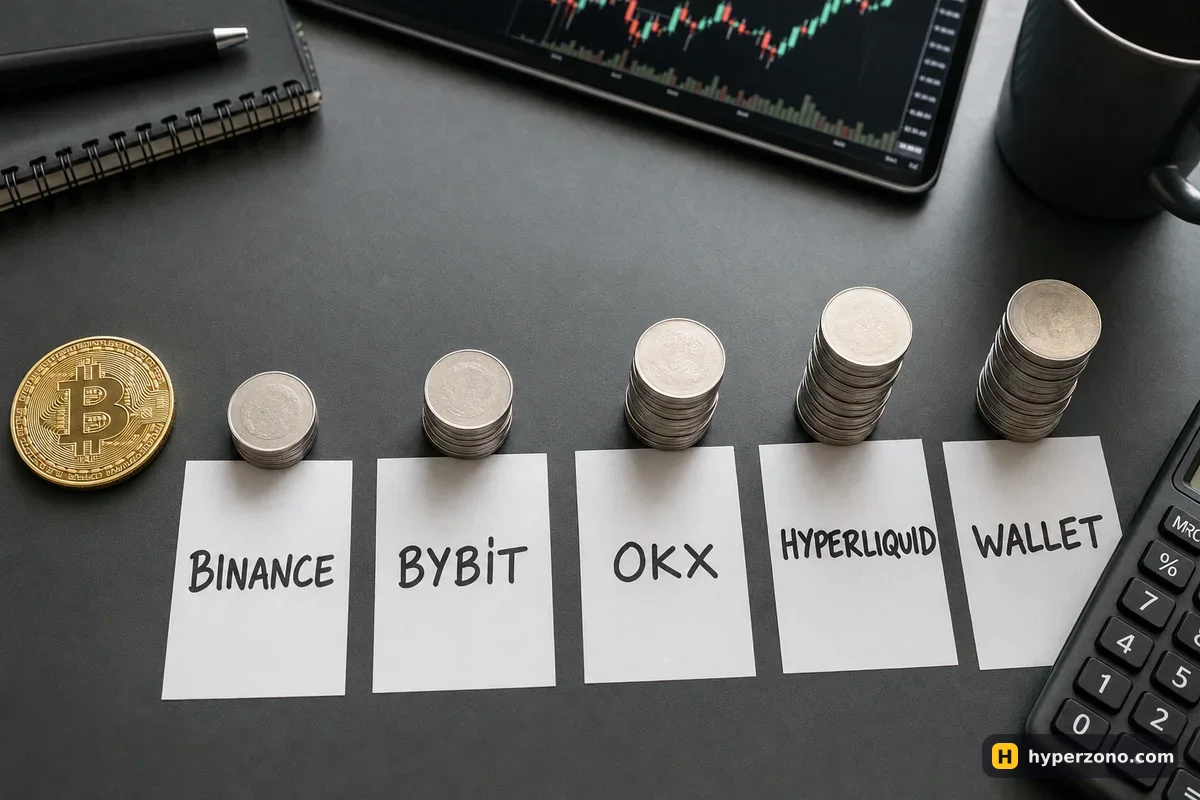
The table below is filled from the exchanges' own public data and refreshed every hour. Read it from left to right: the rate each venue is currently heading into its next payment with, and how often that payment happens. A rate with a plus sign means you pay if you are long and you receive if you are short — on BTC it is positive most of the time, but not always.
| Where | Paid | Rate now | A 1,000 USDT long: 30 days | 90 days | 12 months | Longs paid (90 days) |
|---|---|---|---|---|---|---|
| Binance Futures | every 8 h | +0.0045% | pays 2.91 USDT | pays 14.21 USDT | pays 34.23 USDT | in 77% of settlements |
| Binance Wallet (Aster book) | every 8 h | +0.0100% | pays 4.23 USDT | pays 14.37 USDT | pays 39.15 USDT | in 80% of settlements |
| Bybit | every 8 h | +0.0073% | pays 2.91 USDT | pays 11.51 USDT | pays 27.03 USDT | in 72% of settlements |
| OKX | every 8 h | -0.0000% | pays 3.48 USDT | pays 13.93 USDT | — | in 90% of settlements |
| Hyperliquid | every hour | +0.0013% | pays 6.85 USDT | pays 20.67 USDT | pays 58.53 USDT | in 81% of settlements |
Rate now is what the venue shows for the next settlement. The totals are what a 1,000 USDT long would have paid holding the whole time (price changes aside); a short would have received the same. "Longs paid" is the share of settlements over 90 days when the rate was above zero. OKX only publishes 3 months of history.
Updated 24 Oct 2026, 20:12 UTC from the exchanges’ public APIs.
One thing to watch when you compare the numbers: the rate on its own doesn't tell you the cost, because the venues don't pay on the same schedule. Hyperliquid pays every hour, which makes its number look tiny at first glance; Binance settles every 8 hours by default, some contracts every 4, and the others show their own interval right next to the rate. To put an hourly rate beside an 8-hour one, multiply the hourly rate by 8 — not by 24 — and there is a short page on exactly that in comparing a 1-hour rate with an 8-hour one.
Where to see the BTC rate in each app, and how to read it
On every venue the rate sits on the contract page itself, usually near the price with a countdown to the next payment. If you cannot find it on a particular screen, the exchange's funding history page for that contract always has it.
Binance Futures
Open the BTCUSDT perpetual. The rate and a countdown to the next funding are shown above the chart. The number you see before the payment can still move, because it is worked out from how far the perpetual has been trading above or below the spot price; what you actually pay is the rate at the moment of payment. The quickest way to get used to it is to open a Binance Futures account and watch the countdown next to the price for a day.
Bybit
Open the BTCUSDT perpetual and look at the contract information near the price for the current rate and the countdown to the next payment. Past payments appear in the contract details and in your own transaction history once you hold a position.
OKX
Open BTC-USDT-SWAP. The current rate and the time left to the next payment are shown with the contract data, and past rates are in the contract's funding history.
Hyperliquid
Open the BTC market. The rate is shown per hour, which is why it looks so much smaller than the others, and the payment lands every hour. There is no account to register — you connect a wallet, so if you want to watch hourly funding tick along you can go to Hyperliquid and look at the BTC market without depositing anything.
Binance Wallet, Perpetuals tab
Open the BTCUSDT pair in the Perps list. Execution and the order book there come from Binance's partner Aster, so the funding you see and pay is Aster's funding — check both the rate and the interval on the pair screen before you open anything.
If you have never seen the payment hit your balance, the mechanics are covered separately in what funding is and when you pay it. The short version: you pay or receive only if you are holding the position at the moment of settlement, and closing before it means you pay nothing at all.
What today's rate means for a trade you open now
Say you put 500 USDT of your own money into a bitcoin long at 5x. That gives you a position of 2,500 USDT, and funding is always charged on the position, not on your margin. So take the rate from the table above, multiply it by 2,500, and that is the payment at each settlement — arriving at whatever interval the venue shows next to the rate.
Here is the same 2,500 USDT long at three different rates, settling every 8 hours, so you can see how much the size of the rate matters. These rates are illustrative round numbers, not a forecast — use the live table for today's real ones.
| Rate per settlement | One payment | A day (3 payments) | 30 days |
|---|---|---|---|
| 0.003% (quiet market) | 0.075 USDT | 0.23 USDT | 6.75 USDT |
| 0.01% (common on BTC) | 0.25 USDT | 0.75 USDT | 22.50 USDT |
| 0.05% (crowded longs) | 1.25 USDT | 3.75 USDT | 112.50 USDT |
For a trade you hold for an afternoon, that is noise — a few cents. For a position you sit in for a month, it is a real slice of your 500 USDT, and it grows with leverage: at 10x the same 500 USDT would carry a 5,000 USDT position and pay double, which is one more reason to read how to choose your leverage before you raise it. Put today's rate and your own size into the funding calculator or right here.
Why the cheapest exchange keeps changing
Each venue sets its rate from its own market. When more traders crowd into longs on one exchange, its perpetual trades a little above the spot price there and its rate climbs, while a quieter venue stays flat — and sometimes two venues sit almost on top of each other for weeks. The sign flips too: there have been stretches when shorts were crowded instead, and a bitcoin long was being paid rather than paying.
The table below is the past instead of the present: it adds up what holding a BTC perpetual actually cost month by month on each venue, as a percentage of position size. Read a month across the row to see how far apart the exchanges were, then turn it into money for your own trade — on a 2,500 USDT long (500 USDT at 5x), a month shown as 0.5% means about 12.5 USDT paid out, and a minus sign means that month you would have been paid instead.
| Month | Binance Futures | Binance Wallet (Aster book) | Bybit | Hyperliquid |
|---|---|---|---|---|
| October 2026 | 2.42 USDT | 3.23 USDT | 2.55 USDT | 5.37 USDT |
| September 2026 | 4.53 USDT | 4.29 USDT | 3.90 USDT | 7.22 USDT |
| August 2026 | 6.18 USDT | 6.05 USDT | 4.40 USDT | 7.07 USDT |
| July 2026 | 5.66 USDT | 4.96 USDT | 3.93 USDT | 8.04 USDT |
| June 2026 | 2.03 USDT | 3.76 USDT | 1.15 USDT | 4.83 USDT |
| May 2026 | 2.31 USDT | 0.85 USDT | 1.75 USDT | 2.62 USDT |
| April 2026 | −1.77 USDT | −2.46 USDT | −0.75 USDT | −0.70 USDT |
| March 2026 | −0.92 USDT | 0.66 USDT | −0.13 USDT | 0.76 USDT |
| February 2026 | −0.63 USDT | 0.27 USDT | 1.19 USDT | 1.78 USDT |
| January 2026 | 4.58 USDT | 4.67 USDT | 2.74 USDT | 6.20 USDT |
| December 2025 | 4.24 USDT | 5.52 USDT | 2.70 USDT | 5.29 USDT |
| November 2025 | 4.47 USDT | 5.46 USDT | 2.27 USDT | 7.37 USDT |
| October 2025 | 1.15 USDT | 1.88 USDT | 1.33 USDT | 2.67 USDT |
What a 1,000 USDT long paid in each month (minus means it received). The current month is not over yet. OKX is left out: its API keeps only 3 months of history.
Updated 24 Oct 2026, 10:56 UTC from the exchanges’ public APIs.
That is also why it is worth checking the live rate before you open rather than remembering last month's ranking. For other coins and a longer view, the funding history tool shows what BTC, ETH and SOL positions really paid on each venue, and what it cost to hold a BTC perpetual for a year walks through the comparison.
When this small number stops being small
Two situations turn funding from background noise into something you feel. The first is a crowded market: each venue caps how far the rate can go, and on Binance a USDⓈ-M contract whose rate reaches that cap can switch to hourly funding, going back to a longer interval only once things calm down. The interval is shown next to the rate on the contract page, so check it rather than assuming it is the same as yesterday.
Funding can quietly move your liquidation price. The payment comes out of your futures balance. If every spare USDT is already tied up as margin, it comes out of the money supporting the position instead, and your liquidation price shifts closer to the current price. Keeping a little free balance outside the trade avoids that surprise.
The second situation is simply time. A rate of 0.01% per settlement sounds like nothing, and on a single day it is. Keep that same 2,500 USDT long open for a year at that rate and the payments add up to roughly 270 USDT — real money on a small account, and the reason long-term holders usually buy the coin on spot instead. If you want the same picture for another coin, there is a page for the ETH funding rate.
Is the BTC funding rate the same on every exchange?
No. Each venue works out its own rate from its own market and its own gap to the spot price, so the numbers differ — sometimes by a lot, sometimes barely at all. The live table above shows today's spread between them, and the interval each one pays on.
Do I pay funding if I close my trade before the settlement?
No. You only pay or receive if you are holding the position at the moment funding settles. If you close a few minutes before, that payment passes you by completely — and if you open a few minutes before, you are in it for the full amount, not a share of it.
Why does the rate shown before the payment keep changing?
Because it is worked out from how the perpetual has been trading against the spot price over the period, and that keeps moving until the payment lands. Treat the number on screen as a close estimate of what is coming, not a locked-in charge.
If longs are paying, should I just open a short to collect funding?
Look at the two numbers side by side. At 0.01% a short collects about 0.25 USDT per settlement on a 2,500 USDT position, while a 1% move in bitcoin against you is 25 USDT — so the payment on its own doesn't cover the price risk. People who actually chase funding hold the coin on spot and short the same size so the price move cancels out, which is covered in earning funding with spot plus a short.
How do I compare Hyperliquid's hourly rate with an 8-hour rate?
Multiply the hourly rate by 8 and you have the comparable 8-hour number. Hyperliquid pays every hour, so a small-looking figure on screen can add up to the same cost as a bigger number that settles three times a day.
Does higher leverage mean more funding?
For the same money in your account, yes. Funding is charged on the position size, so 500 USDT at 10x pays twice what 500 USDT at 5x pays. For the same position size, changing leverage doesn't change the funding amount at all.
Where does the funding money actually go?
To the traders on the other side. It is a payment between longs and shorts, and the exchange does not take it — that is what makes it different from a trading fee, which goes to the venue.
Sources and fact-check
Exchange terms were checked against official documents on October 24, 2026. Terms change — before you trade, check what matters to you in the exchange app and in your contract’s specs.
Binance: Introduction to Binance Futures Funding RatesHyperliquid Docs: FundingAster Docs: Funding Rate