
Contents
USDT vs USD: what is actually differentWhy exchanges count your futures money in USDTWhat if the contract asks for USDC or bitcoin instead?Why the network matters when you send USDTWhat can go wrong with USDT itself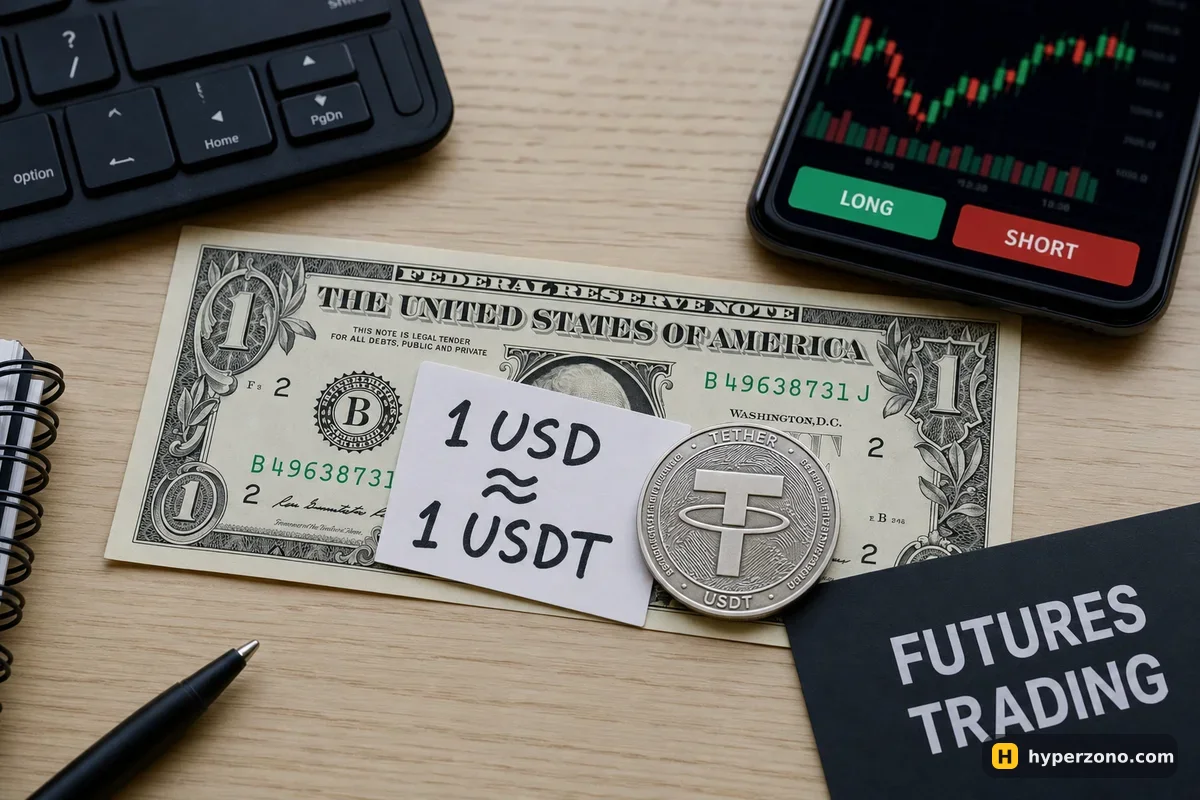
USDT vs USD: what is actually different
A US dollar in your bank account is money issued by a government and held by a bank. USDT is a token issued by a private company called Tether, which says every token is backed by reserves it holds, so that big clients can hand tokens back to Tether and get dollars for them. You personally will never do that — you just buy and sell USDT on the exchange at around a dollar.
The price is not fixed by any law. It stays close to a dollar because that is where everyone trades it, and if it slips to 99 cents, people buy at that price because they expect it to come back to a dollar. It has come back every time so far, but nobody can promise how long that takes.
For your day-to-day trading the difference barely shows: 100 USDT buys roughly the same amount of bitcoin as 100 dollars. The real difference is who stands behind it. With a bank you trust a bank and its regulator; with USDT you trust a company and whatever it holds in reserve.
Why exchanges count your futures money in USDT
Moving real dollars, rupees or naira between countries is slow and expensive, and an exchange would need banking licenses everywhere. A token moves in minutes, any day of the week, so USDT became the common unit everyone agreed on. You buy it once in your own currency and from then on you are just trading.
There is a second reason, and it matters more than you would think. If your deposit were held in bitcoin, your account value would move even when you had no trade open. With USDT the money part stays still, and only the trade moves.
Say you set aside 100 USDT as the deposit for a 500 USDT trade on bitcoin — that is 5x leverage, and the 100 USDT is your margin. Bitcoin goes up 2%, you close, and your 100 USDT comes back plus about 10 USDT of profit, minus a small fee. All the numbers here are just for the example, but the shape of it is real: clean, easy to check, and exactly what you want when you are learning how a trade works.
What if the contract asks for USDC or bitcoin instead?
USDT is not the only option on screen. Some contracts take USDC, another dollar token from a different issuer, and some older contracts are margined in the coin itself — you post bitcoin and your profit comes back in bitcoin. The math on those coin-margined contracts is different, and the result depends on the coin's price as well as on your trade, so beginners are better off leaving them alone for now.
| Contract type | What you post and get back | Who it suits |
|---|---|---|
| USDT-margined | USDT in, profit or loss in USDT | Almost every beginner — the widest choice of coins |
| USDC-margined | USDC in, profit or loss in USDC | Fine too, but fewer contracts and you need to hold USDC |
| Coin-margined (COIN-M) | Bitcoin or another coin in and out | People who already hold the coin and want to keep holding it |
Why the network matters when you send USDT
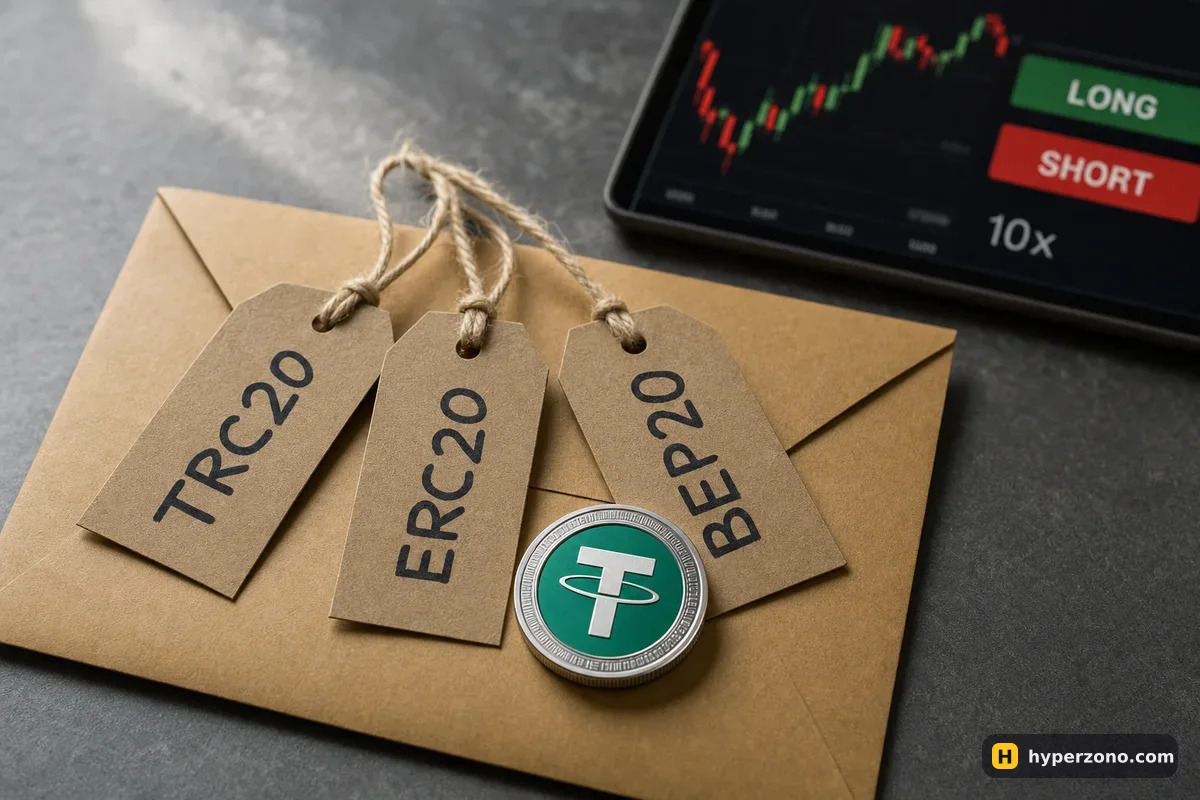
The same USDT exists on several blockchains, and each one is a separate road. The three you will see most often are:
- TRC20 — the Tron network, popular because transfers are usually cheap and quick
- ERC20 — the Ethereum network, the oldest route and often the most expensive one
- BEP20 — BNB Smart Chain, also cheap and widely supported
The tokens are worth the same wherever they sit; only the road differs, along with the fee the network charges. If you buy USDT inside the exchange with a card or through P2P, you never touch this — the coins simply appear on your account. The network only comes up when you send USDT from one place to another, and you can see all of it for yourself once you open a Binance account and look at the deposit screen.
Pick the network the receiver tells you to pick. Copy the deposit address from the exchange and choose exactly the network shown next to it. If you send USDT over a different network than the receiving side expects, the money can get stuck, and often nobody can get it back for you. Check the network name on both screens before you confirm. Everything else about funding your account is covered in how to make your first deposit.
What can go wrong with USDT itself
Two honest risks. The first is a depeg: in nervous moments USDT has traded a little below a dollar before coming back. If that happens while your money sits in USDT, your balance is briefly worth slightly less in real terms, even though the number on screen hasn't changed. The second is issuer risk — you are relying on Tether actually holding what it says it holds.
Neither risk is a reason to avoid futures, but both are a reason not to park your life savings in USDT for years. Keep trading money there, keep the rest where you normally keep money, and buy USDT when you need it — how to buy USDT in your own currency covers the practical side. Spreading some funds into USDC is a fair middle ground if you want a second issuer.
Is USDT the same as a US dollar?
Close, but not identical. One USDT is designed to be worth about one dollar, and in practice it trades there. The difference is that a dollar in a bank is backed by a government and a bank, while USDT is backed by a company's reserves.
Can I trade futures without USDT?
You can use USDC on the contracts that accept it, or coin-margined contracts where you post bitcoin instead. But the widest choice of coins, and the simplest math for a beginner, is on USDT-margined contracts.
Which network should I choose when sending USDT?
Whichever one the receiving side shows next to its deposit address. If you have a free choice, TRC20 and BEP20 are usually cheaper than ERC20. Always compare the network name on both screens before you confirm.
Does my profit come back in USDT too?
On USDT-margined contracts, yes — your margin, your profit, your loss and the fees are all in USDT. From there you can move it back to your spot account or withdraw it.
Is it safe to leave USDT on the exchange between trades?
It is normal practice, but it means trusting both the exchange and the token issuer. Keep only your trading money there, turn on two-factor login, and check that futures are actually available where you live before you deposit anything.