Contents
What you need before your first trade on eachThe same 0.1 BTC long on both, in numbersStocks, gold and the S&P 500 come from different placesWhat happens when something goes wrongWho each route suits
What you need before your first trade on each
On Binance you sign up, verify your identity, pick an experience level when you open the futures account and move USDT from your spot wallet into the futures wallet. Deposits can come from a card, a bank transfer or P2P depending on what the app offers where you live. Two beginner details matter on day one: the smallest bitcoin position is 0.001 BTC, and leverage above 20x is not available during the first 30 days of a futures account.
There is no sign-up form on Hyperliquid. You connect a crypto wallet, deposit USDC into your Hyperliquid balance, and that wallet address is your account. Picking the right network for the deposit is the part worth reading first — our guide to depositing USDC goes through it, and the Hyperliquid overview explains how the venue is built. The quickest way to feel the difference is to open Hyperliquid and look at the trading screen before you deposit anything.
The money path out differs in the same way. From Binance you withdraw to a bank, a card or a wallet, under the exchange's limits and checks. On Hyperliquid the USDC goes back to the wallet you connected, and from there to wherever you want — nobody reviews it, and nobody can reverse a mistake either.
The same 0.1 BTC long on both, in numbers
Say you have 1,500 USDT (or USDC) in your trading account and bitcoin is at 100,000 — round numbers, just to make the math easy. You go long 0.1 BTC, so your position is worth 10,000. At 10x leverage the exchange sets aside 1,000 of your money as margin on either venue and leaves 500 free in the account; the leverage you choose changes the margin, not the money you make or lose on the move.
Entering and exiting at market, Binance charges 0.05% each way at the base level: 5 USDT in, 5 USDT out, so 10 USDT round trip, or about 9 if you pay fees in BNB. Hyperliquid's tier 0 taker fee is 0.045%, so 4.50 in and 4.50 out, about 9 USDC round trip. If bitcoin goes up 2% you make 200 before costs on both; if it goes down 2% you lose 200 plus the same costs, and that loss comes out of the 1,000 margin you set aside. On a trade this size the fee gap is about one dollar.
The position is 10,000.00 USDT in every row. A 2% price move gives the same money result — 200.00 USDT. Only the share of your margin changes: from 10% to 40%.
| Binance Futures | Hyperliquid | |
|---|---|---|
| To start | Account, identity check, USDT in the futures wallet | A crypto wallet, plus USDC deposited into your Hyperliquid balance |
| You trade in | USDT (USDⓈ-M contracts) | USDC |
| Fee at the base level | 0.05% taker / 0.02% maker (0.045% / 0.018% paying in BNB) | 0.045% taker / 0.015% maker at tier 0 |
| Funding | Every 8 hours by default; some contracts every 4 hours, and hourly if the rate hits its cap | Every hour |
| Maximum leverage on BTC | Up to 150x on small positions; above 20x only after the first 30 days | 40x |
| Stocks, gold, oil | Binance's own contracts, 217 of them | Mostly set up by an outside team, trade.xyz |
If you hold the trade for a week, funding comes into the picture: a payment between longs and shorts that you either pay or receive. Say the rate runs against you and averages 0.01% every 8 hours on Binance — that is 1 USDT three times a day, about 21 USDT over seven days. On Hyperliquid the same cost arrives hourly in smaller slices, roughly 0.125 USDC an hour across 168 hours, again about 21 USDC. The interval changes how often you are charged and how fast the rate can react, not the cost by itself: before you call one of them expensive, multiply both rates up to the same period — a day or a week. That is exactly what we do in comparing a 1-hour rate with an 8-hour one.
Size decides far more than the venue does. With 100 USDC of margin at 10x, roughly a 10% move against you wipes out that margin — and the exchange actually closes the trade a little earlier, because it keeps a small cushion of your margin aside and because fees come out too. That is the same arithmetic on both routes, and how the liquidation price is worked out is worth reading before your first real position.
Stocks, gold and the S&P 500 come from different places
Binance lists its own TradFi perpetual contracts: 217 of them, covering US stocks and ETFs, gold, silver, WTI and Brent crude, natural gas, copper, plus Hong Kong and Korean stocks. They trade around the clock including weekends, with commodities up to 100x, stocks between 20x and 75x, and newly listed ones at 20x. One exchange runs all of it, and support for those contracts is Binance's support. If that account route is the one you want, you can open a Binance Futures account and compare its order window with the wallet screen side by side.
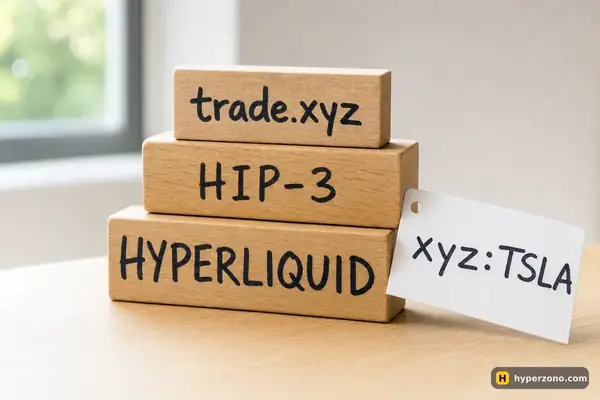
Hyperliquid splits into two layers. Its own crypto perpetuals cover 178 markets, and the stocks, indices and commodities are put there by outside teams — these are called HIP-3 markets. The main one is trade.xyz, with 99 stocks, 7 indices and funds and 9 commodities, settled in USDC: Hyperliquid provides the infrastructure, while trade.xyz chooses the price source and the leverage cap for each market. On 22 October 2026 the busiest of them traded serious size: SpaceX about $343M in 24 hours, the XYZ100 index about $271M, WTI crude about $244M, the S&P 500 market about $241M, with gold quieter at about $34M. For comparison, the same SpaceX contract on Binance Futures trades around $4.4B in 24 hours — more money moving, which usually means it is easier to get in and out at the price you see.
Before you trade any of these, check the specific market rather than the venue as a whole: leverage runs from 10x on many trade.xyz stocks to 20x on Tesla and Nvidia, 25x on gold and 50x on the S&P 500 market, and the current numbers sit in our live Hyperliquid market table. If the asset itself is new to you, start with how gold works as a futures contract or what the S&P 500 and Nasdaq contracts actually track.
A HIP-3 market can cost more than the base fee table. Hyperliquid gives you one fee tier across everything you trade — crypto perps, HIP-3 perps and spot together, from rolling 14-day volume. But the outside team that set up a market can add its own fee share on top, so a stock or index market may charge more than the 0.045% in the base table. Check the fee shown on that specific market before you size the trade.
What happens when something goes wrong
On Binance, liquidation is calculated from the mark price, and if a liquidated position cannot be absorbed by the insurance fund the exchange closes profitable positions on the other side instead. That last step is auto-deleveraging: your position is closed at the price where the losing trader's money ran out, which can be worse than the price you see on the screen at that moment, with no trading fee charged and a notification sent right away. Each of your positions shows an indicator of how near the front of that queue you are, and we explain the whole sequence in why a position gets closed by ADL.
On Hyperliquid the bigger practical difference is custody. Your wallet is your account, so there is no password reset and no support desk that can restore access if you lose the wallet — and no account freeze either. Hyperliquid closes losing positions by its own rules too. Rather than guess how that will play out, open the market's page in the app and read the leverage, the margin it asks for and the liquidation price it shows you before you size the trade.
Availability is the last thing to check, and it is the one that quietly decides the question for many readers. Binance derivatives are not offered in several countries, including the UK, Australia, Brazil, South Korea, New Zealand and Hong Kong, and some jurisdictions are blocked entirely. Hyperliquid shows a geoblock message to visitors from restricted jurisdictions without publishing a country list. Check both in the app or site itself, where you live, before you plan anything.
Who each route suits
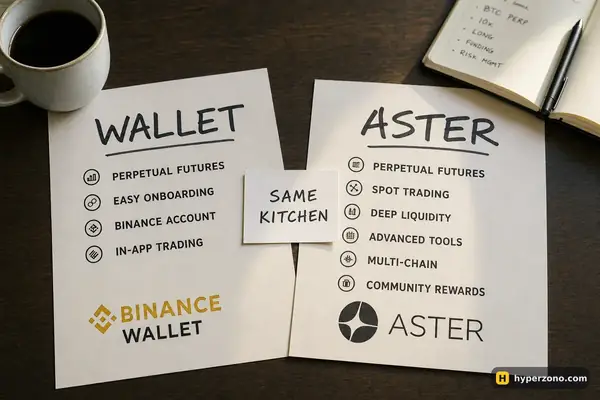
The Binance route fits you if you want one account for everything — buying USDT with a card, spot, futures, stock and commodity contracts from a single company — and you are comfortable with identity verification and with an exchange holding your money. The Hyperliquid route fits you if you already keep crypto in a wallet, want to start without an account at all, and are willing to take full responsibility for the keys, the deposit network and reading each market's own terms.
Nothing stops you from trying both with small amounts, as long as you keep the records separate and count your risk across the two together rather than per venue. If you would rather compare two centralised exchanges first, our OKX or Binance comparison covers that side of the choice.
Is Hyperliquid cheaper than Binance Futures?
At the starting level the difference is small: 0.045% taker on Hyperliquid tier 0 against 0.05% on Binance VIP 0, or 0.045% on Binance if you pay fees in BNB. On a 10,000 position that is around a dollar per round trip. Holding costs can matter far more than the entry fee, so compare funding on the specific contract, and remember a market set up by an outside team can add its own fee on top.
Do I need KYC to trade on Hyperliquid?
There is no exchange registration: you connect a wallet and deposit USDC into your Hyperliquid balance, and that wallet is your account. That also means no support team can recover access for you, so the backup of your wallet is now your responsibility, not an exchange's.
Can I use my Binance account on Hyperliquid?
No. They are two separate routes with separate money: Binance holds USDT in your futures wallet, Hyperliquid works from USDC you deposited from your own wallet. If you want to try both, you move funds yourself and keep two sets of records.
Why does funding every hour matter?
It changes the timing, not automatically the cost. Hourly payments are smaller and track the market faster, which can help if you hold for a few hours; over a week a 0.00125% hourly rate adds up to the same as 0.01% every eight hours. Multiply both rates up to the same period before you decide one looks expensive.
Which route is available in my country?
Check it in the app or on the site itself before you plan anything. Binance derivatives are unavailable in a number of countries and Hyperliquid shows a geoblock message from restricted jurisdictions without publishing a list. Never try to get around a block — that risks your account and your money.
Sources and fact-check
Exchange terms were checked against official documents on October 22, 2026. Terms change — before you trade, check what matters to you in the exchange app and in your contract’s specs.
Hyperliquid Docs: FeesBinance: What Is Auto-Deleveraging (ADL) and How Does It Work?