Contents
Binance futures fees in percent and in USDTMarket or limit: the same trade, two pricesHow to pay less when you trade smallWhere to see your own fee rateHow Binance compares with the other venuesBinance futures fees in percent and in USDT
On USDⓈ-M futures at the base level (checked 2026-10-24) Binance charges 0.02% if your order waits in the order book — the list of other people's offers, and Binance calls this the maker rate — and 0.05% if your order takes a price that is already sitting there, the taker rate. Those are the two columns you will see on the Binance fee page, in the live tables further down and in your own fee settings. There is also a small discount if you pay your fees in a coin called BNB; more on that in a moment. These are the rates a new account starts on, higher-volume levels exist, and rates change, so treat the numbers here as the starting point.
| Level | 30-day volume from | Maker | Taker | A 2,500 USDT trade at market |
|---|---|---|---|---|
| Base | — | 0.02% | 0.05% | 2.50 USDT |
| pay fees in BNB | — | 0.018% | 0.045% | 2.25 USDT |
fees checked 24 Oct 2026 on the exchanges’ fee pages, Binance Futures.
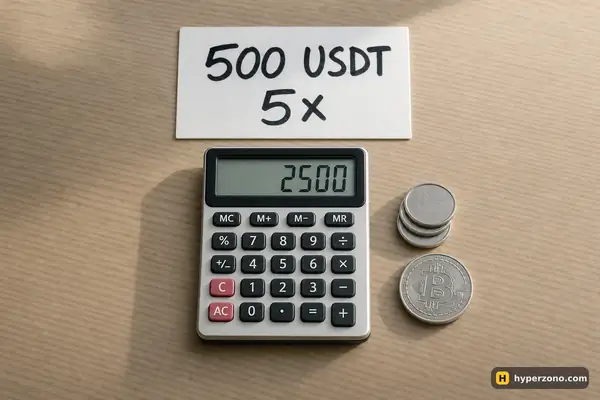
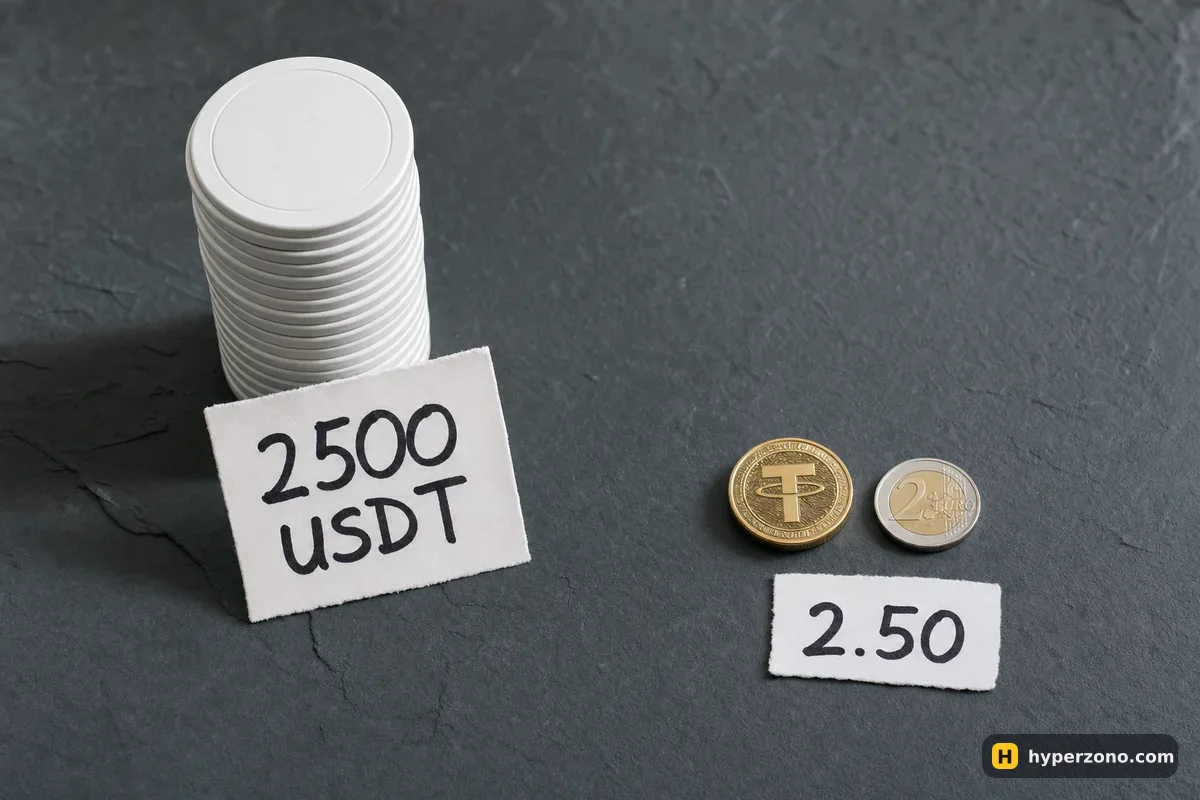
Now the money. You put up 500 USDT of margin and choose 5x, so your position is 2,500 USDT. At the taker rate of 0.05% that is 1.25 USDT to open and 1.25 USDT to close — 2.50 USDT for the full trade, which is half a percent of your 500 USDT. In price terms, bitcoin has to move about 0.1% in your favour before the trade is level. Take the same 2,500 USDT position a different way — 250 USDT of margin at 10x instead of 500 at 5x. The fee is still 1.25 USDT each way, because it is charged on the 2,500, not on your margin and not on the leverage you chose.
Market or limit: the same trade, two prices
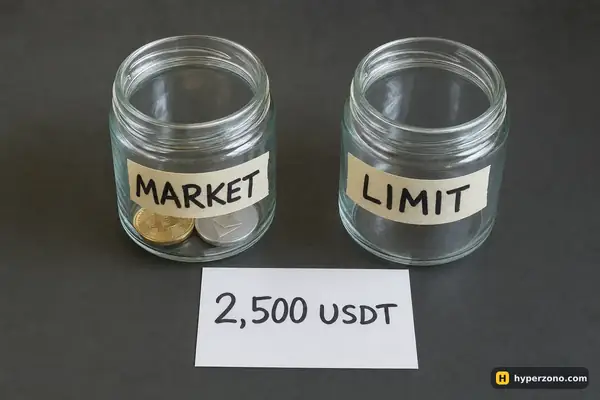
A market order fills instantly at whatever price is available, and that is the taker side, 0.05%. A limit order placed away from the current price waits in the order book until someone else trades against it, which is the maker side, 0.02%. The catch is that a limit order fills only if price comes to it, and a limit order placed right at the current price can fill immediately — in which case you pay the taker rate anyway. The difference between the two order types is explained in more detail on our page about market and limit orders.
On our 2,500 USDT example that gives you three realistic outcomes: 2.50 USDT if you rush in and rush out, 1.75 USDT if you enter with a patient limit order and exit at market, and 1.00 USDT if both ends wait. None of these amounts will decide whether you are a profitable trader, but they tell you something useful: a plan that needs ten trades a day pays ten times this, while a plan with two trades a week barely notices it.
How to pay less when you trade small
With 500 USDT of margin you are not going to reach a volume-based discount level, so the levers that actually work at your size are simple ones. Use limit orders for entries you are not in a hurry about, and trade less often rather than more — the cheapest fee is the one on a trade you did not need to take.
BNB is Binance's own coin. If you keep a small amount of it and turn on the option to pay fees in BNB — it sits in the futures fee settings in the app — the two rates become 0.018% and 0.045%, so the all-market version of our trade costs 2.25 USDT instead of 2.50. If you don't hold BNB, skip it: the saving here is 25 cents, and buying a coin you otherwise don't want adds its own price risk.
The other half of the cost of holding a position is funding, which is paid between traders every few hours and has nothing to do with the fee table; see what funding is and when you pay it. If you want the full picture of what a trade costs from open to close, our page on calculating your real profit puts fees, funding and the price move together in one sum.
Watch the size field, not the leverage slider. Raising leverage from 5x to 20x with the same 500 USDT often raises the position from 2,500 to 10,000 USDT — and the round-trip fee from 2.50 to 10 USDT, with four times the risk attached. You can keep the same 2,500 USDT position at higher leverage by putting in less margin, but then less money stands behind that position, and the price has much less room to move against you before the exchange closes it — see how your liquidation price is worked out before you do that.
Where to see your own fee rate
Binance has a fee page for USDⓈ-M futures, and it shows your own maker and taker rates and your past fees only once you are signed in. The quickest way there is from your account — open Binance Futures and look under the fee section. The same page separates the categories you may be looking at — Spot & Margin, USDⓈ-M Futures, COIN-M Futures, TradFi Futures, Options — so make sure you are reading the USDⓈ-M part if you trade the usual USDT contracts.
Binance works out your level from your futures volume, counting USDⓈ-M and COIN-M together in USD-equivalent values. If you ever do trade enough to move up a level, that level counts across your Binance account, not just on futures. At 500 USDT it will not happen soon — this is just so you know what the page is showing you.
How Binance compares with the other venues
At the base level the big centralised venues are close enough that the difference on one small trade is cents. On the same 2,500 USDT position, entering and exiting at market, Binance and OKX cost about 2.50 USDT, Bybit about 2.75 USDT, Hyperliquid about 2.25 USDT, and the Binance Wallet Perpetuals tab (fees set by Aster) about 2.00 USDT, because there the taker rate on crypto pairs is 0.04%. If both your orders wait in the order book there, you pay nothing at all on entry and exit — the maker rate is 0%. Read the table below as a starting rate, not a ranking — availability, the contracts offered and how the venue works matter far more to a beginner than 0.50 USDT.
| Where | Maker | Taker | How to pay less | A 2,500 USDT trade: market in and out | Limit in, market out |
|---|---|---|---|---|---|
| Binance Futures | 0.02% | 0.05% | pay fees in BNB: 0.018% / 0.045% | 2.50 USDT | 1.75 USDT |
| Bybit | 0.02% | 0.055% | — | 2.75 USDT | 1.88 USDT |
| OKX | 0.02% | 0.05% | — | 2.50 USDT | 1.75 USDT |
| Hyperliquid | 0.015% | 0.045% | up to 40% off for staking HYPE: 0.009% / 0.027% | 2.25 USDT | 1.50 USDT |
| Binance Wallet / Aster | 0% | 0.04% | — | 2.00 USDT | 1.00 USDT |
Base level for a new account. 2,500 USDT is 500 USDT at 5x leverage; the fee is charged on the position size, not on your 500. Taker is the rate when an order fills at once, maker when a limit order waits in the book.
fees checked 24 Oct 2026 on the exchanges’ fee pages, Binance Futures, Bybit, OKX, Hyperliquid, Binance Wallet / Aster.
The same question answered venue by venue sits on our pages for Bybit fees, OKX fees and Aster and the Binance Wallet tab, and if you are shopping purely on price, which exchanges have the lowest futures fees compares them all in one place. For what Binance itself offers beyond the fee schedule — contracts, leverage limits, account setup — see the Binance Futures overview.
Does higher leverage mean higher Binance futures fees?
Not by itself. The fee is a percentage of the position, so 500 USDT at 5x and 250 USDT at 10x both give you a 2,500 USDT position and the same 1.25 USDT per execution. What higher leverage usually does is tempt you into a bigger position, and that is what raises the fee — and the risk.
What is the difference between the maker and taker fee on Binance?
Maker is the 0.02% rate you pay when your limit order waits in the order book and someone else trades against it. Taker is the 0.05% rate you pay when your order takes a price that is already there, which is what every market order does. It is about how your order filled, not which button you pressed.
Is the fee taken from my margin or from my profit?
It comes off your futures balance when each order executes, so you pay once on the way in and once on the way out, whether the trade ends in profit or loss. If you close a position in two parts, each part is charged on its own size.
How do I calculate Binance futures fees in USDT quickly?
Multiply your position size by the rate: 2,500 × 0.05% = 1.25 USDT for one market execution, and double it for a full round trip. The fee calculator above does it for you, and there is a standalone version on our fee calculator page.
Is it worth buying BNB just for the fee discount?
On a 2,500 USDT position the discount is 25 cents for the round trip, so it only makes sense if you already hold some BNB or plan to trade often. BNB is a coin with its own price swings, so buying it purely to save cents adds a risk you didn't have before.
Are fees the only cost of holding a futures position?
No. Holding a perpetual also means funding payments between longs and shorts every few hours, and on a market order you may fill slightly away from the price you saw. Our general page on futures trading fees walks through the whole list.
Sources and fact-check
Exchange terms were checked against official documents on October 24, 2026. Terms change — before you trade, check what matters to you in the exchange app and in your contract’s specs.
Binance: USDⓈ-M Futures Trading Fee Rate