Contents
Aster vs Hyperliquid in one tableFees on the same tradeFunding on the same coinAccount, deposits and accessChoose Aster if… choose Hyperliquid if…Aster vs Hyperliquid in one table
Both are perpetual futures venues where your money sits in your own wallet rather than on an exchange account. The easiest way to reach Aster is the Perpetuals tab inside Binance Wallet — the order book and the funding there are Aster's, and the screen even says "Provided by Aster". If you want the difference between that route and opening Aster as a separate dApp, we covered it in Aster directly vs Aster in Binance Wallet.
Two words come up in every fee table, so here they are in plain terms: you pay the taker fee when you buy or sell at the price on screen right now, and the maker fee when you leave a limit order waiting for someone else to trade against it.
| Aster (Binance Wallet Perpetuals tab) | Hyperliquid | |
|---|---|---|
| How you get in | A self-custodial wallet inside the Binance app; only a verified Binance user can create it | Connect your own wallet, no exchange registration |
| Money you trade with | USDT or USD1 (another dollar-pegged coin), on BNB Smart Chain | USDC |
| Fees at the base level | maker 0%, taker 0.04% on the crypto General group | maker 0.015%, taker 0.045% at Tier 0 |
| Funding paid | every 8, 4 or 1 hour depending on the contract | every hour |
| What trades there | 602 pairs: 463 crypto, 111 stocks, 7 ETFs, 13 commodities, 8 pre-launch | 178 crypto perpetuals, plus trade.xyz markets: 99 stocks, 7 indices and funds, 9 commodities |
| Leverage, examples | many USDT crypto pairs up to 50x, stocks and commodities in USD1 up to 20x, pre-launch 5–20x | BTC 40x, most trade.xyz stocks 10–20x, gold 25x, S&P 500 50x |
Fees on the same trade
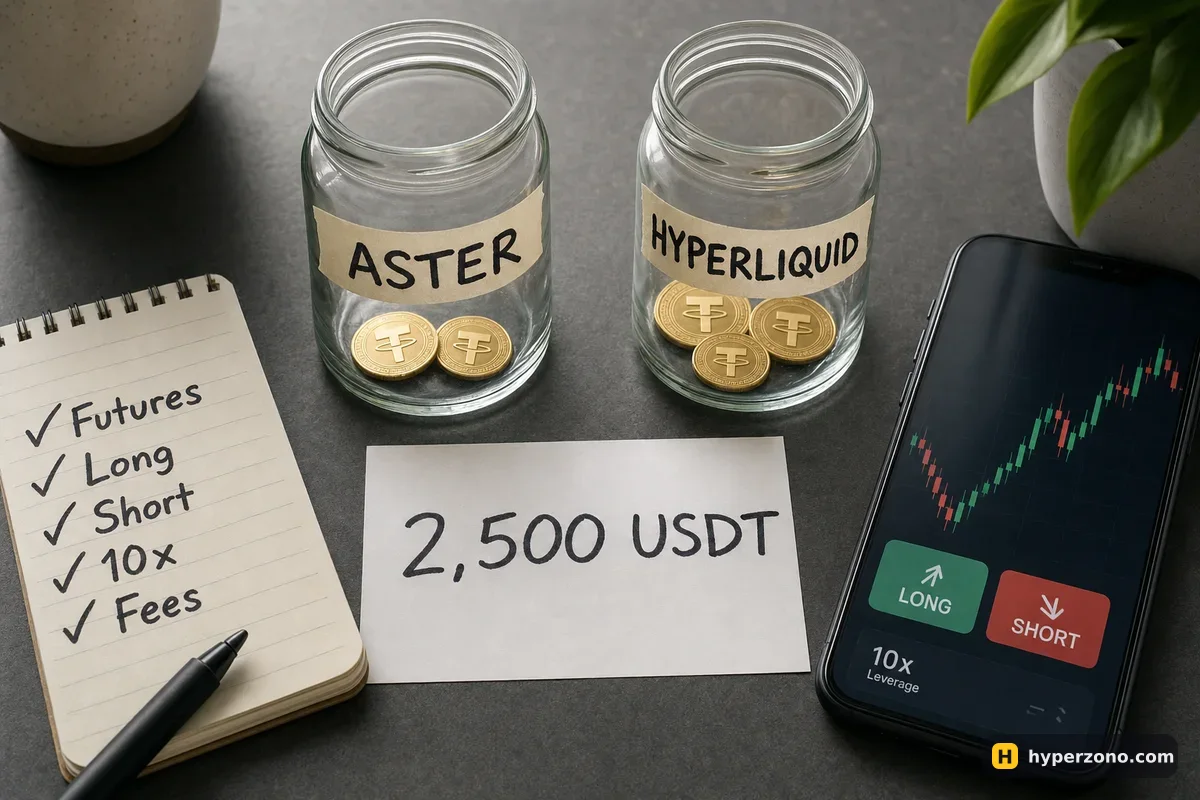
Fees are charged on the position size, not on your margin, and separately on the way in and the way out. Take the example we use everywhere: 500 USDT of your own money at 5x, so a 2,500 USDT position. Buying and selling at market costs 1.00 USDT each way on Aster (0.04%) and 1.125 USDT each way on Hyperliquid (0.045%) — 2.00 against 2.25 USDT for the full round trip. If you use limit orders that sit in the book and wait, Aster charges nothing at all (maker 0%) while Hyperliquid charges 0.015%, which is 0.375 USDT per side.
| Where | Maker | Taker | How to pay less | A 2,500 USDT trade: market in and out | Limit in, market out |
|---|---|---|---|---|---|
| Binance Futures | 0.02% | 0.05% | pay fees in BNB: 0.018% / 0.045% | 2.50 USDT | 1.75 USDT |
| Bybit | 0.02% | 0.055% | — | 2.75 USDT | 1.88 USDT |
| OKX | 0.02% | 0.05% | — | 2.50 USDT | 1.75 USDT |
| Hyperliquid | 0.015% | 0.045% | up to 40% off for staking HYPE: 0.009% / 0.027% | 2.25 USDT | 1.50 USDT |
| Binance Wallet / Aster | 0% | 0.04% | — | 2.00 USDT | 1.00 USDT |
Base level for a new account. 2,500 USDT is 500 USDT at 5x leverage; the fee is charged on the position size, not on your 500. Taker is the rate when an order fills at once, maker when a limit order waits in the book.
fees checked 24 Oct 2026 on the exchanges’ fee pages, Binance Futures, Bybit, OKX, Hyperliquid, Binance Wallet / Aster.
Specific markets change that picture. Aster keeps a separate "Group B" list of smaller and newer pairs where the taker fee is 0.1% — that is 2.50 USDT per side on our example, and bitcoin, ether and solana are not on that list. Most stock and commodity pairs there are charged 0.0125% taker instead, so the full round trip on gold costs about 0.63 USDT. A few tickers sit in the 0.1% Group B list even though they are stocks, so look at the fee shown on the pair before you trade it.
On Hyperliquid, stocks and commodities are listed by another company, trade.xyz, which sets its own rules for those markets. On some of them the deployer runs a discounted rate; on others it adds its own share on top. So the fee on a trade.xyz stock or gold market can differ from Hyperliquid's own 0.045% in both directions. Check what the app shows for that market before you open the trade.
Funding on the same coin
Funding is the payment between longs and shorts on a perpetual contract, and over a few days it can easily be bigger than the fee difference above. Aster pays funding every 8 hours on most contracts (4 or 1 hour on some), Hyperliquid pays every single hour. To compare two rates on screen, multiply Hyperliquid's hourly rate by 8 — then it sits fairly next to an 8-hour rate.
| Coin | Binance Futures | Binance Wallet | Bybit | OKX | Hyperliquid |
|---|---|---|---|---|---|
| BTC | 2.91 USDT | 4.23 USDT | 2.91 USDT | 3.48 USDT | 6.85 USDT |
| ETH | 3.17 USDT | 5.11 USDT | 2.85 USDT | 3.13 USDT | 6.73 USDT |
| XRP | 2.48 USDT | 4.48 USDT | 2.61 USDT | 3.54 USDT | 7.42 USDT |
| BNB | 1.59 USDT | 1.26 USDT | −0.06 USDT | 4.53 USDT | 5.96 USDT |
| SOL | 2.63 USDT | 3.21 USDT | 1.94 USDT | 2.93 USDT | 5.70 USDT |
| HYPE | 3.54 USDT | 3.92 USDT | 1.14 USDT | 3.74 USDT | 6.88 USDT |
| DOGE | 4.10 USDT | 4.26 USDT | 2.84 USDT | 5.58 USDT | 8.64 USDT |
| ENA | 6.42 USDT | 8.01 USDT | 4.71 USDT | 5.11 USDT | 9.18 USDT |
What a 1,000 USDT long paid over the last 30 days on each venue (minus means it received). The coin name opens its page with month-by-month history.
Updated 25 Oct 2026, 01:20 UTC from the exchanges’ public APIs.
The table shows today's rate on each venue and what the last 30 days actually cost, coin by coin — look up the coin you want and compare the 8-hour columns. None of that is fixed: the rate resets at every settlement and can turn negative, which flips a cost into a payment to you, and a month never scales neatly into a year. For how the payments work and who pays whom, read what funding is and when you pay it.
Hold for an hour and fees matter; hold for a week and funding matters. On a 2,500 USDT position the fee gap for a market round trip is 0.25 USDT — small. The funding on that same position over a week or a month can be several times larger, and it changes at every settlement. Pick the venue by how long you plan to stay in the trade, and check the funding table before you open it.
Account, deposits and access
The routes in are genuinely different. For Aster through the app, you need a verified Binance account, then you create Binance Wallet — a keyless wallet with no seed phrase — and back it up, because perpetuals in the tab do not work until the backup is done. Then you send USDT or USD1 to the wallet on the BNB Smart Chain network and trade from the Perpetuals tab. USD1 is another dollar coin, and some pairs are priced in it instead of USDT. The steps are in our Binance Wallet setup guide. You can also open Binance Wallet and look at the Perps list first, without depositing anything.
Hyperliquid skips registration entirely: you connect a wallet you already own and deposit USDC, which is covered step by step in how to deposit USDC to Hyperliquid. That also means there is no support desk holding your balance — losing access to the wallet means losing the money, on either venue.
Access by country is worth checking before you move any funds. Aster's terms exclude residents of, and people located in, Russia, Ukraine, the USA, Canada, the United Kingdom, China, North Korea, Cuba, Iran, Venezuela and Syria. Hyperliquid publishes no country list; its app simply shows a message if you are in a restricted jurisdiction. Open each one from where you actually live and see what it says — never try to work around a block.
Choose Aster if… choose Hyperliquid if…
Pick Aster — in practice, the Perpetuals tab in Binance Wallet — if you already have the Binance app on your phone. Two more reasons: limit orders that wait in the book cost you nothing, and stocks, gold and oil are charged 0.0125% taker, about 0.63 USDT in and out on our 2,500 USDT example. Pre-IPO pairs like OpenAI or Anthropic are there too, so check the fee shown on the pair before you open it. The full pair list with leverage per pair is in our live Binance Wallet market table.
Pick Hyperliquid if you want no exchange account in the chain at all, or you already hold USDC in a wallet. Hourly funding settlements are the other reason: the cost of holding updates every hour instead of every eight. The big coins there turn over a lot — bitcoin traded about $2.2bn in 24 hours on 22 October 2026. You can open Hyperliquid and connect a wallet to look at the markets before depositing anything, and the live market table shows what is listed and at what leverage.
Is Aster cheaper than Hyperliquid?
On the headline fee numbers, slightly. At the base level Aster charges 0% maker and 0.04% taker on its crypto General group, Hyperliquid 0.015% and 0.045% at Tier 0. On a 2,500 USDT trade that is 2.00 USDT against 2.25 USDT for a market round trip — real, but small next to what funding can cost over a week.
Which is better for a beginner, Aster or Hyperliquid?
If you already have a verified Binance account, Aster through the Perpetuals tab is the shorter path: the wallet lives in an app you know. If you prefer not to register anywhere and already hold USDC in a wallet, Hyperliquid gets you to a trade faster. Either way, start small and set a stop-loss on the first trade.
Which venue has cheaper funding?
It changes. Funding is a payment between traders, not a fee the venue keeps, so it reflects how longs and shorts are balanced on that particular order book, and each venue has its own balance. Hyperliquid settles every hour, Aster usually every eight, so multiply the hourly rate by 8 to compare them fairly — the live funding table on this page does that for you.
Can I trade stocks and gold on both?
Yes, by different routes. The Binance Wallet Perpetuals tab lists 111 stocks, 7 ETFs, 13 commodities and 8 pre-launch pairs, with stock and commodity pairs usually at a 0.0125% taker fee. On Hyperliquid those markets are listed by a separate company, trade.xyz — about 99 stocks, 7 indices and funds and 9 commodities — with rules, leverage and fees set there, so check what the app shows for the market first.
Do I need a Binance account to use Aster?
For the Perpetuals tab inside Binance Wallet, yes: only a verified Binance user can create that wallet, and you must finish the wallet backup before perpetuals become available. Aster also exists as its own dApp, which is a different route with a different setup — we explain the difference on a separate page.
Sources and fact-check
Exchange terms were checked against official documents on October 24, 2026. Terms change — before you trade, check what matters to you in the exchange app and in your contract’s specs.
Aster Docs: FeesHyperliquid Docs: Fees