Contents
Why you need an approach at allThe order to learn things inChoosing a strategy you can repeatYour trade plan is the part that saves moneyWhich coins to practise onWhat to skip while you are learningYour next step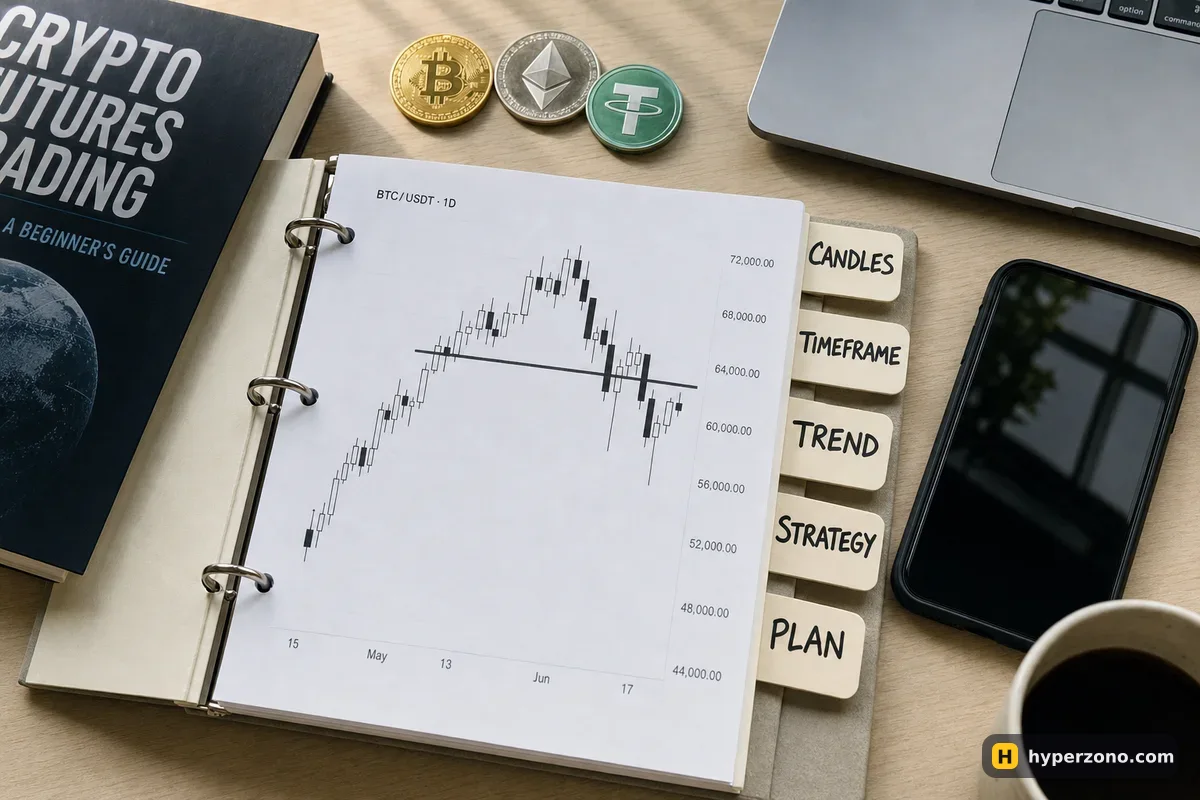
Why you need an approach at all
Most beginners lose money not because they picked the wrong coin, but because every trade is decided differently. One trade is opened because the price jumped, the next because a chat group said so, the third because the first two went badly and the money has to come back. An approach is simply a set of rules you use the same way every time, so you can tell whether the rules work or whether you broke them. Most of the ways beginners lose money come down to not having that.
Before you start here, it helps if you already know what a long and a short are, what leverage does to your money and what liquidation means. If any of that is still fuzzy, spend an hour on long and short, what leverage does to your money and liquidation first. Strategy on top of shaky basics is just faster guessing.
The order to learn things in
You can read the pages in this section in any order, but this sequence is the one that actually builds on itself. Each step takes an evening, not a month.
Read the candles
What one green or red bar on the chart is telling you: where the price opened, closed and how far it swung in between. Everything else sits on top of this.
Choose your chart interval
The same coin looks calm on one interval and wild on another. Pick one and stay on it, so your trades are comparable.
See the trend and the obvious levels
Is the price slowly climbing, slowly falling, or going back and forth between the same two levels? That alone decides whether you are looking for a long or a short.
Add at most one or two indicators
They smooth out what you already see on the chart. They do not predict anything, and five of them on one screen will contradict each other.
Pick one simple strategy
A rule for entry, a rule for the stop, a rule for taking profit. Boring is the point.
Write the trade down before you open it
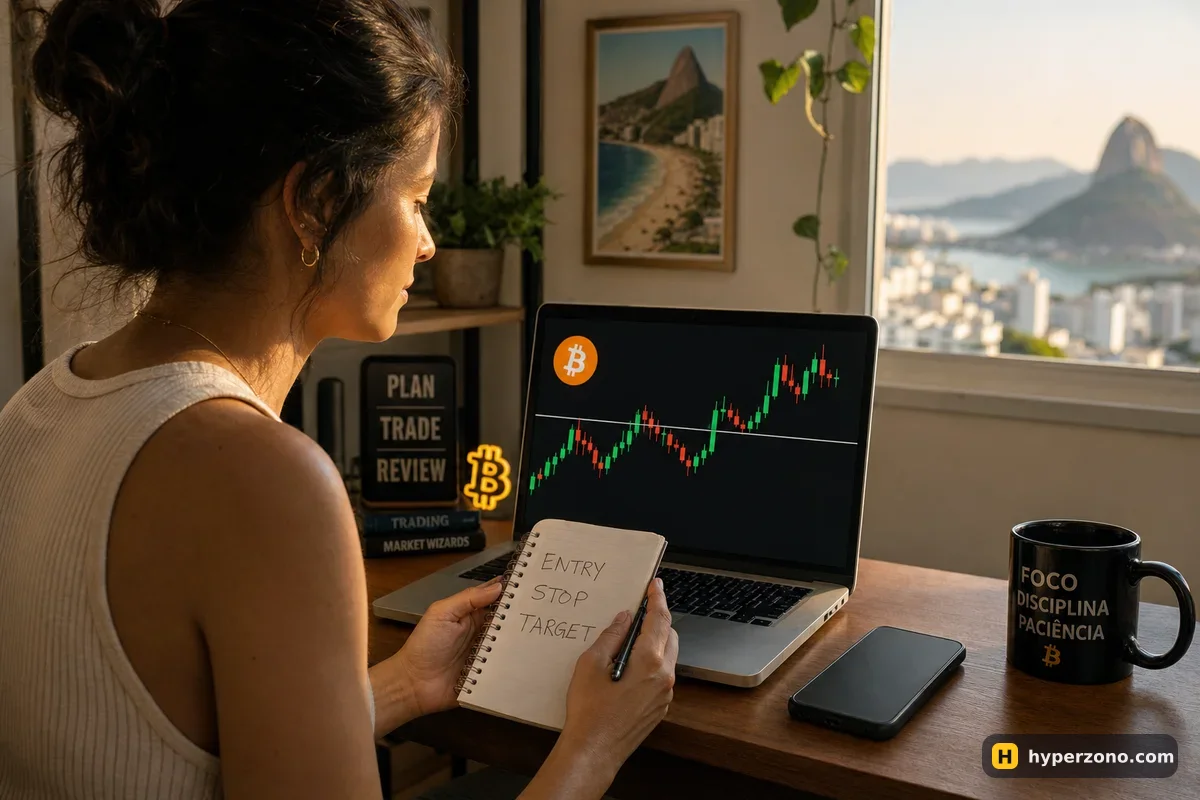
Price in, price out, price where you admit you were wrong, and how much money that costs you. Then click.
The pages for the first steps are how to read a candlestick chart and which timeframe to use. Once the chart stops looking like noise, move on to how to tell when to buy and when to sell and, only after that, to the few indicators a beginner actually needs. Reading is faster when you have a live chart next to the text, so it is worth having a window open where you can see a real BTC chart on Binance Futures while you read.
Choosing a strategy you can repeat
A beginner strategy should fit in three lines on paper and work the same whether the market is quiet or loud. Which futures strategy suits a beginner walks through a few repeatable ones — following a clear trend, trading a price range, and waiting for the price to break out of one — and is honest about what each costs you in losing trades. Choose one of them and leave the other two alone until you have actually traded it twenty times.
Size it so a losing run is boring. A single winning trade proves nothing, and a single losing one does not kill a method. Pick a position size where twenty losses in a row would still leave you with money and a calm head. And write each trade in a note as it happens: entry, exit, and whether you followed your own rule or talked yourself out of it.
Your trade plan is the part that saves money
The plan is where a vague idea turns into numbers: entry, stop, target, position size, and the amount in dollars you accept losing if you are wrong. How to write a plan for a single trade shows the short version you can keep in your notes app. Pair it with how much to put into one trade and how a stop loss works — those two decide whether a bad run is an annoyance or the end of your account.
Which coins to practise on
For your first dozen trades, stay on the big, heavily traded pairs — bitcoin and ethereum against USDT. They move enough to be interesting, the price does not jump around randomly in quiet hours, and your stop is more likely to be filled near the price you chose. Small coins move faster, which feels exciting and empties accounts just as fast. Which coins to trade first goes through the choice properly, including the minimum position sizes you will run into.
What to skip while you are learning
Two things eat beginners' time and money early on. The first is ready-made signals: someone else's entry gives you no way to know when to get out, and you learn nothing you can reuse — the honest look at Telegram signals explains why. The second is stacking indicators until the screen is unreadable; two is plenty, and often one is better.
Automation can wait too. A grid bot or copy trading does not remove risk, it just moves the decisions somewhere else, and the honest version of that is in can a bot lose all my money. The buttons and order types can wait as well — when you need them, how to close a trade and lock in the profit covers the part that matters most.
Your next step
Read the chart pages, choose one strategy, write one plan — and then take the smallest real step: a single trade with a tiny amount, or the same trade in demo mode. How to open your very first futures trade walks you through it click by click, and trying futures in demo mode on Binance lets you rehearse without money (demo is not available in every country, so check it in the app when you sign up).
What is the best strategy for crypto futures beginners?
There is no best one, only the one you can follow without hesitating. Trend following and range trading are the two most common starting points because the rules are short and you can see on the chart whether the conditions are there. What matters more than the choice is the size: keep each position small enough that a losing trade is forgettable by dinner time.
Do I need indicators to trade futures?
No. Plenty of people trade from the candles and a couple of horizontal lines where the price has turned before. An indicator or two can help you stay patient, but they are a summary of past prices, not a forecast — if you cannot explain what one is measuring, take it off the chart.
Which chart interval should a beginner use?
Something slow enough that you are not making a decision every minute — many beginners settle on the 1-hour or 4-hour chart. The faster the interval, the more trades, the more fees, and the more chances to act on emotion. The timeframe page goes through how to pick one and stay with it.
How long before a strategy starts working?
You need a sample, not a week. Twenty or thirty trades at a size that does not scare you will show you one thing clearly: whether you actually followed your own rules. Whether the rules make money takes much longer and a written record of every trade — so start the record now, even if it is three lines per trade in your phone.
Can I just copy signals instead of learning all this?
You can, but you will be guessing at the hardest part: when to get out and how much to risk. Signals do not tell you what to do when the price goes halfway to the target and stalls. Learn the basic plan first; then, if you still want someone else's decisions, read about copy trading where at least the exit is handled too.
Should I learn strategy or risk management first?
Risk management, honestly. A mediocre strategy with a stop loss and a small position survives long enough to improve; a brilliant one with no stop can be wiped out in a single bad hour. Start with position sizing and stop losses, then come back here.