Contents
What a year of holding a long actually costFrom a percentage to money for your tradeWhy the four exchanges show different numbersYou only pay if you are holding at the settlement momentWhat this history cannot tell you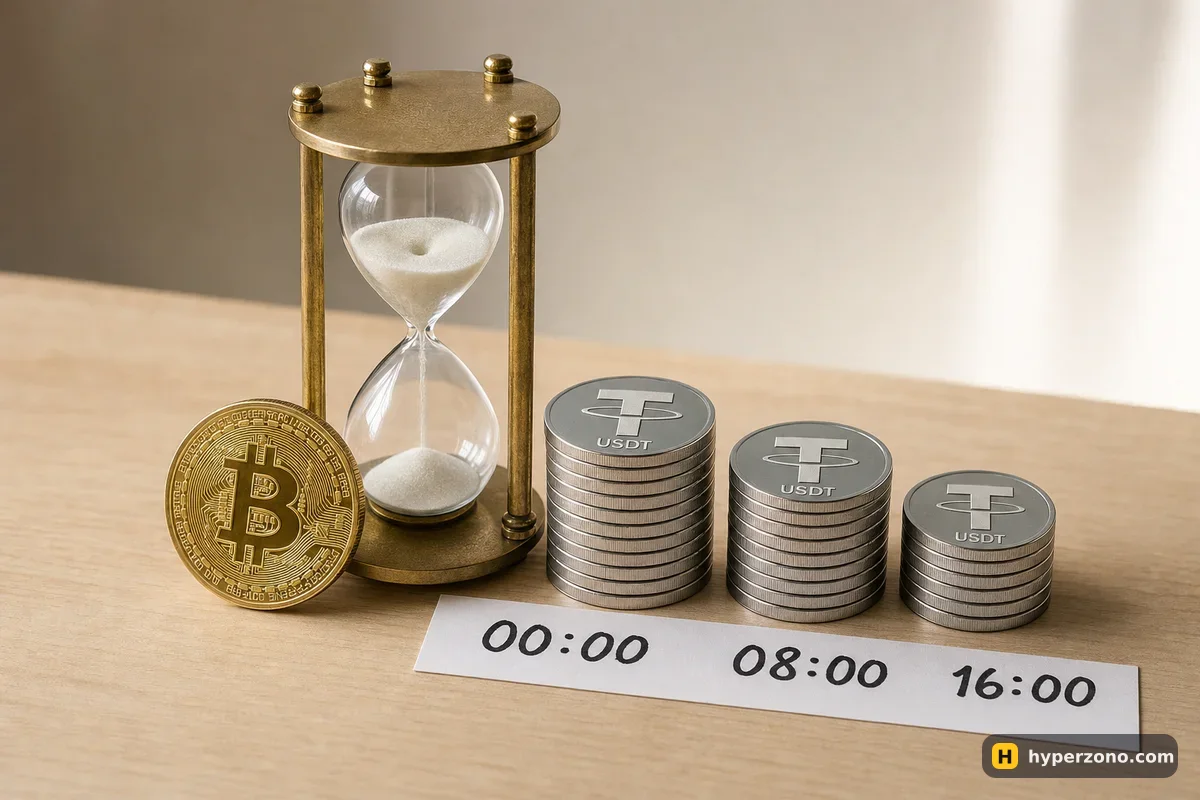
What a year of holding a long actually cost
Over the 12 months to 20 October 2026, a bitcoin long paid 3.36% of its position value in funding on Binance, 2.71% on Bybit and 5.79% on Hyperliquid. The table has the same sums for ether and solana, with what each one would have cost on a 1,000 USDT position.
| Coin | Binance, 12 months | Bybit, 12 months | Hyperliquid, 12 months |
|---|---|---|---|
| BTC | +3.36% — paid 33.60 USDT | +2.71% — paid 27.10 USDT | +5.79% — paid 57.90 USDC |
| ETH | +2.49% — paid 24.90 USDT | +2.44% — paid 24.40 USDT | +6.39% — paid 63.90 USDC |
| SOL | −0.47% — received 4.70 USDT | +0.04% — paid 0.40 USDT | +0.77% — paid 7.70 USDC |
The pattern is the same for all three coins: Bybit and Binance were the cheapest places to hold a long, Hyperliquid the dearest, and solana was the only one where longs were sometimes paid instead of paying. On Binance a solana long ended the year about 4.70 USDT ahead per 1,000 USDT of position, because the rate spent a good part of the year below zero. A plus sign means longs paid shorts and a minus means shorts paid longs, so if you were short in those months, flip every sign in the table.
OKX publishes only about three months of history, which is why it sits outside the table. Over the last 90 days a long there paid 1.34% of its position value on bitcoin, 1.10% on ether and 0.78% on solana. Measured over exactly the same 90 days, bitcoin cost a long 1.41% on Binance, 1.08% on Bybit and 2.06% on Hyperliquid — the same ranking as the full year, with OKX in the middle of the group rather than cheapest.
Look at single months and the picture jumps around. On Binance, bitcoin's most expensive month for longs was August 2026 at +0.62% of position value, while in April 2026 longs were paid 0.18% instead. Solana is the clearest warning against reading one month as a trend: it gave longs money over the full year, yet in the last 90 days the same contract cost longs +0.83%. One month cannot be used to price the next.
Every figure here is the exchange's own published funding payments for the BTC, ETH and SOL perpetuals settled in USDT — in USDC on Hyperliquid, where the amounts work out near enough dollar for dollar — added up over the period. The sum ignores the fact that your position value drifts with price, so treat it as a close estimate rather than a bank statement. If you are not sure what funding is in the first place, the short version lives on the page about what funding is and who pays whom.
From a percentage to money for your trade
The arithmetic is short. Take the full size of your trade, multiply it by the rate shown, and that is one payment. You pay it, or get it, every time the clock reaches a settlement while your trade is open.
One funding payment on a 1,000.00 USDT position. Traders pay each other, not the exchange. Each contract has its own rate and interval.
Say you plan a 1,000 USDT long on bitcoin and want to hold it for a week. Over the last 30 days funding on Binance added up to +0.29% of position value, which is about 0.0097% a day, so seven days works out to roughly 0.07% — around 70 cents. The same week on Hyperliquid, where the last 30 days summed to +0.71%, would have been closer to 1.70 USDC. As a short in those same weeks you would have been on the receiving side of both amounts.
Leverage does not change the payment, because it is always counted on the full 1,000. It changes how the payment feels. That 1,000 USDT position at 10x uses about 100 USDT of your own money, so 70 cents of funding is 0.7% of what you put in, for one week. To run the sum for your own size, rate and number of payments, use the funding calculator — you type in a rate and it gives you one payment in money.
Why the four exchanges show different numbers
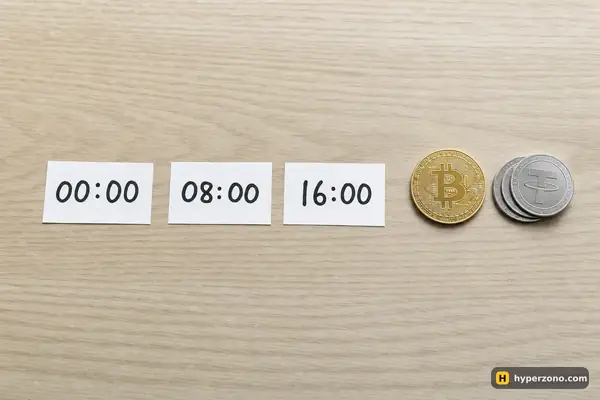
The biggest reason is how often the payment happens. On these contracts Binance, Bybit and OKX settled every 8 hours during our period — Binance's default times are 00:00, 08:00 and 16:00 UTC — which is three payments a day. Hyperliquid settles every hour, so twenty-four. A single payment is about the same size in both places: the biggest one we saw over the year was +0.0100% on Binance and +0.0090% on Hyperliquid. The difference is how often it lands, three times a day against twenty-four, and that is a big part of why Hyperliquid's bitcoin year adds up to 5.79% against Binance's 3.36%, and its ether year to 6.39% against 2.49%.
The rest is the exchange's own formula, plus the maximum and minimum rate each contract allows, and those limits are not the same everywhere. On Binance, when a rate pushes into its cap the interval can drop to 1 hour, and some contracts run every 4 hours as standard; the exact limits sit in the contract specification in the app. Comparing a 1-hour rate with an 8-hour one deserves its own walkthrough, and that is coming on the page about 1-hour versus 8-hour funding.
You only pay if you are holding at the settlement moment
Funding is a payment between traders — the exchange does not keep it — and only someone holding the position at the settlement moment pays or receives. That tempts people into closing a minute before the clock and reopening after. On a 1,000 USDT position the payment you dodge is about 10 cents at a 0.01% rate, while closing and reopening at Binance's base taker fee of 0.05% each way costs about 1 USDT. The fee is certain, the saving is small, and a market order placed seconds before the clock may not fill when you want it to.
Hourly settlement leaves no gap to step through. On an exchange that pays every hour there is no quiet window between payments. If you hold a position overnight there, plan to pay or receive eight times by morning rather than once.
This is really a question about holding time: a trade that lasts an afternoon barely meets funding at all, while a position kept for weeks meets it dozens of times. The page on how long you can hold an open position goes through that side of it.
What this history cannot tell you
Past rates describe what traders were willing to pay in those months, nothing more. In a hot week funding can run at the cap for days, and in a sharp sell-off it flips negative and pays longs instead. Exchanges also change intervals, caps and contract rules, so a 12-month average can describe a product that no longer works the same way. The live rate and the countdown to the next payment sit on the contract's own trading screen, so if you open a Binance Futures account you can check both there before you hold anything overnight.
If you want the longer version of this data with the reasoning behind it, we wrote it up in the funding cost study. And before picking an exchange on price alone, check whether its futures are offered where you live — the page on exchange availability by country explains how to check that during sign-up.
Is a 0.01% funding rate per hour, per day or per payment?
Per payment. On Binance, Bybit and OKX these contracts settle every 8 hours by default, so 0.01% charged three times is about 0.03% a day. On Hyperliquid the published rate is per hour, so the same-looking number is charged twenty-four times a day. Always check the interval before comparing two rates.
Which exchange was cheapest to hold a long on?
Over the 12 months in our data, Bybit's bitcoin perpetual summed to +2.71% and Binance's to +3.36%, while Hyperliquid's came to +5.79%. Ether followed the same order: +2.44% on Bybit, +2.49% on Binance and +6.39% on Hyperliquid. That is history, not a promise — rates move with demand on each exchange, and the gap in any given month can be much smaller or reversed.
Why is there no 12-month figure for OKX?
OKX publishes roughly three months of funding history, so there is simply no older data to add up, and putting its 90-day numbers next to everyone else's year would make it look artificially cheap. Over the same last 90 days, bitcoin cost a long 1.34% on OKX, 1.41% on Binance, 1.08% on Bybit and 2.06% on Hyperliquid.
Do shorts always get paid?
No. Shorts receive when the rate is positive and pay when it is negative. Over the past year positive settlements were the majority — 77% of them on Binance's bitcoin contract — but solana on Binance spent enough time negative that longs ended the year ahead on funding.
Where does the payment come from — my margin or my profit?
It is taken from, or added to, your futures balance at the settlement moment, separately from the profit or loss on the price move. On a tight position that shrinks your margin buffer and moves your liquidation price a little closer, which is one more reason not to run with a thin cushion.
Can funding alone make a trade lose money?
On a trade held for hours, almost never — the amounts are cents on a small position. Over weeks at a high rate it can quietly cancel out a small price gain, which is exactly what these sums are for: work out the cost for your size and your holding time before you open the trade, not after.
Sources and fact-check
Exchange terms were checked against official documents on October 20, 2026. Terms change — before you trade, check what matters to you in the exchange app and in your contract’s specs.
Binance: Get Funding Rate History (API docs)Bybit: Get Funding Rate History (API docs)OKX: Get funding rate history (API docs)