Contents
What is actually in the Perpetuals tabWhy the price keeps moving on a SaturdayPerpetuals tab or Stocks tab: these are two different thingsWhat gold and SpaceX have actually doneYour first trade on gold, step by stepWhat it costs to open and to holdBefore you put money in
What is actually in the Perpetuals tab
On 21 October 2026 the tab listed 602 pairs: 463 crypto, 111 stocks, 13 commodities, 7 ETFs and 8 pre-launch pairs on companies before their IPO. So in one list you get BTC, gold, WTI oil, natural gas, Meta, Intel, Micron, SanDisk, SK Hynix and the Nasdaq-100 ETF, all settled in USDT or USD1. Maybe your broker doesn't offer US stocks at all, or the money takes days to get there. Here you never become the owner of a share — you simply bet on the price going up or down and get paid the difference, so there is no broker and no account to open with one.
Volume is the first thing to look at, because it decides how smoothly your order fills. Gold (XAUUSD1) traded about $330M in 24 hours. Then come SanDisk at about $66M, SK Hynix at $62M, WTI oil at $50M, Micron at $44M and SpaceX at $34M. Below that come silver in USDT around $4.9M, Brent $3.9M, the Nasdaq-100 ETF pair about $0.9M, and several small ETFs lower still. The full live list, updated daily, sits in our table of every Binance Wallet pair.
| Pair | What it follows | 24h volume | Max leverage |
|---|---|---|---|
| XAUUSD1 | Gold | $330M | up to 20x |
| SNDKUSD1 | SanDisk shares | $66M | up to 20x |
| SKHYNIXUSD1 | SK Hynix shares | $62M | up to 20x |
| CLUSD1 | WTI crude oil | $50M | up to 20x |
| SPCXUSD1 | SpaceX shares | $34M | up to 20x |
| XAGUSDT | Silver | $4.9M | up to 100x |
| QQQUSDT | Nasdaq-100 ETF | $0.9M | check in the app |
You will often see the same instrument twice — SPCXUSD1 and SPCXUSDT, XAUUSD1 and XAUUSDT. It is the same underlying price, quoted against a different stablecoin, and the two versions behave differently in practice: SpaceX in USD1 did $34M with up to 20x, while the USDT version did $8M with up to 50x. More leverage on the lower-volume one is not a bargain. Pick the version that trades more, and keep the leverage modest.
Why the price keeps moving on a Saturday
These contracts do not follow exchange opening hours. They trade continuously, including weekends and holidays, because the price comes from an index rather than from the New York floor being open. That is the appealing part: news breaks on Sunday evening and you can act on it. Volume at the weekend is lower than on a weekday, so it is worth looking at the 24h volume of your pair before you place the order.
A US stock like Nvidia (NVDAUSDT) is a good one to watch for this: it keeps moving on a Sunday here, even though New York is closed, because the contract follows an index rather than the trading floor.
The switches above the chart change the window: All history for the whole life of the pair, 30 days for the recent trend, 7 days for the last week, where the quieter weekend stretches are easiest to spot. If you had put 100 USDT into this pair with no leverage at the left edge of the window you choose, the line under the chart shows what that would be worth now.
Your profit and your liquidation price are never taken from the last trade blinking on the screen — the wallet works them out from a fair price built from several sources. In the quiet hours (overnight, weekends, public holidays) that price is smoothed even more, so a spike that lasts one second at three in the morning is less likely to close your position. What this cannot fix is your own fill: it depends on how much is trading in that particular pair, so check its 24h volume and take the busier version when the same instrument is quoted twice. Weekend behaviour across exchanges is covered more broadly in do stock and index futures trade at night and on weekends.
Perpetuals tab or Stocks tab: these are two different things
Binance Wallet has both a Perpetuals tab and a separate Stocks tab, and beginners mix them up constantly. In the Perpetuals tab you never hold the share. You post margin, choose long or short, and your result is the price difference multiplied by your position size — plus the fee and, while the trade is open, funding payments between traders. You can profit from a fall, and you can lose the money you put into the trade if the price goes the other way far enough.
The Stocks tab is a different section, built around tokenized stocks — a token tied to a share, rather than a contract on its price. What you can and cannot do there is different, so check the tab name at the top before you tap anything; the quickest way to feel the difference is to open Binance Wallet and flip between the two lists. We compare the two product types in more depth in tokenized stock vs futures contract, and the mechanics of the tab itself are explained in how perpetuals work in Binance Wallet.
What gold and SpaceX have actually done
Look at what the gold pair did between 20 August and 21 October 2026, using daily closing prices. Gold started the period at 4,528 and ended at about 4,136 — roughly 8.6% lower. The highest close in that window was 4,684 on 24 August, the lowest 4,114 on 7 October. Average daily volume over the last four weeks of the period was about $230M. This is closing prices only, over two short months; it does not include fees or funding, and a different two months would look nothing like this.
Use the All history / 30 days / 7 days switches to change the window — All history for the long view, 7 days to see what the pair has done this week. The mark on the line is that lowest close on 7 October. If you had put 100 USDT into gold at the start of this window with no leverage, you would be looking at about 91 USDT at the end.
Put 100 USDT of margin against that move with no leverage and you would be looking at roughly 91 USDT at the end — an unpleasant but survivable two months. At 3x the same 8.6% drop becomes about 26% of your margin, so 100 USDT turns into roughly 74 before costs. Same asset, same period, three times the bruise. That one line is the whole argument for starting small and low.
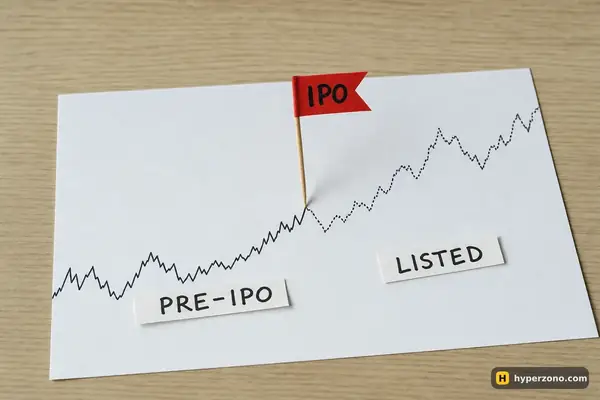
A single company swings harder than metal. Take SpaceX quoted in USDT, SPCXUSDT: it touched 208 in late May 2026, fell to about 108 by the end of July — close to half its value — and in October it was back near 162, still below that May high. SpaceX was still a pre-IPO contract in May; it listed on Nasdaq on 12 June 2026 and the contract carried on without a break as an ordinary stock pair.
This chart is the USD1 version, the one with the larger volume; All history shows the whole run and the mark on 12 June is listing day, while 30 days and 7 days zoom into the recent moves. If you had put 100 USDT into SpaceX near that May high and held it to October with no leverage, about 78 USDT of it would be left.
Companies that have not listed yet work differently and have their own page: OpenAI, Anthropic and other pre-IPO names. For a first trade, a calmer and busier market like gold is the kinder choice.
Your first trade on gold, step by step
Open the wallet and finish the backup
Binance Wallet lives inside the Binance app and on web3.binance.com. Only a verified Binance user can create one, and until the wallet is backed up the Perpetuals tab stays closed to you. There is no seed phrase to write down — it is a keyless wallet with backup through biometrics, cloud with a recovery password, or a QR code. The full walkthrough is in creating and backing up the wallet.
Find the pair in the Perpetuals tab
Type XAU in the search. You will see XAUUSD1 and XAUUSDT. Compare the 24h volume shown next to each and take the busier one — on our check day that was XAUUSD1 with about $330M against $2.5M.
Choose direction and a low leverage
Long if you think gold rises, short if you think it falls. Then set the leverage by hand to 2x or 3x. The app will offer you much more. A bigger number does not add money to your account — it only moves your liquidation price closer to where the price is now.
Check the margin mode before you confirm
Before you confirm, look at the margin mode next to the leverage. Isolated means only the money you put into this trade is at risk. Cross means the whole balance in the wallet can be pulled in to keep the position alive — for a first trade, isolated is the calmer choice. The difference is explained in cross margin vs isolated margin.
Decide the money before the size
Say you assign 100 USDT of margin at 3x in isolated mode — that is a position of about 300 USDT, roughly 0.07 ounces of gold at 4,136. A 1% move in gold is then about 3 USDT for you, in either direction. Write that number down before you confirm anything.
Set a stop-loss in the same order window
Pick the price at which you accept you were wrong — say 2% against you, about 6 USDT on this example — and set it as you place the order, not afterwards. Where exactly the fields sit is shown in opening a trade in Binance Wallet step by step; why this one habit matters more than any indicator is in what a stop-loss is.
Confirm and read the position line
After it fills, check three things: your entry price, the liquidation price the app shows, and the funding countdown. If the liquidation price is uncomfortably close, reduce the position or add margin rather than hoping.
The leverage slider is the risk, not the asset. Gold moves far less in a day than SpaceX or SanDisk — but 20x on gold can hurt you faster than 2x on a stock. Choose the number yourself every time instead of leaving whatever the app suggests.
What it costs to open and to hold
Stock and commodity pairs are the cheapest group in this tab. If you tap buy or sell at the current price, you pay 0.0125% — about 0.04 USDT on a 300 USDT trade, and the same again when you close, so under a tenth of a dollar for opening and closing together. If instead you leave a limit order sitting in the list and someone else trades against it, these pairs charge nothing at all. Crypto pairs cost more when you take the current price: 0.04%. Not every stock pair sits in the cheap group either, so read the fee shown in the order window for your pair before you confirm; one page cannot promise it for all 602 of them.
Then there is funding, the payment that passes between longs and shorts while the contract is open — it does not go to the exchange. Depending on the contract it settles every 8, 4 or 1 hours, and you only pay or receive if you are holding at that moment. A positive rate means longs pay shorts. On a position held for a few days this can quietly outweigh the trading fee, so check the rate and the countdown on the pair's page; the mechanics are explained in what funding is.
Before you put money in
A few things worth knowing in advance. Volume differs a lot from one pair to another — gold turned over about $330M in 24 hours and SpaceX about $34M on 21 October 2026 — so look at the number next to the pair you want and take the busier version when the same instrument is quoted twice. Execution and the order book come from Binance's partner Aster, so trade questions go to Aster support rather than to Binance. Contract rules such as maximum leverage, risk limits and funding can be changed at any time, and the risks specific to this route are collected in what can go wrong in Binance Wallet futures.
One more practical point: the terms covering this tab, dated February 2026, exclude residents of, and people located in, Russia, Ukraine, the USA, Canada, the United Kingdom, China, North Korea, Cuba, Iran, Venezuela and Syria. Rules change and such lists are rarely complete, so check whether the tab actually opens for you where you live rather than assuming.
Do I own the stock or the gold when I trade these pairs?
No. A perpetual is a contract on the price, settled in USDT or USD1. No share is registered in your name, no metal is delivered, and no broker is involved. That is also why you can open a short and profit if the price falls — something owning the asset will never do for you.
Can I really trade Apple-style stocks at the weekend?
The contracts in the tab run continuously, weekends included, because their price comes from an index rather than from an exchange session. Volume at the weekend is lower than on a weekday, so check the 24h volume shown next to your pair and take the busier version if the same instrument is quoted twice.
How much money do I need to start?
Minimum order sizes differ by pair and are not published in one place, so check the figure the order window shows for the pair you pick. In practice a first trade of 50–100 USDT of margin at 2–3x on a busy pair like gold is enough to feel the mechanics without the result keeping you awake.
How do I tell whether a pair trades enough?
Look at the 24h volume shown next to the pair in the Perpetuals tab. The main ones turn over tens to hundreds of millions of dollars a day — gold about $330M and SpaceX about $34M on 21 October 2026 — and trading runs at the weekend too. Several companies have both a USDT and a USD1 pair with different volume, so take the busier of the two.
Can I lose more than the money I put into one trade?
When the price moves against you far enough and your margin runs low, the position is closed automatically — that is liquidation. In isolated margin only the money assigned to that trade is on the line; in cross margin the rest of your wallet balance can be pulled in first. Keep leverage low, trade isolated at the start and always set a stop-loss, and that scenario stays rare and cheap.
Is the gold price here the same one I see in the news?
It follows a gold index built from several price sources, so it moves with the market you read about, but the exact sources and the contract rules belong to the pair, not to the headline. Open the pair's page in the app and read its details before you trade it — especially on the commodity pairs, where the way the price is built can differ from one contract to the next.
Sources and fact-check
Exchange terms were checked against official documents on October 21, 2026. Terms change — before you trade, check what matters to you in the exchange app and in your contract’s specs.
Binance Wallet: XAUUSD1 Perpetuals — price chart and tradeAster Docs: Stock PerpetualsAster Docs: Fees