Contents
Who writes the rules where you liveWhat the rules change for your first tradeBinance and UAE residents: what the register actually saysOther exchanges serving the UAETax, brieflyWhat to do nextWho writes the rules where you live
If you live in Dubai, the authority you care about is VARA. Its rulebook describes VARA as the sole authority regulating virtual assets across Dubai's mainland and free zones, with one exception — the Dubai International Financial Centre, which sits outside its remit. If you live in Abu Dhabi or another emirate, a different authority sets the rules, so the 5x cap below is a Dubai number and you should not assume it applies to you.
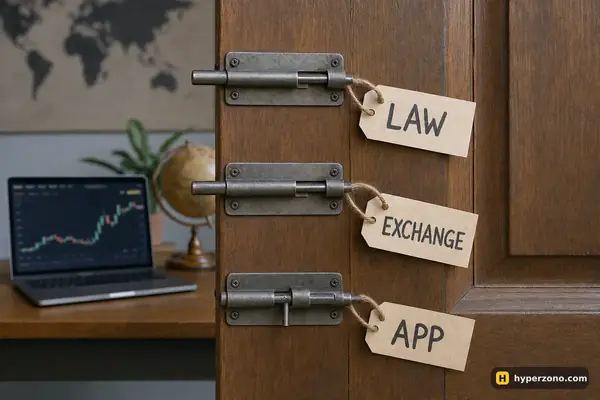
One thing worth knowing before you compare exchanges: big platforms run separate local companies for different regions, each with its own licence and its own list of products. In Dubai, Binance's local company is Binance FZE. The global website and the local company can look identical in the app and still offer you different things, which is why the practical check is the one described in the overview of exchange availability by country: enter your real country of residence at sign-up and see what the app actually shows you.
What the rules change for your first trade
VARA only lets a company sell futures if its licence says so in writing. A platform can hold a VARA licence and still have no permission for derivatives — the two things are listed separately on VARA's public register. So "this exchange is VARA-licensed" is a different statement from "this exchange may sell you futures".
For retail clients, VARA caps leverage at 5 to 1. In money that means you always put down at least 20% of the trade yourself — 200 USDT of your own money for a 1,000 USDT position — and the platform can ask for more if it thinks 20% is too thin for you or for that contract. Before you get access at all, the exchange has to assess your knowledge and experience, your financial position, how much of your savings you plan to put into derivatives and whether you could absorb a sudden large loss. If it decides the product is not suitable for you, it must block your access, and it has to keep repeating that assessment while you trade.
Here is why that cap is on your side, as an illustrative example. With 200 USDT of margin at 5x, your position is 1,000 USDT and a 2% move either way is about 20 USDT — a tenth of your margin. At 50x the margin behind that same 1,000 USDT position would be only 20 USDT, and the same 2% move would take nearly all of it. The cap removes the fastest way beginners lose everything, and the page on what leverage a beginner should pick suggests staying below the legal maximum anyway.
Two more rules touch your money directly. Your derivatives account has to be kept separate from your other trading accounts on the same platform, and the platform cannot quietly take money from those other balances to cover a futures loss — it needs your explicit permission, given before each position and never by default. If the price moves too far, the platform closes the position for you; that is liquidation. If what is left is less than zero, the rules say you have to top the account back up before you can open another trade — can you end up owing the exchange? explains how that happens.
On perpetual contracts you pay or receive a small amount for holding the position — that's funding — and in Dubai the platform has to work it out at least three times a day and show retail clients a chart of what is coming. That is more warning than you get in most places, and it is worth a look before you hold a position overnight.
Binance and UAE residents: what the register actually says
Binance announced that Dubai resident accounts are being moved from the global exchange to Binance FZE, its VARA-regulated local company. Your email, password and UID stay the same, and users who had upgraded their KYC were migrated automatically; residents who missed the KYC deadline in that announcement risked having their account restricted to withdrawals only. UAE residents outside Dubai stayed on the global exchange for the time being, per the same announcement, which was last updated in April 2025 — treat it as history and check your own account status in the app.
On VARA's public register, Binance FZE holds licence VL/24/04/001, issued 15 April 2024, status Active, with activities that include Exchange Services (including VA Derivatives Trading). Read the licence conditions underneath, though. Derivatives trading there is permitted for institutional and qualified investors — those are professionals and people with large portfolios, so if you are opening your first futures account with a few hundred dollars, that is not you. Ordinary retail clients appear only in the general permission to serve customers. Nothing on VARA's register or in Binance's own announcement says Binance FZE offers futures to ordinary retail clients in Dubai — the announcement lists its products and doesn't mention futures at all.
You can still open a Binance account with your real country of residence and look for yourself — plenty of people in Dubai use it for buying and holding coins. Just don't count on a futures section appearing: by the register, derivatives there are for institutional and qualified investors, and that is a different door from the one a beginner walks through.
Other exchanges serving the UAE
OKX serves the UAE through its local company, OKX Middle East Fintech FZE, which offers futures, perpetuals and options to retail as well as qualified investors after a suitability test. That is the clearest confirmed route for an ordinary resident, so if futures are what you came for, check what OKX shows UAE residents during sign-up. Bybit's own service-restricted page names "Dubai (for Bybit Virtual Asset Platform Operator LLC only)" — that is a restriction on one specific Bybit company, and the page does not say what it means for Bybit's other arms, so guessing helps nobody.
Three things no public page answers. Whether Binance FZE opens futures to ordinary retail clients in Dubai. Whether Dubai's 5x cap applies in your emirate. Which contracts a given local company has live today. Registers and app menus change without notice, so your own screen after verification is the only current answer — this page is dated 20 October 2026.
Tax, briefly
The UAE government portal (u.ae) says the UAE does not levy income tax on individuals. It also notes 5% VAT on goods and services, excise tax on certain goods, and corporate tax on the net profit of corporations and other businesses — so trading conducted as a business is a different conversation from trading your own savings. That page says nothing about crypto specifically, and none of this is tax advice; if you trade through a company or at size, ask a UAE tax adviser and keep your exchange statements.
What to do next
Register with your real country
Enter the UAE as your country of residence. That is what sends you to the right local company and the right onboarding questions.
Finish verification
Emirates ID or passport plus the usual checks — the KYC documents page covers what is normally asked for.
Look for the derivatives section
If it is offered to you, expect a suitability questionnaire, a separate derivatives account and a leverage slider that stops at 5x.
Practise before you risk money
Whether or not futures appear for you, run twenty trades in demo mode first; demo availability varies by country, so check in the app.
Are crypto futures illegal in the UAE?
No. Dubai's regulator has a published rulebook that allows exchange-traded derivatives through licensed platforms. The restrictions are on who may offer them and on how much leverage a retail client gets, not on the product itself.
Do I have to be a 'qualified investor' to trade futures in Dubai?
Qualified and institutional investors are professionals and people with large portfolios, and that is probably not you if you are starting with a few hundred dollars. VARA's rulebook does set rules for retail investors too, including the 5x cap and a suitability check, so retail is not excluded in principle. But an individual platform's licence can be narrower — on VARA's register, Binance FZE's derivatives permission names only institutional and qualified investors.
What happened to my old Binance.com account after I moved to Dubai?
Binance announced that Dubai resident accounts move to Binance FZE with the same email, password and UID. Accounts that did not complete the KYC upgrade by the deadline in that announcement could be limited to withdrawals only. Check your account status and verification state in the app rather than relying on a date from 2025.
Why is my leverage slider capped at 5x?
Because Dubai's rules say a platform must not let retail clients trade derivatives at more than 5 to 1. In practice you always put down at least 20% of the trade yourself, and the platform can ask for more than that if it thinks 20% is too thin for you or for that contract.
What if the futures section never appears in my app?
Then your local company is not allowed to offer it to you, and there is no honest way around that. Don't register with a country you don't live in — exchanges check residence again at withdrawal and during support cases. Use demo mode to learn the mechanics, and keep an eye on what gets added later.
Sources and fact-check
Exchange terms were checked against official documents on October 20, 2026. Terms change — before you trade, check what matters to you in the exchange app and in your contract’s specs.
VARA: Exchange Services Rulebook, Part V — Exchange Traded Derivative Services RulesVARA: Binance FZE (Public Register)Binance: Dubai Resident Account Users to be Transitioned to Binance Dubai (FZE)