Contents
What actually decides whether you can tradeWhat each exchange's own documents say about IndiaHow to check it yourself in ten minutesWhere the tax and legal questions belongYour money sits with a company outside IndiaWhat happens to an open trade if access is cutA sensible first step from IndiaWhat actually decides whether you can trade
Say you sign up, verify your identity and move 50 USDT across, and the futures tab simply isn't there. Nothing illegal has happened to you. That exchange has decided not to offer derivatives to people in India, and from your phone it looks exactly like a door that won't open. A different exchange may open normally with the same documents and the same money.
An exchange can close its door to a country purely as its own business decision, and it can reopen it later without anyone announcing a change in the law. That is why headlines about blocked apps rarely answer your question. The thing you can check today is the exchange's own terms page and your own verified account, so start there.
What each exchange's own documents say about India
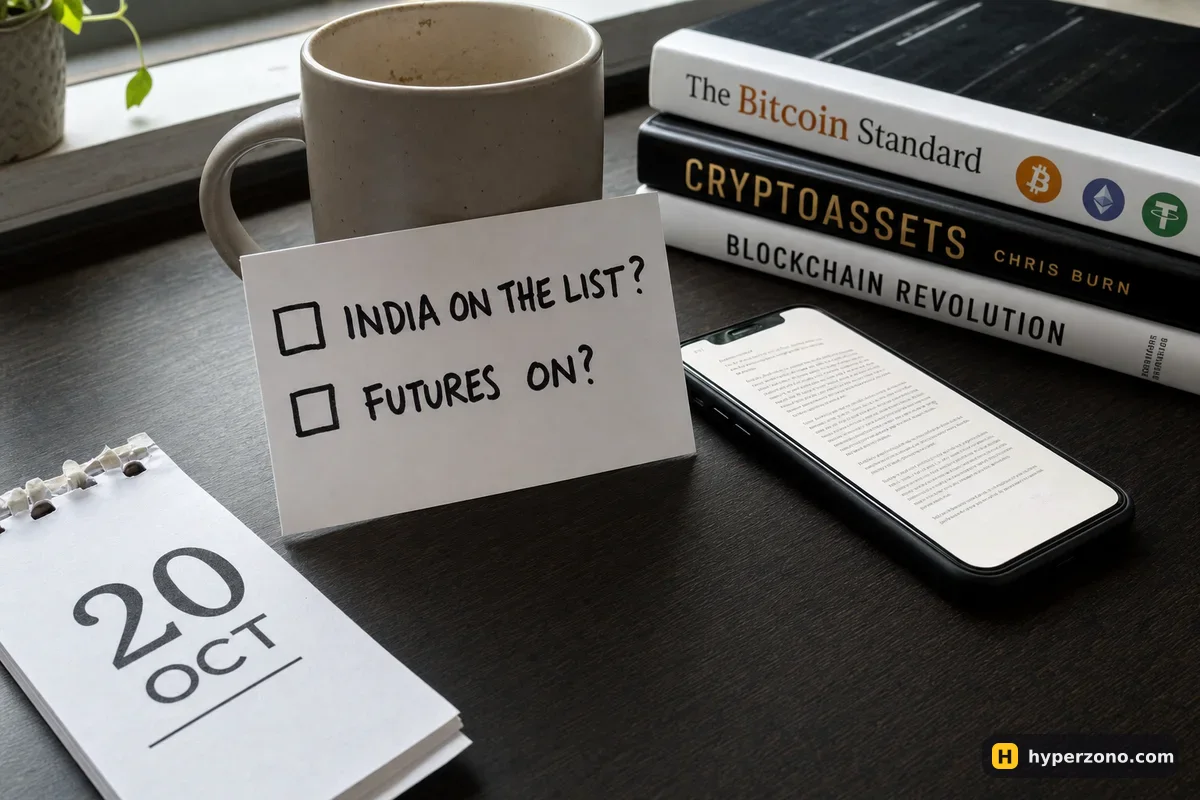
Everything in this table comes from the exchanges' own public terms and help pages, checked on 20 October 2026. All of these lists say in their own words that they are not exhaustive and can change without notice, so they are a starting point, not a permanent answer.
| Exchange | What its own documents said on 20 October 2026 |
|---|---|
| OKX | India is named in the Risk & Compliance Disclosure (last updated 8 July 2026) as a restricted jurisdiction. For a reader in India this is simply a no. |
| Gate | India appears in the Restricted Locations section of the User Agreement (last updated 22 July 2026). Gate says a restriction may cover all or part of its services, and that the list can change without notice. |
| Bybit | India is not named on Bybit's service-restricted countries page (last updated 16 October 2026). That page covers the service as a whole, not futures specifically, and says itself the list is not exhaustive. |
| Binance | Binance has a prohibited-countries page, but we could not open it to check whether India is on it. Its global terms also say people in some countries get only part of the services, so the only reliable test is whether the futures section opens in your own verified account. |
| Hyperliquid | Hyperliquid publishes no country list we could open. The app shows a geoblock message for restricted jurisdictions without naming any country. |
For OKX and Gate the honest answer today is: not available here, move on. For Bybit, India being absent from the restricted list is a reason to check during sign-up, not a promise — the real test is whether the futures section opens for your verified account. If you plan to try Bybit, do that check before you move any money in, and read our Bybit overview so you know what its contracts look like. For a quick view of other countries, there is our availability by country page.
How to check it yourself in ten minutes
Open the exchange's help center, not a review site
Search for "restricted" or "India" inside the exchange's own support pages. Note the date shown on the page — an old page is a weak answer.
Look for an India-specific page
Some exchanges publish a page about tax handling or product availability for one country. If there is one for India, it may list products that are switched off there, such as bots, cards or stock-style contracts.
Finish verification before you deposit
Identity checks are where the country question usually gets decided in practice. If futures stay greyed out after verification, that is your answer for that platform.
Deposit only after both checks pass
In practice that means something like 20–50 USDT first, opening one small trade to see the fees, the stop-loss and the withdrawal actually work before you add more.
If the app blocks you, that is the answer. Do not try to get around a country restriction by hiding your location, using a relative's documents or giving a foreign address. It breaks the exchange's own terms, and the usual result is a frozen account at the moment you try to withdraw — exactly the situation you were trying to avoid. A platform that will not serve India simply is not an option for you.
Where the tax and legal questions belong
This page can tell you which exchanges open and which don't. It cannot tell you how your profit is taxed or what you have to report, and nobody should take that from a blog. Assume any profit may be taxable, set money aside for it from the start, and take the actual rates and forms from the Income Tax Department's own website and from a tax professional in India — our page on how crypto futures are taxed in India covers the groundwork, and which futures records to keep shows what to export each month.
The practical habit that makes that conversation short is record keeping. Export your trade history and your funding payments every month to your own device instead of relying on an exchange keeping them available to you forever. An accountant can work with a spreadsheet of entries, exits and fees in minutes; screenshots of a phone screen are much harder to use.
Your money sits with a company outside India
Whichever exchange lets you in, the account is with a company registered somewhere else and operating under its own terms. If a platform freezes your balance, pauses withdrawals or fails, you are dealing with that company and that contract. Check for yourself what protection, if any, exists before you trust it with money, and keep only your working trading balance there — the rest belongs in your own wallet or bank.
Exchanges also advertise local registrations and licences. A registration is not insurance on your balance and it is not a promise that the exchange will keep serving you, so check on the regulator's own site what it actually covers before you let it reassure you. Treat it as one small signal among the checks on our how to check an exchange is not a scam page.
What happens to an open trade if access is cut
Nobody can promise you how any exchange would handle a future restriction. What is worth knowing is the mechanic you may meet: an exchange can switch derivatives in a country to close-only, which means you can reduce or close an existing position but not open a new one.
How much that hurts depends entirely on your size. If you are holding 20 USDT of margin on one trade, you close it and move on with your day. If most of your account sits in one 20x position, you are closing it at whatever price the market gives you that hour, and that price is not your choice. This is one more reason to keep each trade small — our page on how much to put into one trade shows a simple way to set that number.
A sensible first step from India
Because access can change and because futures punish beginners quickly, the cheapest way to start is without real money at all. Demo mode lets you open longs and shorts, set a stop-loss and watch a liquidation happen on a practice balance — our guide to learning futures without risking money walks through it, and the Bybit demo account is a short setup.
Do twenty practice trades first. Then, if the futures section really does open for your verified account, sign up on Bybit with the small amount you decided on in advance and keep it small while you learn how the fees, the stop-loss and the withdrawal behave with real money.
Is crypto futures trading illegal in India?
We won't guess about the law for you — the rules and rates change and getting them wrong is expensive. The Income Tax Department's own site and an accountant in India are the right place for that. What we can tell you is the practical side: on 20 October 2026 OKX and Gate named India in their own restricted lists, Bybit did not, and we could not confirm Binance's list either way. So for some exchanges the door is simply shut regardless of what you decide.
Which exchanges say they do not serve India?
As of 20 October 2026, OKX names India in its Risk & Compliance Disclosure and Gate names India in the Restricted Locations part of its User Agreement. Both lists say they are not exhaustive and can change. Bybit does not name India on its service-restricted page. Binance has a prohibited-countries page, but we could not open it to see whether India appears there, so check it yourself and see whether futures open in your verified account.
Does a local registration or licence mean my money is safe on that exchange?
No. A registration usually covers reporting or conduct duties, not your balance, and it is not a promise that the platform will keep serving your country. Look up on the regulator's own site what the registration actually covers before you treat it as protection. Then judge the exchange on its own terms pages, its track record and how much of your money you leave sitting there.
How much tax will I pay on futures profit in India?
Take the rates and forms from the Income Tax Department's own website and from a tax professional in India — our page on how crypto futures are taxed in India covers the groundwork, but the final numbers are not a blog's job. A wrong number copied from a forum costs far more than an hour with an accountant. Export your trade history and funding records monthly so that conversation is quick.
Can I get around a block if an exchange does not serve India?
Don't try. Hiding your location or using someone else's documents breaks the exchange's terms, and the problem usually appears at withdrawal, when the account gets reviewed and the money sits there. If a platform restricts India, treat it as closed to you — look at one that does serve you, or stay in demo mode while you learn.