Contents
What is actually allowed for someone like youWhy a rule about CFDs applies to your crypto tradeWhat 2:1 feels like with real moneyWhich exchanges say yes, no, or nothing at allWhat happens to an account you already haveTax, in one paragraphWhat is actually allowed for someone like you
If you live in Australia and you are an ordinary retail client, you are allowed to trade crypto derivatives — you just have to do it with a provider licensed to serve Australian retail clients. The restriction is not on you, it is on who may offer the product. That is why a global exchange can refuse you while a licensed local entity of the same brand accepts you.
You will also see talk of "wholesale" or "sophisticated" clients, who can be offered more than retail clients. That classification has legal tests about income and assets, and it is not a box you tick to get higher leverage. Taking that label means giving up exactly the protections described below, which is the opposite of what a beginner needs.

Why a rule about CFDs applies to your crypto trade
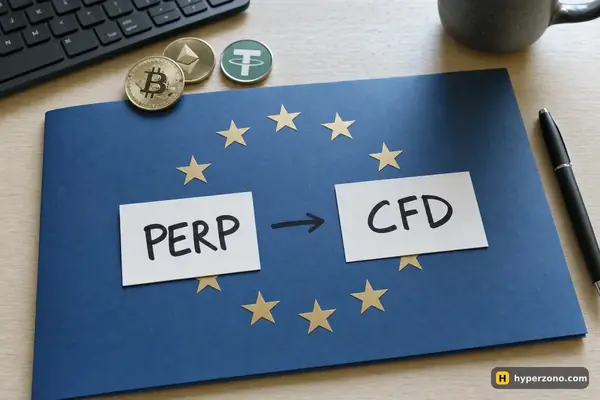
The rules that shape all this were written for a product called a contract for difference. You bet on the price of something without owning it, and when the trade closes you and the provider simply settle the difference in cash. Perpetual crypto contracts settled in cash are treated like CFDs under ASIC's order — a contract with a fixed expiry date usually is not. On a licensed Australian retail account that means a 2:1 cap and the protections below. ASIC put that order in place in March 2021 and it runs until 23 May 2027.
Contracts settled by handing over the coin itself sit in a greyer area, and ASIC is now consulting on bringing them in too. For your first trade the practical picture stays simple: tight leverage, and a set of rules your provider has to follow whether you read them or not.
Here is what that order gives you in return for the tight leverage:
- Leverage limits — 2:1 on an Australian retail account.
- Standardised margin close-out — the provider must close your positions when your margin falls too low, instead of letting them run.
- Negative balance protection — you can't be left owing the provider more than you put in. That comes with this route; it is not a general rule of futures everywhere.
- A ban on certain inducements — no bonuses or giveaways to get you to open an account.
These are not decorations. In 2023–24, 68 out of every 100 Australian retail CFD clients finished the year down. Across all retail clients, net losses came to more than $458 million, including $73 million in fees. In the first six months after the whole set of rules came in, ASIC measured net client losses per quarter falling by 91%. If you want to see why a small cap changes outcomes so much, our page on what leverage a beginner should use shows the same effect with simple numbers.
What 2:1 feels like with real money
Say you set aside 500 USDT. At 2:1 the largest position you can open is 1,000 USDT, so a 5% move in bitcoin is 50 USDT for you — 10% of your money, up or down, before fees. The same 500 USDT at 20x on a global exchange would control 10,000 USDT, and that same 5% move would be 500 USDT: your whole margin gone in one direction, doubled in the other. The cap feels slow, and that slowness is the point.
A rule change is being discussed, and it is not law yet. ASIC is consulting on these rules right now — paper CS 64, comments close on 9 November 2026. Two proposals would touch you: keeping the current protections for another 10 years, and widening the definition so crypto contracts settled by transfer of digital assets are covered as well. It all needs Ministerial approval, so nothing changes for you today.
If that widening goes through, more crypto contracts would clearly fall under the same protections, though a contract still has to meet the other tests, and some crypto derivatives with a fixed expiry date would stay outside. A separate proposal in the same paper would stop providers from offsetting your long and short positions when they work out how much margin you must post, which would mean putting up more money for a hedged pair than some providers ask today.
Which exchanges say yes, no, or nothing at all
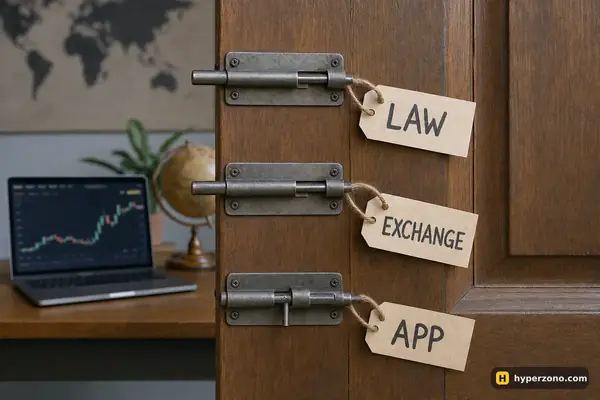
OKX is the clearest case. Its global Risk & Compliance Disclosure (last updated 8 July 2026) lists Australia as restricted for derivatives, so the global OKX site is not the Australian route. Separately, OKX Australia Financial Pty Ltd offers derivative products to retail and wholesale clients. For a retail client that means perpetual futures with USDT as your money, at up to 2:1, and only after you pass a short set of questions about how these contracts work. Our general OKX review describes the worldwide product, which is not what an Australian retail account looks like.
Binance's own materials list Australia among the places where derivatives are not offered, and the company has never published a full country list. Treat that as a "probably no" and confirm it in the app during sign-up, before you move any money. Bybit does not name Australia on its service-restricted list (updated 16 October 2026), but its derivatives FAQ says users must not be in regions where derivatives trading is unavailable and names none of them — so that is not a yes either. The reliable check is the one the app does on you at sign-up, and our page on where exchanges are available explains how that decision is made in general.
Before you trust any smaller platform that promises Australians 50x, check whether it actually holds an Australian licence and whether ASIC has published a warning about it. ASIC's licence register and investor alert lists are free to search, and our scam check routine covers what else to look at.
What happens to an account you already have
When a venue decides it will not serve derivatives to residents of your country, the usual steps are limiting services, blocking new positions, or switching your open positions to close-only so you can exit but not add. Money normally stays withdrawable, but the timing is not yours to choose. Export your trade history, funding records and account statements now rather than later — you will want them for your own records and for tax.
Trying to get around a block — hiding where you are, or using someone else's documents — is not something we will help with. It breaks the venue's terms, and the usual result is a frozen account with your own money inside it.
Tax, in one paragraph
The ATO publishes its own guidance on crypto assets for individuals, last updated 18 August 2026, covering what they are and how tax applies. How your result is treated depends on how you hold and dispose of assets, and trading carried out in a business-like way is handled differently from occasional investing. We are not tax advisers, so take your exported records to a registered tax agent and ask about your situation before your first profitable year, not after.
Is crypto futures trading legal in Australia?
Yes, for retail clients, as long as the provider is licensed to offer derivatives to Australian retail clients. The product itself is regulated rather than banned. What is limited is the leverage and the marketing, not your right to trade.
Why is my leverage only 2:1 when the app shows 50x for other countries?
Because ASIC's product intervention order caps leverage on CFDs for retail clients, and for crypto-assets the cap is 2:1. A global exchange showing 50x is showing you a product it does not offer to Australian retail clients. Same brand, different entity, different rules.
Can I become a wholesale client to get higher leverage?
Wholesale classification has legal tests based on income and assets, and it is not meant as a leverage upgrade. Taking it removes the retail protections — the margin close-out and the negative balance protection — that keep your downside defined. For a beginner that is a poor trade.
Can Australians still use Binance Futures?
Binance's own materials list Australia among the places where derivatives are not offered, and there is no full official country list to point you at. Treat it as a probable no, and let the sign-up flow in the app confirm it before you deposit anything.
Do ASIC's rules cover every crypto contract?
Perpetual crypto contracts settled in cash are treated like CFDs under the order, which is where the 2:1 cap for retail clients comes from. A contract with a fixed expiry date usually is not covered, and contracts settled by transfer of the digital asset itself sit in a greyer area. ASIC's consultation paper CS 64 proposes bringing those in; comments close on 9 November 2026 and any change needs Ministerial approval, so the existing order applies for now.
What happens if the price gaps past my margin level?
On a licensed Australian retail account the provider must close you out when your margin runs low, and negative balance protection means you can't be left owing them more than you put in. That protection comes with this route — it is not a general rule of futures everywhere. Our page on liquidation explains what the close-out itself looks like.
Sources and fact-check
Exchange terms were checked against official documents on October 20, 2026. Terms change — before you trade, check what matters to you in the exchange app and in your contract’s specs.
ASIC: CS 64 Protecting retail investors — proposed extension and amendments to the CFD product intervention order (ASIC Corporations (Product Intervention Order—Contracts for Difference) Instrument 2020/986)OKX: How do I access cryptocurrency derivative products in Australia?ATO: What are crypto assets?ASIC media release 20-254MR: product intervention order strengthens CFD protections (crypto-asset CFDs capped at 2:1)