Contents
Pick a coin and two venues, then read one numberWhy four fees, and how many days they take to earn backToday's rate or the last 30 days: which one should you trust?What the calculator leaves outPick a coin and two venues, then read one number
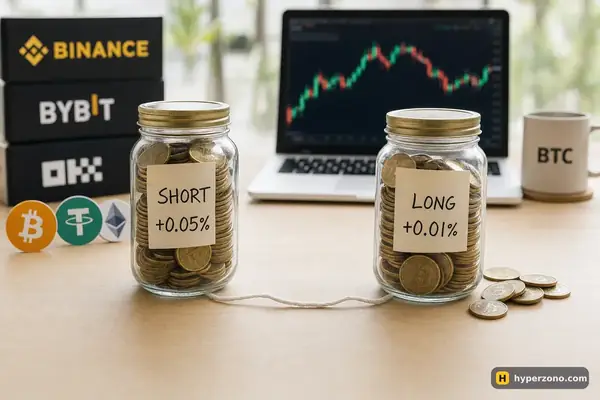
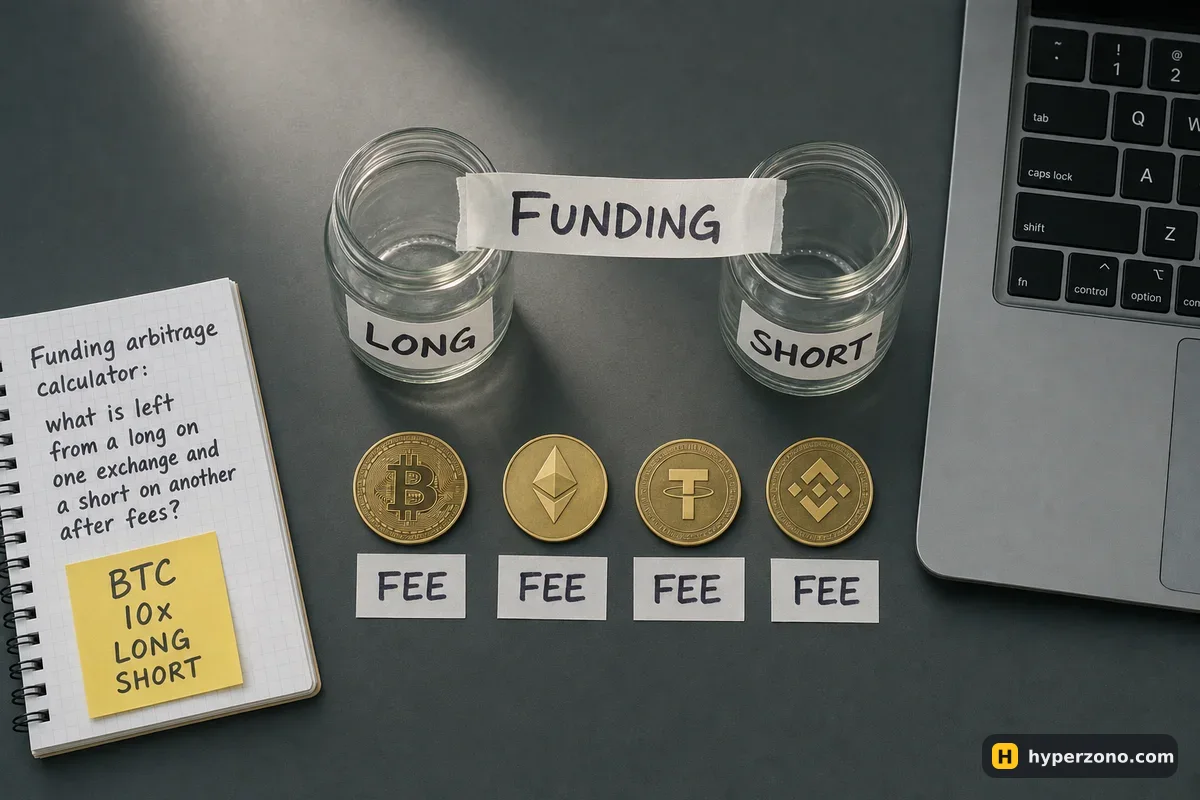
The idea is simple: you hold a long where longs pay little and a short where longs pay a lot, in the same size, so a price move on one side is offset by the other and what you keep is the funding difference. Each of those two trades is called a leg. If the payments themselves are still fuzzy, the funding basics page is the short read that explains who pays whom and when; how this two-venue trade is built and what breaks it is on the two-exchange funding page, and this page is the arithmetic.
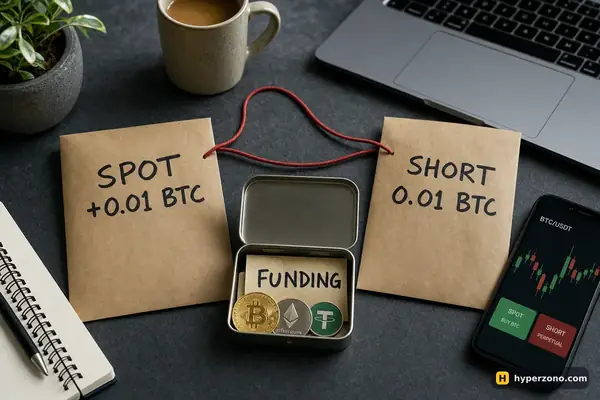
If you would rather hold the coin itself instead of a second futures leg, that is a different setup: spot plus a short perpetual. In the calculator, choose the coin, the venue for the long leg, the venue for the short leg, and type the size of one leg in USDT. Size means the position, not your margin: 500 USDT at 5x is a 2,500 USDT position, and funding and fees are both charged on that 2,500, never on the 500.
Read the sign first. A positive result means the short leg collects more than the long leg pays, which is the direction you wanted. A negative result means you picked the legs the wrong way round, or that the gap simply isn't there today — and swapping the two venues flips the sign, so it costs nothing to check both ways.
The table below is where the rates come from. Each row is one coin on one venue: the funding interval — usually 8 hours, hourly on Hyperliquid, and 4 hours on some contracts, so check the one shown for your pair — and what a 1,000 USDT long actually paid or received over the last 30 and 90 days. For a 2,500 USDT position, multiply those figures by 2.5. All of it ignores price changes; it is only the funding part of your result.
| Coin | Binance Futures | Binance Wallet | Bybit | OKX | Hyperliquid |
|---|---|---|---|---|---|
| BTC | 2.91 USDT | 4.23 USDT | 2.91 USDT | 3.48 USDT | 6.85 USDT |
| ETH | 3.17 USDT | 5.11 USDT | 2.85 USDT | 3.13 USDT | 6.73 USDT |
| XRP | 2.48 USDT | 4.48 USDT | 2.61 USDT | 3.54 USDT | 7.42 USDT |
| BNB | 1.59 USDT | 1.26 USDT | −0.06 USDT | 4.53 USDT | 5.96 USDT |
| SOL | 2.63 USDT | 3.21 USDT | 1.94 USDT | 2.93 USDT | 5.70 USDT |
| HYPE | 3.54 USDT | 3.92 USDT | 1.14 USDT | 3.74 USDT | 6.88 USDT |
| DOGE | 4.10 USDT | 4.26 USDT | 2.84 USDT | 5.58 USDT | 8.64 USDT |
| ENA | 6.42 USDT | 8.01 USDT | 4.71 USDT | 5.11 USDT | 9.18 USDT |
What a 1,000 USDT long paid over the last 30 days on each venue (minus means it received). The coin name opens its page with month-by-month history.
Updated 25 Oct 2026, 01:20 UTC from the exchanges’ public APIs.
Why four fees, and how many days they take to earn back
You open two positions and you close two positions. That is four fills, each charged on the full position size of that leg, on whichever venue it sits. If you take the price already showing on the screen, you pay the higher of the two rates — the exchange calls that a taker fee. If you leave an order waiting at your own price and someone else trades into it, you pay the lower maker rate, but your order may never fill.
Say the gap on bitcoin works out over a month roughly the way the table below shows, with 2,500 USDT a side, the long on Bybit and the short on Hyperliquid, both opened and closed with market orders at base fee levels. The funding column is a made-up example to show the shape of the result; only the fees are real rates. The live table above has today's actual funding, and the funding history has the past months.
| Leg | Funding over 30 days (example) | Fees, in + out |
|---|---|---|
| Long BTC on Bybit, 2,500 USDT | paid about 7 USDT | 2.75 USDT |
| Short BTC on Hyperliquid, 2,500 USDT | received about 17 USDT | 2.25 USDT |
| Together | +10 USDT | −5.00 USDT |
In that example the gap pays about 0.33 USDT a day while the four fills cost 5.00 USDT, so the fees are back in roughly two weeks and the month ends about 5 USDT ahead. That is against 1,000 USDT of margin, but you cannot actually run it on exactly 1,000: once you add the spare money each side needs so a sharp move doesn't liquidate a leg, the return on everything you parked is lower than it looks. Hold for three days instead of thirty and you finish behind.
Fee levels are the one part you can lower on purpose. Entering with limit orders that wait in the book pays the maker rate — 0% on the Binance Wallet Perpetuals tab, 0.015% on Hyperliquid — but a waiting order may not fill, and a funding trade with only one leg filled is just a one-sided bet on price. These are the base rates both the calculator and the exchanges' own fee pages use.
| Where | Maker | Taker | How to pay less | A 2,500 USDT trade: market in and out | Limit in, market out |
|---|---|---|---|---|---|
| Binance Futures | 0.02% | 0.05% | pay fees in BNB: 0.018% / 0.045% | 2.50 USDT | 1.75 USDT |
| Bybit | 0.02% | 0.055% | — | 2.75 USDT | 1.88 USDT |
| OKX | 0.02% | 0.05% | — | 2.50 USDT | 1.75 USDT |
| Hyperliquid | 0.015% | 0.045% | up to 40% off for staking HYPE: 0.009% / 0.027% | 2.25 USDT | 1.50 USDT |
| Binance Wallet / Aster | 0% | 0.04% | — | 2.00 USDT | 1.00 USDT |
Base level for a new account. 2,500 USDT is 500 USDT at 5x leverage; the fee is charged on the position size, not on your 500. Taker is the rate when an order fills at once, maker when a limit order waits in the book.
fees checked 24 Oct 2026 on the exchanges’ fee pages, Binance Futures, Bybit, OKX, Hyperliquid, Binance Wallet / Aster.
Today's rate or the last 30 days: which one should you trust?
They answer different questions. Today's rate tells you what you will actually be charged at the next settlement, so it decides whether holding overnight makes sense. The 30-day figure tells you whether the gap is a habit on that pair or a one-off spike you are about to chase.
When the two disagree, treat the shorter number as noise until it repeats. Signs really do flip between venues — the same coin can charge longs on one exchange and pay them on another over the same stretch of days, which is exactly where the gap comes from. Open the funding history and look at the same coin month by month on both venues before you decide the spread is reliable.
One thing trips people up when they compare venues: Hyperliquid pays funding every hour, most others every eight. To put an hourly rate next to an 8-hour one, multiply the hourly figure by 8, not by 24 — the interval comparison page shows why. And no venue stays the cheap side forever; the cheap leg and the expensive leg can swap places within a week.
What the calculator leaves out
It counts funding and the four fees, and that is all. The first thing missing is capital: two legs means money on both sides, so the example above needs 500 USDT of margin on Bybit and 500 on Hyperliquid, plus spare on each. Money parked as a buffer earns nothing in this trade, but it is the reason the trade survives a bad hour.
The second thing is that one leg can be liquidated on its own. The price move cancels across the two venues only while both positions exist — if the short closes itself during a sharp move, you are suddenly holding a plain long with no hedge and nobody watching. Use isolated margin on each side, keep leverage low so the liquidation price sits far away, and check both accounts at least once a day.
Then there is slippage, which no fee table shows: a market order fills across several prices, and on a quiet pair that can cost more than the fee itself. Moving money between venues costs a network fee and time. And funding timing has its own edges — Aster's own documentation notes a 15-second deviation between the scheduled settlement and the charge, so a position opened just after the clock ticks over can still be charged for that interval.
Both sides have to actually work for you. On a normal exchange that means an account that passes identity verification where you live, and futures being offered there at all. On an on-chain venue like Hyperliquid there is no sign-up and no account in your name — you connect a wallet and deposit USDC. Check both routes, and the money path into each, before you size anything.
Where you live decides more than people expect here, so start with which exchanges are available in your country, and if one leg is on-chain, read how to deposit USDC to Hyperliquid before you count on that side being ready.
If the numbers above look thin for your size, that is the useful result, not a failure. The sensible next step is to run one leg properly first: open a Binance Futures account, take the smallest position the pair allows, set a stop-loss straight away, and watch what funding does to your balance over a couple of settlements. On one leg the price still decides most of your result — funding is the small line you are there to watch.
What exactly is a funding rate?
It is a small payment passed between the two sides of a perpetual contract every few hours — usually every 8 hours, hourly on Hyperliquid. When the rate is positive, longs pay shorts; when it is negative, shorts pay longs. The exchange only moves the money, it does not keep it, and you only pay or receive if your position is open at the settlement moment.
Can I lose money on funding arbitrage?
Yes. The price move is largely offset while both legs are open and the same size, but you still carry liquidation risk on each leg, the risk of the rate flipping against you, the health of two venues at once, and the four fees that come out before anything else. It depends far less on which way price goes, but it is not a trade without risk.
How much money do I need for both legs?
For 2,500 USDT a side at 5x you need 500 USDT of margin on each venue, so 1,000 USDT at a minimum, plus a buffer on each so a sharp move doesn't liquidate one leg. Many people run much lower leverage on a funding trade precisely so that buffer is large.
Which coin has the biggest funding gap?
It changes constantly, which is why the live table above exists instead of a fixed answer. Compare the 30-day and 90-day columns for the same coin across venues, find the widest spread that keeps repeating, and only then look at today's rate.
Does the calculator include slippage and the spread?
No — it uses the base taker fee for each venue. On busy pairs like BTC and ETH the extra cost of a market order is small; on quieter pairs it can be bigger than the fee, so add your own margin of error before deciding.
Can I run both legs on the same exchange?
A long and a short on the same contract cancel each other's funding, so there is nothing to collect. The whole point is two different venues with two different rates, or a spot holding paired with one short perpetual.
What happens if the funding rate flips while I am in the trade?
The leg that was paying you starts costing you, and the daily number in the calculator turns negative. Recheck the rates at least once a day, and decide in advance how many days of negative funding you will accept before closing both legs.
Sources and fact-check
Exchange terms were checked against official documents on October 24, 2026. Terms change — before you trade, check what matters to you in the exchange app and in your contract’s specs.
Hyperliquid: FundingAster: Funding Rate