Contents
What each side of the trade doesHow much money it takes, and where it sitsWhat you actually collect, and what it costsWhen it stops payingHow to close both legs without opening a new betWhere to set it upWhat each side of the trade does
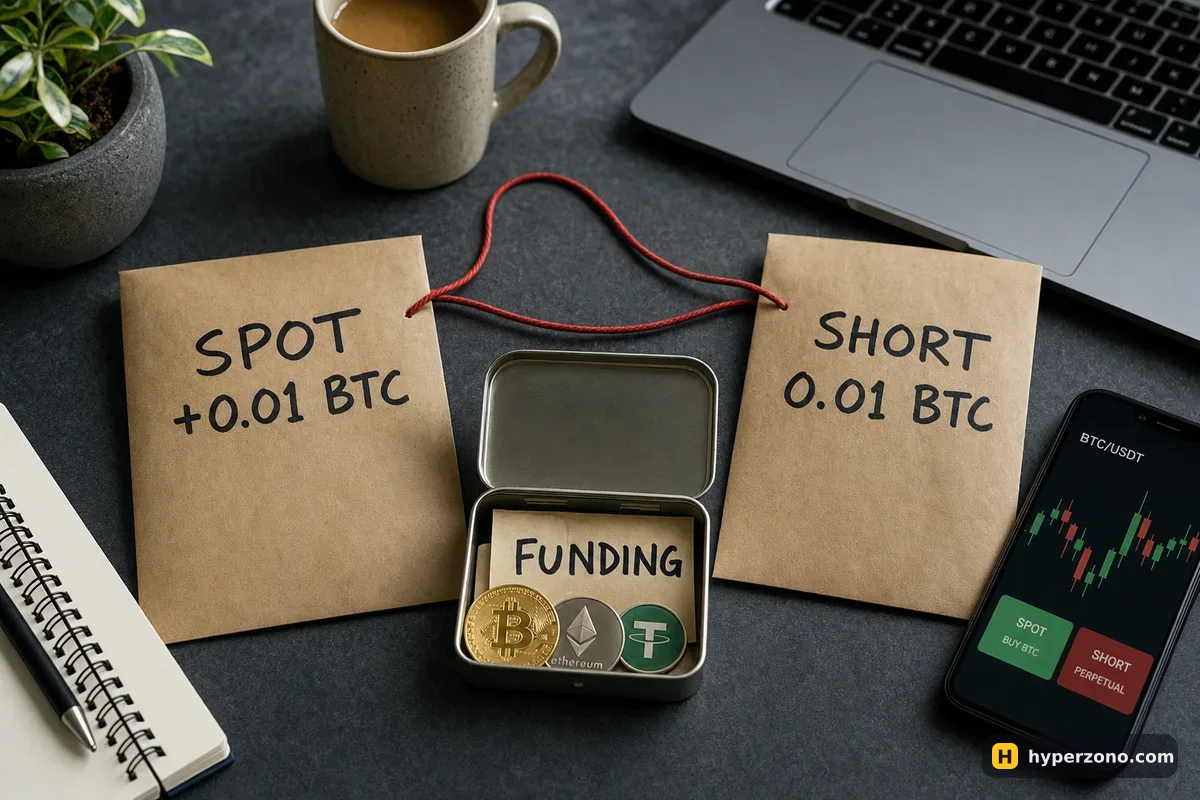
Say you buy 0.01 BTC on the spot market and, on the futures side, open a short on BTCUSDT for the same 0.01 BTC. If bitcoin rises, your coins are worth more and your short loses about the same amount. If bitcoin falls, the short gains and the coins lose. What is left over is the funding payment, and on a perpetual contract with a positive rate that payment goes from longs to shorts — so your short leg receives it.
Funding is not a fee the exchange collects; it is a transfer between traders, and only the person holding the position at the settlement moment pays or receives. On Binance that moment comes every 8 hours by default — 00:00, 08:00 and 16:00 UTC — though some contracts settle every 4 hours, and if a rate hits its cap the interval can shorten to 1 hour. If the whole idea of funding is new to you, start with what funding is and come back. This page is not about protecting a holding you already have — that is hedging — here the payment itself is the goal.
How much money it takes, and where it sits
Take illustrative numbers: bitcoin at 80,000 USDT, and 0.01 BTC on each leg. The spot leg costs the full 800 USDT — you own the coins, there is no leverage there. The short leg has a position size of 800 USDT too, and how much margin it needs depends on the leverage you pick: at 2x that is 400 USDT, at 5x about 160 USDT. So the same construction ties up roughly 1,200 USDT at 2x and about 960 USDT at 5x.
Lower leverage on the short is not timidity, it is the whole point. When bitcoin rises, your gain sits in the coins on the spot side, and the exchange cannot use it as margin for the short. The loss on the short, though, is taken out of your futures wallet straight away — that is why the short needs room to breathe. If bitcoin jumps 20% in a day, your coins are worth 160 USDT more and your short is down about 160 USDT, and a 5x short with 160 USDT of margin is already being closed before the loss gets that far — the exchange steps in a little earlier, once the margin left drops below the minimum it requires.
Isolated short of 800.00 USDT, 5× leverage, maintenance margin 0.50% of position size (example). Simplified model without closing fees, risk-limit tiers or other positions — the exchange will show its own price.
Two practical choices follow. Keep a buffer of free USDT in the futures wallet so you can add margin to the short when price runs up, or use cross margin so that buffer is used automatically — and remember cross margin links the short to everything else in that wallet. The short being liquidated is the one thing that truly breaks this trade: you would be left holding coins with no protection, having locked in the loss on the futures side.
What you actually collect, and what it costs
Funding is calculated on the size of your short, not on the margin you put up. With a short of 800 USDT and an illustrative rate of 0.01% every 8 hours you receive about 0.08 USDT each time — roughly 0.24 USDT a day, 1.68 USDT a week, around 7.2 USDT over 30 days. On 1,200 USDT of tied-up capital that is about 0.6% for the month. Real rates are nothing like a constant: they swing from several times that to negative, so look at the funding history for BTC and ETH before you assume a number, and at the year-long funding cost study to see how long calm and expensive stretches actually last.
Now the costs, because there are four trades, not two: buy spot, open short, close short, sell spot. On Binance USDⓈ-M futures at the base level, taking the price costs 0.05% and posting a limit order that waits costs 0.02%. On 800 USDT of position size that is about 0.40 USDT each way with market orders — roughly 0.80 USDT for the futures round trip, or about 0.32 USDT if both sides are filled as limit orders. The spot buy and sell are charged separately at the spot rate, which you should check on the exchange's fee page for your account level.
Put those together and the break-even is easy to see: at 0.24 USDT of funding a day, the futures round trip alone eats three to four days of payments, and the spot fees push that further out. This construction only makes sense if you plan to hold it for weeks, not hours. Try your own coin, size and rate here:
If you would rather see the whole thing before committing money, the funding rate and settlement countdown are visible on every contract page — open a Binance Futures account and watch the rate on BTCUSDT for a few days next to the funding calculator.
The payment only lands if you are holding at the settlement minute. Opening a short two minutes before settlement collects a full payment; closing two minutes before collects nothing for that whole 8-hour block. That is also why people who close and reopen around settlements usually end up paying more in fees than the payments are worth.
When you watch the chart of the coin, read it for the size and speed of the moves rather than the direction. A long, calm drift is comfortable for this construction; a 15–20% week in either direction is the kind of move that forces you to top up the short's margin or watch it get uncomfortably close to liquidation.
When it stops paying
The obvious one is the rate turning negative. When shorts pay longs, your short leg is being charged every settlement, and you are now paying for the privilege of holding a position with no view on price. There is nothing clever to do about it with this setup — you either accept a stretch of small payments out while you wait, or you close both legs. Negative stretches on big coins have happened often enough that you should check the history rather than hope.
The second one is a sharp rally. Your spot coins are fine, but the short's margin is draining, and if you cannot move USDT across in time the position is liquidated on the mark price, not on the last trade you saw.
The third one is subtler: the exchange can close a winning short for you. Binance calls it auto-deleveraging, and it is the last step after liquidations, when the fund that normally absorbs a bankrupt position cannot cover it. The exchange closes your winning short at the price where the losing trader on the other side ran out of money, and that price can sit outside the range you see on the chart, so you may get less than your screen showed. You are notified straight away and there is no fee on that close; the price used has a name, the bankruptcy price. Binance says this cannot be ruled out completely, and each position shows an ADL likelihood indicator you can look at.
The fourth reason is the most common and the least dramatic: the rate drops to almost nothing, and after fees you are working for small change.
Build this with the normal USDT contract — BTCUSDT, ETHUSDT — rather than the version settled in the coin itself, since the coin-settled contracts get closed out this way more often.
How to close both legs without opening a new bet
Decide before the settlement
If the next funding payment is an hour away and the rate is still positive, waiting for it costs nothing. If the rate has already flipped, do not wait.
Close the short first, with a reduce-only order
In the position panel, close the full 0.01 BTC. Reduce-only makes sure you are closing, not accidentally flipping into a fresh short.
Sell the spot coins straight after
The gap between the two is the only moment you are actually exposed to price. Keep it to minutes, not hours, and do both legs in the same session.
Move the margin back and count the result
Add up funding received, subtract all four fees, and compare with what you expected. Funding received and fees paid both show in your futures transaction history.
Where to set it up
The simplest setup is one exchange account with both wallets — spot for the coins, USDⓈ-M futures for the short. On Binance these are two wallets inside the same account, so moving USDT between them is an internal transfer, not a blockchain withdrawal. Other big exchanges are built along the same lines — check in the app that both wallets and the contract you want are there before you deposit.
On size: the minimum order on BTCUSDT is 0.001 BTC, so the smallest honest version of this trade is 0.001 BTC on each leg — whatever that costs at the time, plus margin. ETHUSDT starts from 20 USDT of position size, which makes it cheaper to test the mechanics. Check that futures are available where you live during sign-up, because several countries are served only partly or not at all, and the app will tell you that before you deposit anything.
Does funding arbitrage remove all the risk?
No. The price risk is mostly cancelled between the two legs, but you still carry the risk of the short being liquidated in a fast rally, of funding turning negative while you hold, of the exchange closing your winning short through auto-deleveraging, and of the ordinary risk of keeping money on an exchange. Low price risk is not no risk.
Do I need leverage at all on the short leg?
You need some, otherwise the margin for the short would equal the full position size and the whole construction would cost double. Many people use something modest like 2x or 3x on the short so there is plenty of distance before liquidation, and keep spare USDT in the futures wallet on top of that.
What if funding goes negative — can I just flip the trade around?
The mirror version means shorting the coin on spot, which needs borrowing rather than simply owning, and that has its own cost and rules. With a plain spot-plus-short setup your realistic options when the rate flips are to wait it out if the payments are tiny, or to close both legs and stop paying.
How much capital do I need to make this worth doing?
Work backwards from fees rather than from a target. On a very small position, the four trades can cost several days or weeks of funding, so the payments only start to matter if you hold for a long stretch. Run your own size and rate through the funding calculator before deciding.
Can I run this on any coin with a high funding rate?
You can open it, but a very high rate usually comes with a fast-moving market, where the short leg can be squeezed hard within hours and exits cost more than the quoted fee. Checking the funding history of the coin over weeks, not the number showing right now, saves a lot of trouble.
Does holding the coins on spot protect my short from auto-deleveraging?
Binance ranks positions for auto-deleveraging by profit and effective leverage on the futures side, and it does have a Delta Neutral Account setting that gives hedged positions a lower ranking — the details are in its own FAQ in the app. Do not assume your spot balance counts for anything there unless that setting says so.
Sources and fact-check
Exchange terms were checked against official documents on October 22, 2026. Terms change — before you trade, check what matters to you in the exchange app and in your contract’s specs.
Binance: What Is Auto-Deleveraging (ADL) and How Does It Work?